

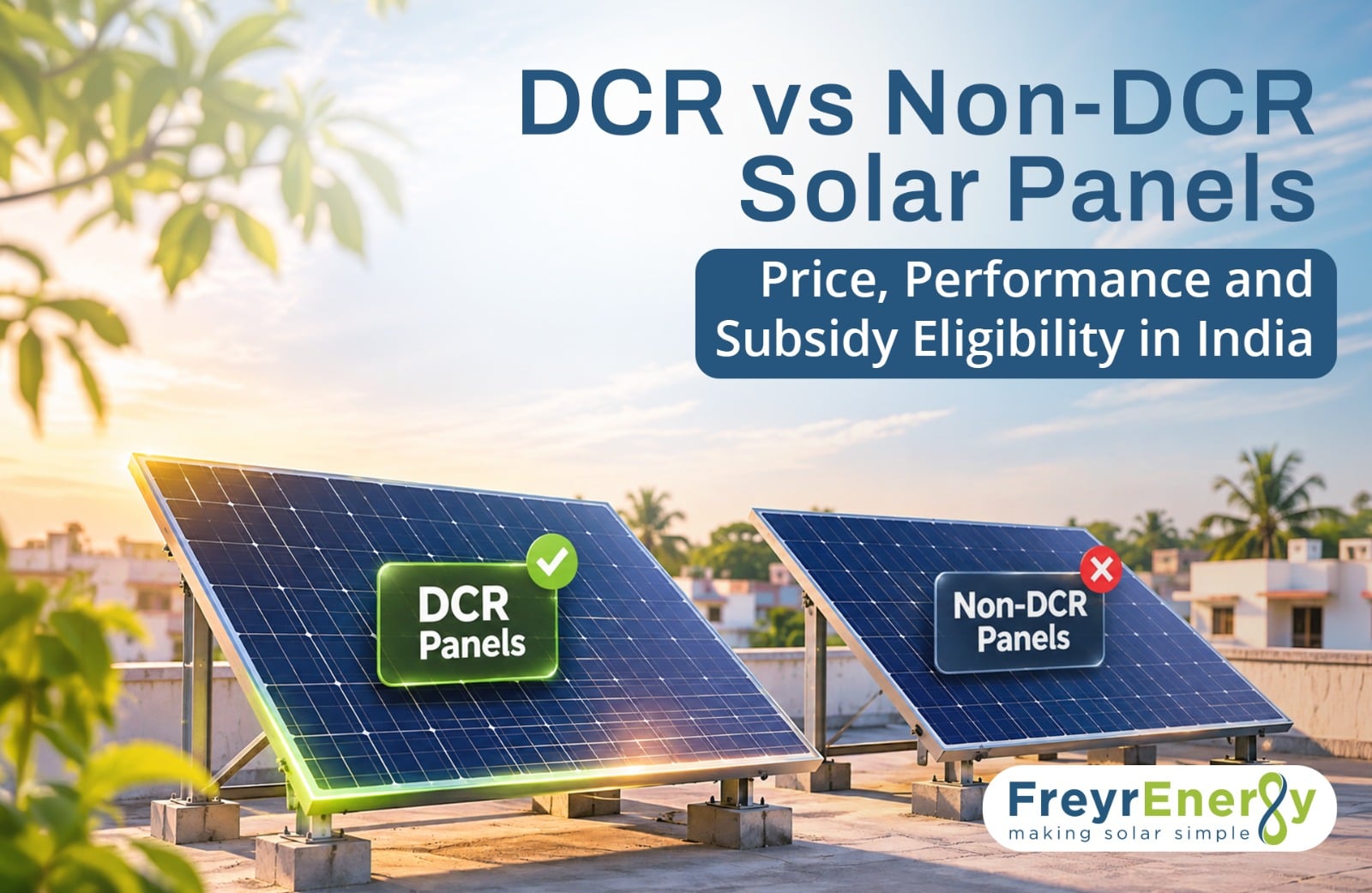
Direct Answer
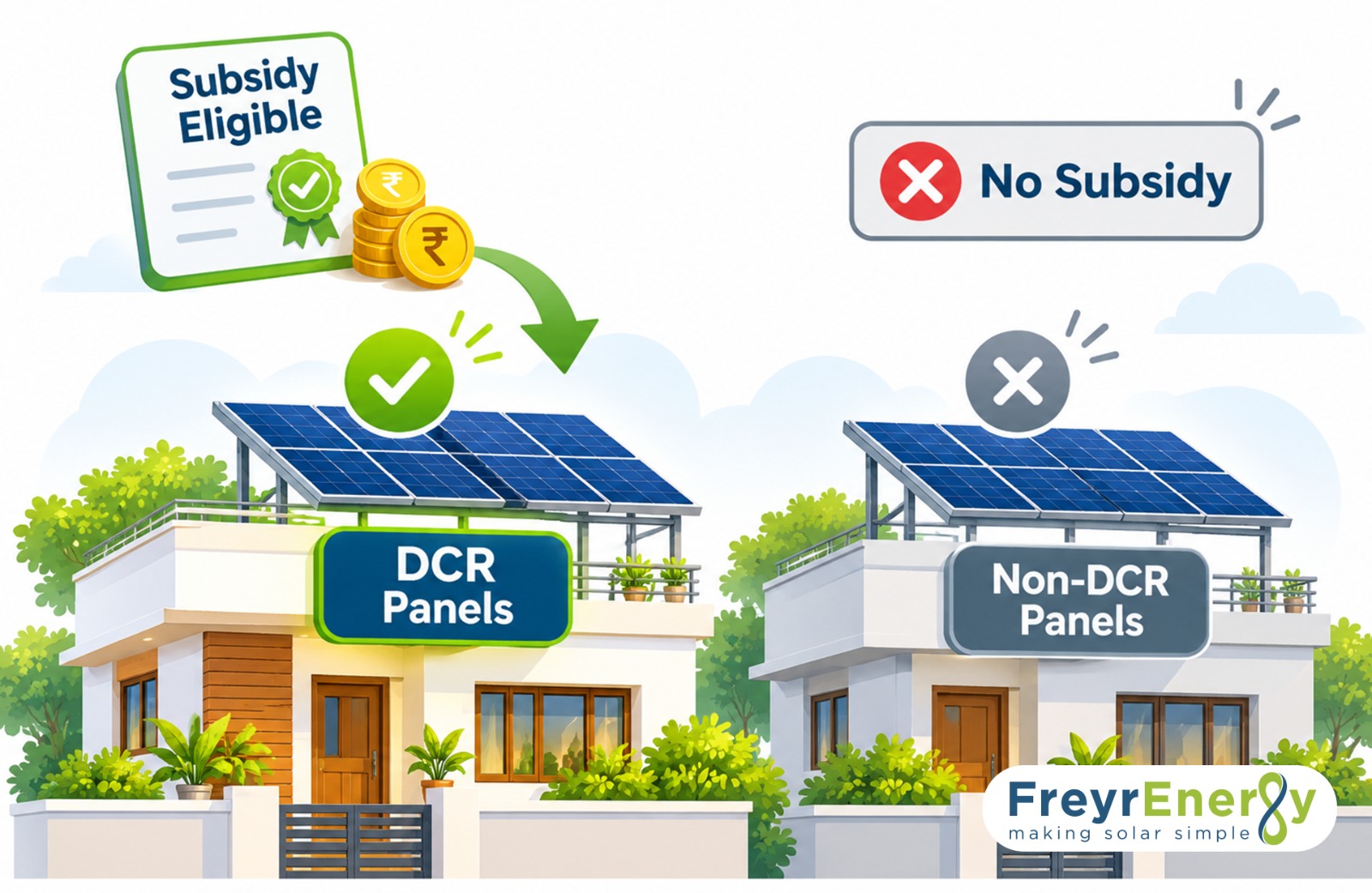
Residents must choose DCR modules if they wish to avail the PM Surya Ghar subsidy. If you go with non-DCR modules, you can’t claim this subsidy.
While buying solar panels, most buyers compare wattage and price. However, it is more than that. Two terms matter when buying solar panels: DCR and Non-DCR. The difference between them becomes more evident when you apply for government subsidies.
Solar panels must meet India’s manufacturing requirements. DCR solar panels fulfil those. Non-DCR solar panels do not meet these conditions. Both panels can generate electricity. However, their eligibility with respect to subsidies is different. Which one to choose entirely depends on your project requirements, budget and applicable government rules.
Key Takeaways
- DCR stands for Domestic Content Requirement.
- DCR modules use qualifying Indian-made cells and modules.
- Non-DCR modules may still be assembled in India.
- Do not expect higher efficiency from DCR.
- Before you install, it is important to verify the module serial number.
What Are DCR Solar Panels?
DCR solar panels meet the domestic manufacturing conditions laid down by the Ministry of New and Renewable Energy (MNRE).
Both solar cells and modules must meet the applicable requirements. These panels are important for government-supported projects where domestic content is compulsory.
What does DCR stand for in solar panels?
DCR means Domestic Content Requirement, known to support Indian solar manufacturing and local supply chains.
How are DCR solar panels manufactured?
For crystalline silicon cells, the manufacturing process must begin with an undiffused silicon wafer. The required cell manufacturing steps must happen in India.
The solar module must also be manufactured in India using qualifying domestic cells. Some might think that importing foreign cells and assembling them in India will make a module DCR-compliant. But it doesn’t work that way.
What makes a solar panel DCR-compliant?
It is vital for the manufacturer to meet the guidelines as laid down by MNRE. He also has to maintain proper manufacturing records. In addition, cell-to-module traceability is also vital.
A valid DCR certificate helps establish compliance. The exact module should appear in the verification system.
Why does the Indian government promote DCR solar panels?
India is trying to strengthen its domestic solar energy manufacturing industry. The policy has been initiated to enhance production, employment, and the supply chain at the local level.
This policy also lessens our dependence on imported solar cells and modules.
What Are Non-DCR Solar Panels?
Non-DCR solar panels are exactly the opposite of DCR. They do not fulfil MNRE guidelines. They use imported solar cells. A few are also assembled using foreign cells.
This means non-DCR panels are either imported foreign material or foreign solar panels assembled in India.
How are Non-DCR solar panels different?
They do not follow manufacturing compliance. This is the main difference. The process of generating electricity is the same. However, the efficiency and performance may vary as per the technology and specifications.
Where are Non-DCR panels manufactured?
A few manufacturers assemble solar modules using imported cells. Some import the finished modules. Therefore, check the manufacturer’s details before buying. Also, going deeply into the product documentation can keep you informed.
Can Non-DCR panels be used for residential rooftop installations?
Yes, you can use them for your home without a subsidy. However, they must follow the applicable technical and DISCOM requirements.
Are Non-DCR panels eligible for government subsidies?
No. Non-DCR modules are not eligible for the PM Surya Ghar subsidy. A few buyers may select low-priced non-DCR. However, they may have to give up the subsidy. Ultimately, they will be paying a higher price for the overall solar energy project.
DCR vs Non-DCR Solar Panels: Key Differences
| Comparison factor | DCR solar panels | Non-DCR solar panels |
| Manufacturing requirement | Meets domestic content rules | Does not meet DCR rules |
| Solar cell origin | Qualifying domestic cells | Domestic or imported |
| Solar module origin | Manufactured domestically | Domestic or imported |
| PM Surya Ghar CFA | Eligible if scheme rules are met | Not eligible under DCR requirement |
| Price | May carry a premium | May be comparatively economical |
| Efficiency | Model dependent | Model dependent |
| Performance | Depends on specifications | Depends on specifications |
| Warranty | Manufacturer-specific | Manufacturer-specific |
DCR is not a performance rating. It is just a manufacturing classification. Also, one shouldn’t assume that a DCR is more efficient than a non-DCR.
DCR vs Non-DCR Solar Panel Price in India
Since local cell sourcing and manufacturing are required for DCR solar panels, they may be expensive. Not only for that reason, but prices also depend on wattage, manufacturer, technology and order quantity.
The following table shows retail references from September and October 2026 for these Mono PERC price ranges. Prices are indicative:
| Panel category | Indicative price per watt | Approximate 550W panel price |
| Non-DCR Mono PERC | ₹18–₹23 | ₹9,900–₹12,650 |
| DCR Mono PERC | ₹24–₹28 | ₹13,200–₹15,400 |
These are panel-only estimates. Includes applicable GST. Installation, mounting structures and other components cost extra. Actual dealer prices may vary.
What is the price of DCR solar panels in India?
The price for a 550W DCR Mono PERC panel is around ₹13,200–₹15,400. Other factors that impact the price are brand, availability and warranty.
What is the price of Non-DCR solar panels in India?
A similar 550W Non-DCR panel may cost around ₹9,900–₹12,650. Compare the exact model before purchasing.
Why are DCR solar panels sometimes more expensive?
Cells sourced from the domestic market can increase procurement costs. Manufacturing capacity and high demand from projects with subsidies can hamper the availability also.
What factors affect solar panel prices?
Wattage, technology, DCR status, manufacturer and warranty matter. Bifacial modules and higher-efficiency models may cost more.
Compare similar products rather than comparing only their price per watt.
Is There a Difference in Performance Between DCR and Non-DCR Solar Panels?
Electricity production doesn’t depend on DCR status. The output is the same for similar specifications, irrespective of whether a panel is DCR or non-DCR. However, installation conditions can hamper the output.
Are DCR solar panels more efficient than Non-DCR panels?
No evidence proves DCR panels are more efficient.
However, you can compare efficiency, power tolerance and degradation ratio. You can get more information from the datasheet. Don’t just believe a DCR label.
Do DCR and Non-DCR panels generate the same amount of electricity?
They can produce similar electricity when wattage and specifications are comparable.
Shade, temperature, dust and panel direction affect both types. Good installation matters just as much.
Does panel technology affect solar panel performance?
Yes. Mono PERC, TOPCon and other technologies have different performance characteristics.
Temperature coefficient, degradation and bifaciality should be checked before selecting a model.
Which performs better: Mono PERC or TOPCon?
TOPCon often has better efficiency and temperature performance. Mono PERC can be cheaper.
Check actual data sheets and prices before you decide. The best option will depend on your roof space and budget available.
Know more about: Types of Solar Panels in India: Mono, TOPCon and Bifacial
PM Surya Ghar Subsidy: Are DCR and Non-DCR Panels Eligible?
What is the PM Surya Ghar Muft Bijli Yojana?
It is a central government scheme. It supports residential grid-connected rooftop solar installations.
Eligible households receive Central Financial Assistance (CFA) once they complete the required installation. It is also mandatory to complete the verification process.
Are DCR panels mandatory to receive the PM Surya Ghar subsidy?
Yes. Here are a few requirements of the scheme:
- Use domestic solar cells and modules that comply with the local guidelines
- Modules must fulfil the technical requirements of the applicable scheme.
DCR verification is part of the process.
Can you claim a subsidy with Non-DCR solar panels?
No. Non-DCR modules do not meet the domestic content requirement for PM Surya Ghar CFA.
How much subsidy can homeowners receive?
| Residential solar capacity | Central subsidy |
| 1 kW | ₹30,000 |
| 2 kW | ₹60,000 |
| 3 kW or above | ₹78,000 maximum |
The subsidy is available for eligible residential installations. Commercial and industrial consumers cannot claim this residential CFA.
What happens if you install Non-DCR panels?
Your installation will not be eligible for PM Surya Ghar central assistance. You may replace the modules later to gain the subsidy. However, it will involve additional cost. Therefore, it will be a wise strategy to confirm compliance before installation.
Are there exceptions for residential solar installations?
Follow the latest scheme. Go through the DISCOM requirements. Do not blindly follow the supplier’s claim.
How to Identify and Verify Genuine DCR Solar Panels
A label saying Made in India is not sufficient proof. You should verify the actual module.
How to check whether a solar panel is DCR-compliant
Ask your installer for the DCR certificate and module serial number.
Ensure the model, manufacturer and certificate details are the same as mentioned in the supplied panel.
What is a DCR certificate?
The certificate is the main proof declaring the solar module is in compliance with domestic guidelines.
The National Institute of Solar Energy (NISE) manages the official DCR Verification Portal.
How to verify solar panel serial numbers
Visit the NISE DCR Verification Portal.
Enter the certificate number or panel serial number. You can also scan the available QR code.
What documents should you request from your solar installer?
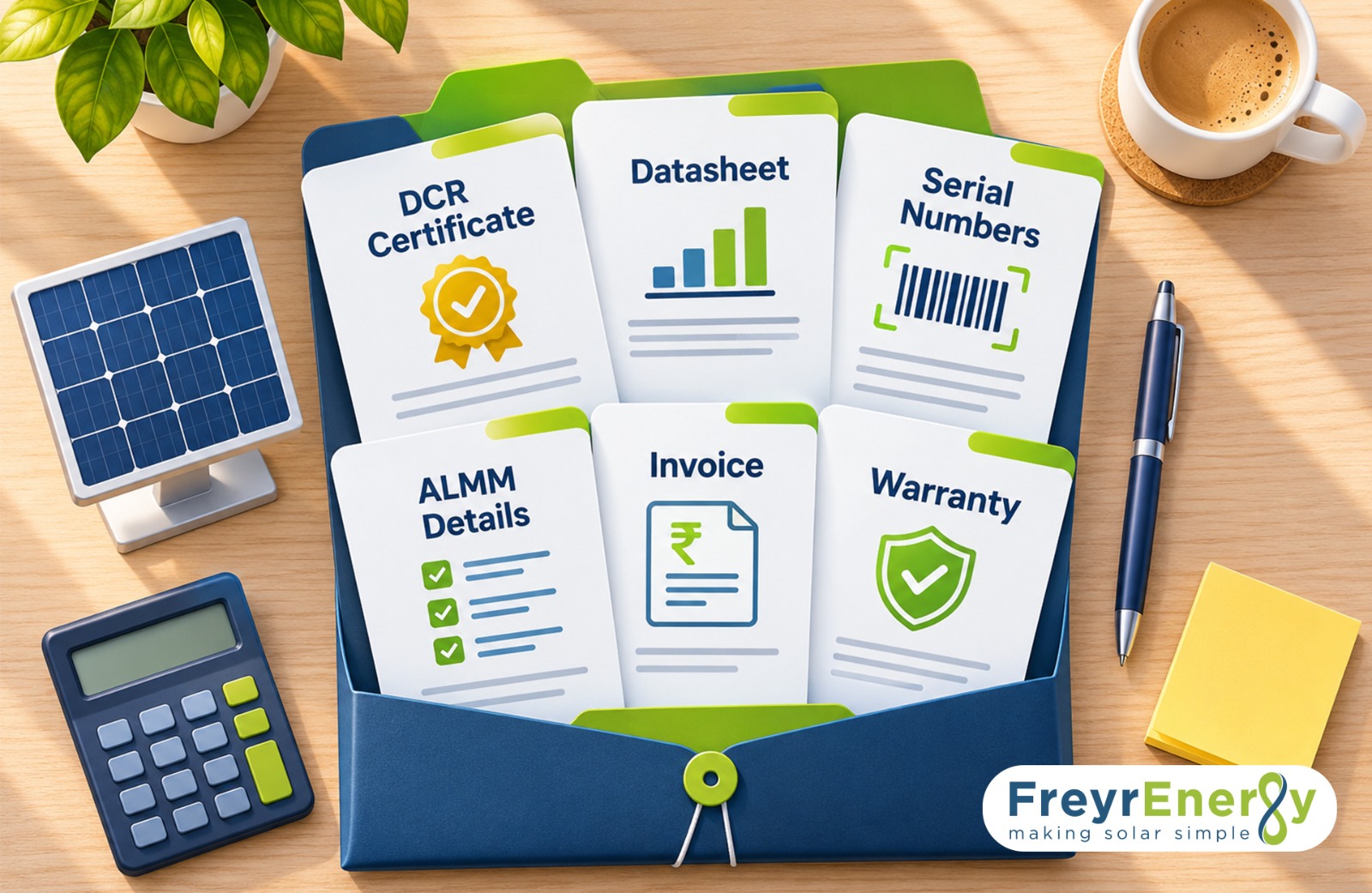
Get the following documents:
- DCR certificate.
- Solar module datasheet.
- Module serial number list.
- Manufacturer information.
- Model details.
- ALMM listing details.
- Purchase invoice.
- Warranty terms.
Keep these records safely for future reference.
DCR vs Non-DCR Solar Panels: Which One Should You Choose?
The right option depends on your project and subsidy requirement.
| Your requirement | Recommended option |
| Want PM Surya Ghar subsidy | DCR |
| Residential system without CFA | Compare permitted DCR and Non-DCR |
| Commercial rooftop project | Check project regulations |
| Want a specific technology | Compare compliant models |
| Prioritise long-term performance | Compare efficiency, degradation and warranties |
For home installations tied to subsidies, DCR is the best choice.
Without CFA, compare the two versions in terms of cost, warranty, and quality. Commercial projects must adhere to the relevant regulations and procurement requirements.
Common Mistakes to Avoid When Buying DCR Solar Panels
Do not just depend on a sales claim and don’t fall prey to a “Made in India” label. It’s essential to verify the certificate and the module serial number. Check that you are purchasing the exact model and that it fulfils the scheme requirements.
A manufacturer may have one model which is DCR-compliant. It doesn’t mean that all the products from him are DCR-compliant.
Before you finalise, it is essential to confirm whether the project is eligible for subsidy or not.
Source link