

It’s the Super Bowl of renewable energy.
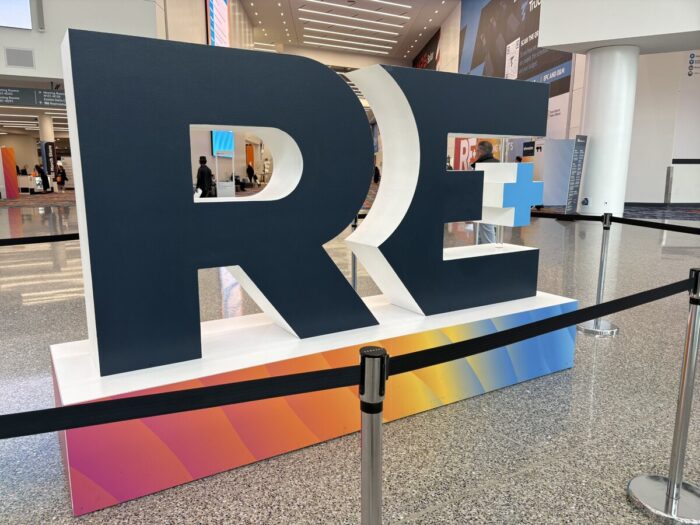
RE+ 2026 once again packed the Las Vegas Convention Center Nov. 16-19, this year to the tune of an estimated 40,000-plus attendees. This year’s conference boasted three full halls of exhibitors, all showcasing the latest and greatest in solar, storage, and renewable energy at large.
Each of those three halls echoed with the same thought: optimism.
Despite the consistent inconsistencies in policy at the federal level, and the potential expiration of remaining renewable energy tax credits, the solar sector of the renewable energy industry is more determined than ever to keep things steady. I wrote in my Intersolar 2026 recap in February that there were far fewer “ghost stories” than I’d anticipated as a solar newcomer, following the first full year of the second Trump administration. RE+ 2026 was a doubling down of that sentiment.
Nine months can change a lot, and the solar industry’s outlook is even rosier now. What I saw at RE+ 2026 was a resilient renewable energy industry that is willing and able to make the best of a political landscape that, while improved by this year’s midterm election results, is still less than ideal. Here’s a trio of topics you might have missed while prowling the 200-acre Las Vegas Convention Center.

Finding a place for AI
Artificial intelligence has been the loudest buzzword in business for the past few years, especially since the advent of consumer programs like ChatGPT, Claude, or proprietary in-engine options like X’s Grok or Microsoft Copilot. As adoption has taken off, the solar industry is racing to see who can best capitalize on this potentially revolutionary technology in ways that are not only fast and sensible for business, but safe above all else.
Alon Mashkovich, co-founder and CEO of enSights, believes he has an answer.
“When we started, it was really by solving a pain that we’ve had, in working with so many asset owners and operators,” he says. “All of them had been suffering from underperformance issues, mainly because they didn’t have one single system of record that allows them, really, to understand the data and understand everything in one place. This is where it started.”
Since then, Mashkovich and enSights have launched the company’s Energy Business Management platform, which acts as that aforementioned “single system of record.” The platform unifies monitoring, energy management, operations, and finance for renewable energy firms, creating an intelligent spreadsheet that keeps track of anything an energy asset owner might need.
Of course, programs like this are far from infallible, and Mashkovich understands that. While he believes AI management technology can one day reach a point of true autonomy, thereby bringing the energy industry along with it, the program still has red flags and points of human intervention built in.
Optimistic energy asset owners can still make the system fully autonomous, if they so choose, but Mashkovich says these practices could come with a serious trade-off.
“It takes time, and we’re still early in the process,” he says. “It’s not there, and we believe it will take time, especially with critical infrastructure. I don’t think you can trust it 100%, I don’t see that (and) I don’t see it coming in the near future. But, there are many places where you can have your routine set, and it will shorten the way to a decision.”
The enSights AI network continues to grow, with about 100,000 individual sites on the system. The technology isn’t perfect yet, Mashkovich says, but the framework is there to greatly speed up energy management for businesses around the world. As more businesses learn, the network only becomes more solid.
Election repercussions
The midterm elections were a veritable landslide from Democratic politicians, with about 94% of U.S. households swinging left in this election cycle, according to political outlet The New Republic and map research by Ground News. “Practically everything is blue,” wrote reporter Edith Olmsted, and that includes the political skies over the solar industry.
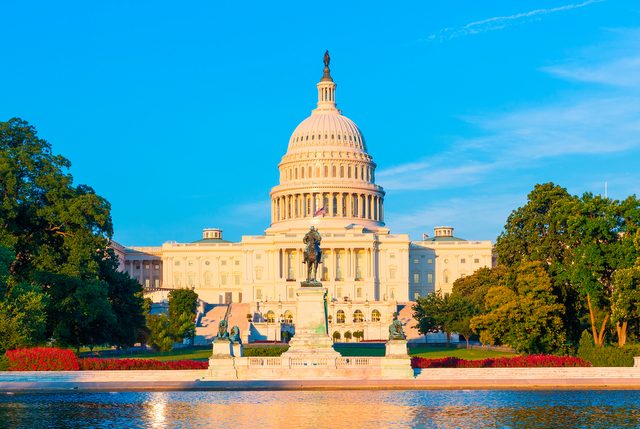
With 258 House of Representatives seats (and counting), and 56 Senate seats, Democrats currently hold their largest Congressional majority in more than 35 years. Despite a Republican-controlled White House which can often be described as “unpredictable,” Democrat lawmakers should be able to get some renewable energy legislation to the desk of President Trump. But before the 120th Congress can begin in 2027, there is a permitting reform-shaped elephant sitting on the floor of the House of Representatives.
The most notable piece of legislation at this year’s RE+ show was, of course, the Bipartisan American Affordability and Jobs Act of 2026 (BAAJA). In her panel, ‘Permitting in the 119th Congress,’ Erin Duncan spoke at length about both the benefits and potential tradeoffs of the bill, which has passed the Senate as of Nov. 19, and now heads to the House of Representatives for further discussion and voting.
“There’s a lot of reasons to be happy and excited about this permitting bill,” says Duncan, VP of Congressional affairs at the Solar Energy Industries Association (SEIA). “One, it shows that Congress can still do big, brave, bipartisan things, and that is really awesome to see. Number two, it’s going to help unleash a lot more solar and storage.”
There exist just a few problems with passing BAAJA before this Congress’s deadline, according to Duncan. First off, the House isn’t in session right now, and it could take until the White House Christmas party for them to all be in the same room together. Second, a lot of Republican politicians that lost their seats are already ready to go home.
“Congress usually tries to keep these lame duck sessions as short as possible, for a lot of reasons,” she says. “Not the least of which is the fact that anyone who lost their election has started getting kicked out of their offices and moved downstairs to a cubicle with one chair.
“They don’t even have computers; they have to bring their own laptops.”
The race is on before the 120th Congress can really kick in, bringing potentially a cavalcade of bills off the back of BAAJA’s passage. Duncan’s hope is that the bill can pass through the House with no changes, meaning it would go right to the desk of President Trump, who has shown support for the bill in the past. Combined with the doors it would open for potential further solar and storage legislation, BAAJA could bring renewable energy into a new era.

A new beginning
“I still feel like we’re at the beginning of the industry, in many ways,” says Tor Valenza, colloquially known as ‘Solar Fred.’ A veteran of the solar industry since 2009, Valenza does marketing work for Renewable Properties and Soltec, and acts as a mouthpiece for the industry as a whole. He says that despite the constant policy changes, he remains optimistic about the state of renewable energy going forward.
“We’re learning about how well we can integrate wind, solar, geothermal, and everything right now. It’s so cool to be at the beginning.”
What the solar industry needs to do now, in Solar Fred’s estimation, is create the brand voice that will lead this technology into the future. The science is sound, the products are scalable, and yet the industry still has a “perception problem” and the solution for that is much easier said than done.
Valenza likened the answer to this problem to something like the famous ‘Got Milk?’ campaign, or Nike’s ‘Just Do It’ ads. Something intangible that stirs up a feeling of support among Americans who remain unconvinced of solar.
“Solar is still an appliance, and it needs to be more than that,” Valenza says. “It is such a broad solution for that energy independence feeling, that feeling of clean power. We as an industry still haven’t solved that for consumers, except for the consumers that have gone solar.”
The road ahead is not easy; they call this industry the Solar Coaster for a reason. But Valenza says the renewable energy space has all the reason to be optimistic going forward, if only because the proof of concept is already built. Solar can obviously scale. Now, the fight is about public perception.
“When you marry an optimist with the solar industry, you’re always thinking bigger,” he says. “I think we have exceeded our expectations (in scaling).
“Climate change aside, it just makes sense for everybody. It’s the fastest to build, and it’s the cheapest to build. So it’s the solution right now, when capacity is going up, but we need politicians to support us. Politicians will only support us when people support us.”
— Solar Builder magazine
Source link