

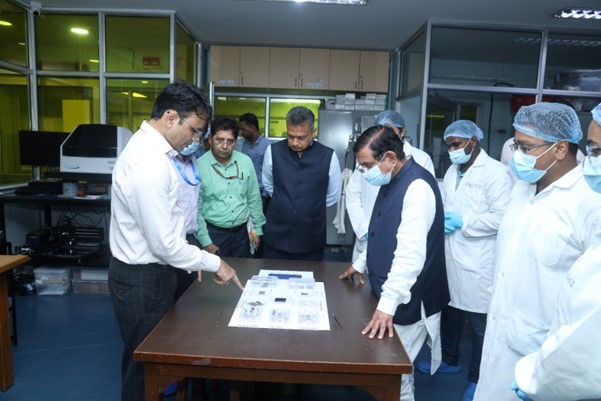

Union Minister for New and Renewable Energy and Consumer Affairs, Food and Public Distribution, Shri Pralhad Joshi, visited the National Centre for Photovoltaic Research and Education (NCPRE) at IIT Bombay, underscoring the government’s commitment to supporting cutting-edge renewable energy research under the vision of Aatmanirbhar Bharat.

During his visit, Shri Joshi toured several state-of-the-art laboratories at NCPRE, including the Perovskite Tandem Solar Cell Lab, Silicon Fabrication Lab, and Medium Voltage Laboratory. He also held interactive discussions with the institution’s principal investigators and advisory board members to review progress and explore future opportunities in solar innovation.
A key highlight of the visit was the demonstration of a significant national breakthrough: a 4-Terminal Silicon/CdTe-Perovskite Tandem Solar Cell developed by ART-PV India, a startup incubated at IIT Bombay. The solar cell has achieved a conversion efficiency of 29.8%, one of the highest performance benchmarks recorded in India. The achievement marks a major milestone in India’s journey toward high-efficiency, low-cost solar energy solutions.

Launched in 2010 with financial support from the Ministry of New and Renewable Energy (MNRE), NCPRE has received over ₹200 crore in funding over the last 15 years to support research and education aligned with India’s 100 GW solar energy goal.
The MNRE is also backing ART-PV India with a $10 million (~₹83 crore) grant to establish a pilot-scale manufacturing facility at the IIT Bombay campus. The initiative aims to translate lab-scale innovation into scalable, commercially viable solutions, with a focus on developing indigenous intellectual property for global deployment.
Speaking at a media briefing after the visit, Shri Joshi lauded the work of NCPRE and ART-PV India. “The Ministry is proud to support the development of high-efficiency Silicon-Perovskite Tandem Solar Cells, which have the potential to exceed 30% efficiency. This is not only a technological breakthrough but a blueprint for clean, scalable, and self-reliant energy production,” he stated.
Shri Joshi emphasized that the innovation gives India a strategic edge as global demand surges for efficient and affordable solar technologies. “This development reflects India’s shift from being an adopter of renewable technologies to becoming a global leader in solar R&D,” he added.
The Minister also reiterated MNRE’s commitment to strengthening India’s clean energy ecosystem through initiatives such as the Renewable Energy Research & Technology Development (RE-RTD) program and the recently approved Research Development and Innovation (RDI) Scheme. The RDI budget stands at ₹1.27 lakh crore under the Central Government’s push to elevate India’s Gross Expenditure on Research and Development (GERD).
Encouraging the IIT Bombay–ART PV team to move toward commercial demonstration, Shri Joshi said that the goal is to prove that Perovskite Tandem Solar Cells are not only scalable but economically viable for mass production. He stressed that bridging the gap between academia and industry would be key to transforming India into a global clean energy hub.
“This approach is in line with Prime Minister Shri Narendra Modi’s vision of turning Indian R&D into global benchmarks. By investing in indigenous technologies across solar, green hydrogen, energy storage, and PV reliability, we are building an innovation ecosystem that will define the future of energy—not just for India, but for the world,” the Minister concluded.
Related
Source link