
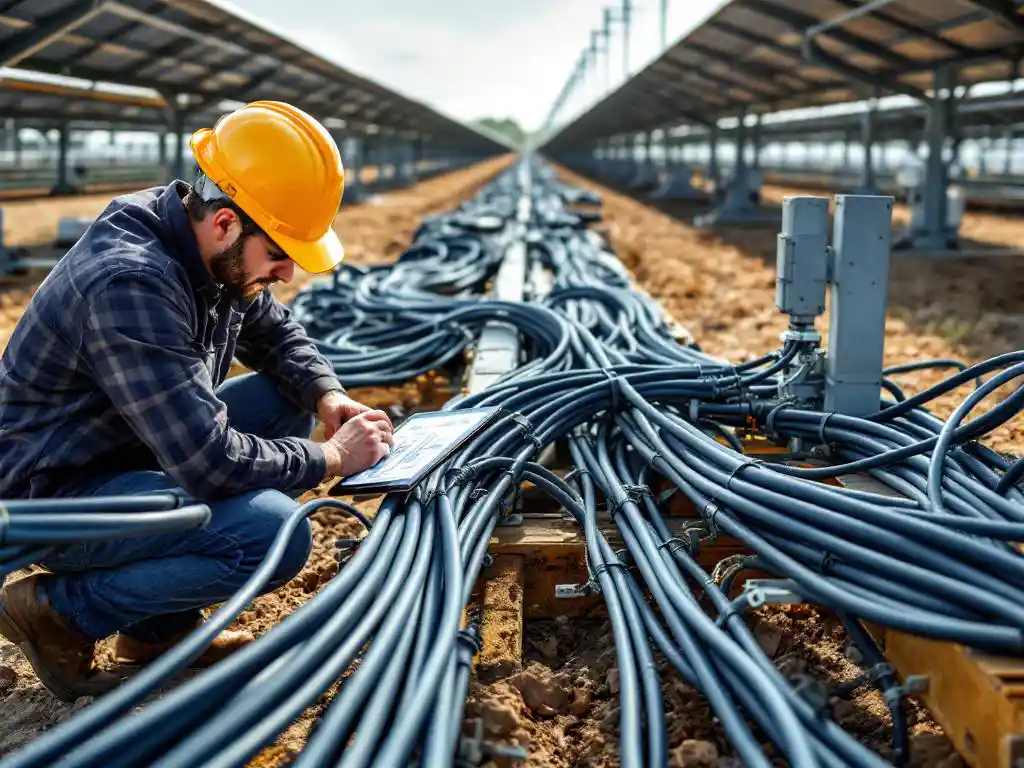
Complex cable routing in solar farms involves designing electrical pathways that accommodate terrain variations, voltage requirements, and regulatory compliance while minimising costs and maximising system performance. Unlike residential installations, utility-scale projects require sophisticated planning for DC collection systems, AC transmission networks, and maintenance accessibility. Modern solar design software automates these calculations, significantly reducing engineering time while ensuring construction-ready documentation.
What makes cable routing complex in large-scale solar installations?
Large-scale solar installations face unique challenges that make cable routing significantly more complex than residential systems. Terrain variations create uneven ground conditions requiring careful pathway planning, while extensive distances between components demand precise voltage drop calculations to maintain system efficiency.
Voltage considerations become critical when managing hundreds or thousands of panels across vast areas. DC collection systems must handle varying string configurations, while AC transmission networks require proper sizing to prevent power losses. The sheer scale means that minor routing inefficiencies can result in substantial cost overruns and performance degradation.
Regulatory compliance adds another layer of complexity, with electrical codes dictating specific clearances, grounding requirements, and safety protocols. Environmental factors such as flood zones, wildlife corridors, and soil conditions further constrain routing options. These installations also require redundancy planning and maintenance access routes that residential systems typically do not need.
The interconnection of multiple inverters, transformers, and monitoring systems creates a web of electrical pathways that must be carefully coordinated. Each component has specific requirements for cable types, burial depths, and separation distances that must be integrated into a cohesive design.
How do you plan efficient cable pathways across varied terrain?
Efficient cable pathway planning begins with comprehensive terrain analysis using topographical data and site surveys. Engineers must identify the most direct routes while avoiding obstacles like wetlands, steep slopes, and existing infrastructure that could complicate installation or increase costs.
Terrain modelling becomes essential for understanding elevation changes and their impact on cable runs. Cut-and-fill analysis helps determine where ground modification might be necessary, while 3D visualisation allows engineers to identify potential conflicts before construction begins. This approach prevents costly field modifications and ensures optimal cable placement.
Cost optimisation involves balancing shorter cable runs against installation complexity. Sometimes a longer route around an obstacle proves more economical than dealing with challenging terrain conditions. Engineers must consider trenching costs, conduit requirements, and future maintenance accessibility when selecting pathways.
Environmental considerations play a crucial role in pathway selection. Routes must minimise ecological impact while maintaining system reliability. This often requires creative solutions such as directional boring under sensitive areas or elevated cable runs in specific locations.
Modern solar design software integrates terrain data with electrical requirements to automatically suggest optimal routing solutions. These tools can process complex topographical information and generate multiple pathway options for comparison and selection.
What are the key considerations for DC and AC cable routing in solar farms?
DC and AC cable routing require different approaches due to their distinct electrical characteristics and safety requirements. DC collection systems handle lower voltages but higher currents, requiring careful attention to string configurations and combiner box placement to minimise voltage drops and maximise energy harvest.
DC routing focuses on efficient collection from panel strings to inverters. String configurations must account for terrain variations and shading patterns while maintaining proper voltage levels. Combiner boxes need strategic placement to minimise cable runs without creating maintenance access issues. Proper DC grounding and equipment grounding conductor routing ensure system safety and code compliance.
AC transmission systems handle higher voltages and require different safety clearances and installation methods. These systems typically involve fewer but larger cables running from inverters to transformers and ultimately to the point of interconnection. AC routing must consider electromagnetic interference, proper separation from DC systems, and utility interconnection requirements.
Voltage drop calculations become critical for both systems but affect them differently. DC systems lose energy directly, while AC systems can experience both power losses and power factor issues. Engineers must calculate impedance, resistance, and reactance for AC systems while focusing primarily on resistance for DC calculations.
Safety clearances differ significantly between DC and AC systems. DC systems require specific separation distances and arc-fault protection, while AC systems need different clearances and may require additional safety equipment such as disconnect switches and protective relaying.
How do modern software tools streamline complex cable routing design?
Modern software tools transform cable routing from manual calculations into automated processes that integrate with CAD environments and provide construction-ready documentation. These platforms combine electrical engineering calculations with terrain analysis to generate optimal routing solutions in a fraction of the traditional design time.
Automated stringing calculations eliminate repetitive manual work by instantly determining optimal string configurations based on panel specifications, terrain conditions, and electrical requirements. The software considers factors such as temperature coefficients, voltage drop limits, and inverter input requirements to generate multiple configuration options for comparison.
CAD integration allows engineers to work within familiar AutoCAD environments while accessing specialised solar design capabilities. This integration maintains existing workflows while adding powerful automation features for cable routing, BOM generation, and construction documentation. Engineers can visualise complex routing scenarios in 3D and identify potential conflicts before they become field issues.
Advanced platforms provide seamless integration with industry-standard tools like PVsyst, allowing engineers to export detailed electrical models for performance simulation. This integration ensures that routing decisions align with energy production goals and system optimisation requirements.
Construction documentation generation becomes automated, producing single-line diagrams, detailed drawings, and comprehensive bills of materials directly from the routing design. This eliminates transcription errors and ensures that field installation teams receive accurate, up-to-date information for efficient project execution.
These software solutions significantly reduce engineering time by transforming complex calculations into automated processes. What once required weeks of manual work can now be completed in days, allowing engineering teams to handle more projects while maintaining accuracy and compliance with industry standards. For expert guidance on implementing these solutions in your projects, contact our technical specialists.
Frequently Asked Questions
What software features should I prioritize when selecting a cable routing tool for my solar farm project?
Look for software that offers automated string calculations, terrain integration with topographical data import, and CAD compatibility with your existing workflow. Essential features include real-time voltage drop calculations, automated BOM generation, and the ability to export to industry-standard tools like PVsyst for performance validation.
How do I handle cable routing conflicts when multiple systems intersect in the same area?
Use 3D visualization tools to identify conflicts early and establish clear separation hierarchies – typically AC transmission lines get priority routing, followed by DC collection systems, then communication cables. Plan for adequate separation distances between different voltage levels and consider using different trenching depths or conduit systems to manage intersections safely.
What are the most common cable routing mistakes that lead to cost overruns during construction?
The biggest mistakes include inadequate terrain analysis leading to unexpected trenching costs, insufficient consideration of maintenance access requirements, and failure to account for utility interconnection pathway constraints. Poor coordination between DC and AC routing phases often results in conflicts that require expensive field modifications.
How do I optimize cable routing for future expansion or system modifications?
Design routing infrastructure with 20-30% spare capacity in trenches and conduit systems, and establish clear pathway corridors for future additions. Document routing decisions thoroughly and consider modular approaches that allow sections to be modified without affecting the entire system. Plan transformer and inverter locations with expansion capabilities in mind.
What documentation should I provide to construction teams for efficient cable installation?
Provide detailed routing plans with GPS coordinates, cross-sectional drawings showing burial depths and separation distances, comprehensive cable schedules with specific part numbers, and clear installation sequences. Include environmental restrictions, access limitations, and any special installation requirements for challenging terrain areas.
How do environmental regulations impact cable routing decisions in utility-scale projects?
Environmental regulations often require specific routing corridors to avoid wetlands, protected habitats, and archaeological sites. You may need to use directional boring under sensitive areas, implement seasonal construction restrictions, and obtain additional permits for certain routing methods. Factor these constraints into your initial routing analysis to avoid delays.
What’s the best approach for validating cable routing designs before construction begins?
Conduct thorough design reviews using 3D modeling to identify conflicts, perform detailed voltage drop calculations across all system scenarios, and validate routing against local electrical codes and utility requirements. Consider peer reviews with experienced solar engineers and field verification of critical routing decisions during site visits.
Source link