

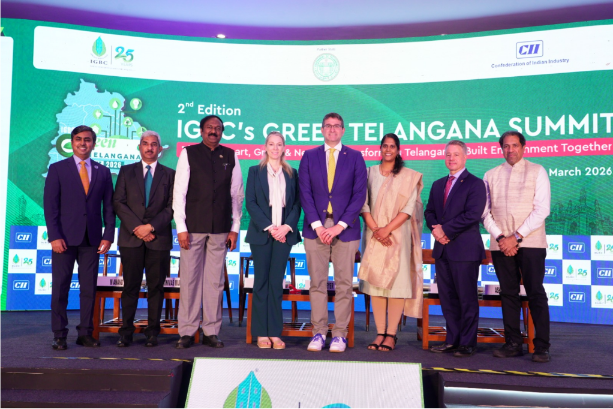

The CII Indian Green Building Council (CII IGBC) successfully organized the second edition of the IGBC Green Telangana Summit 2026 on 6 March 2026 in Hyderabad. The summit brought together policymakers, industry leaders, architects, urban planners, and sustainability experts to discuss the future of sustainable development in Telangana’s built environment. Held under the theme “Smart, Green & Net Zero: Transforming Telangana’s Built Environment Together,” the event focused on exploring practical strategies that can support environmentally responsible growth while meeting the demands of rapid urban development.
The summit served as an important platform for dialogue on sustainable construction practices, climate-responsive urban planning, and the role of smart technologies in shaping modern cities. Discussions also focused on the development of net-zero buildings and the importance of creating resilient urban infrastructure that can support long-term environmental goals. Through a combination of keynote addresses, panel discussions, and technical sessions, participants explored global best practices, policy approaches, and emerging technologies that are influencing the future of sustainable urban development.
The day-long program began with an inaugural session attended by several prominent national and international leaders. The event was graced by Matt Meyer, Governor of the State of Delaware in the United States; Bill McQuade, President of ASHRAE; C Shekar Reddy, National Chairman of the Indian Green Building Council; Vijay Sai Meka, President of NAREDCO Telangana; Ar Srinivas Murthy, Chairman of the IGBC Hyderabad Chapter; and M Anand, Deputy Executive Director of IGBC. Their presence highlighted the growing international interest in India’s green building initiatives and the collaborative efforts needed to promote sustainable infrastructure development.
Over the past several years, Telangana has emerged as one of the leading states in India in promoting green buildings and sustainable urban growth. The state currently has more than 1,245 projects registered with IGBC, covering a total green building footprint of approximately 1.67 billion square feet. These projects span multiple sectors and include over 715 commercial developments, around 335 residential projects, more than 110 metro transit projects, over 40 logistics facilities, 15 built environment developments, and more than 20 net-zero projects. Much of this progress has been concentrated in Hyderabad, which has become one of the top cities in India for green building development and sustainable infrastructure.
The summit also provided a global perspective on sustainable urbanization. During his address, Matt Meyer, Governor of Delaware, acknowledged the important role played by IGBC in advancing green building and net-zero initiatives. He noted that governments and cities around the world are increasingly facing the urgent challenge of climate change, making collaboration between regions more important than ever.
He emphasized that the progress being made in Hyderabad and across India holds global significance. According to him, such platforms help bring together leaders from different regions to exchange knowledge, share technologies, and identify practical pathways that can accelerate climate action. He also highlighted that Telangana’s strong focus on smart and net-zero development reflects the kind of forward-looking leadership needed to create resilient and inclusive growth in the coming decades.
Speaking at the summit, C Shekar Reddy, National Chairman of the Indian Green Building Council, highlighted IGBC’s role in shaping India’s green building movement and emphasized Telangana’s important contribution to the country’s sustainability progress. He pointed out that India is currently experiencing one of the fastest phases of urban expansion in its history. By 2040, the nation’s built-up area is expected to grow nearly two and a half times its current size. In this context, he noted that Telangana is demonstrating how rapid development can be combined with environmentally responsible planning.
He also shared that India now has more than 19,000 IGBC-registered projects representing a green building footprint of approximately 15.74 billion square feet. This places India as the second-largest green building market in the world. Within this national progress, Telangana has played a key role. As the state continues to expand across sectors such as housing, infrastructure, information technology, and industry, Reddy stressed the importance of ensuring that new developments follow green and net-zero principles. With supportive policies, technological innovation, and collaboration between government and industry, he said Telangana has the potential to become a national benchmark for sustainable urban development.
One of the highlights of the summit was the unveiling of the Telangana Coffee Table Book, which features more than 40 iconic IGBC-certified green and net-zero projects across the state. The publication showcases several notable examples of sustainable architecture and infrastructure, demonstrating how environmental design principles are being integrated into modern construction practices. The summit also saw active participation from leading industry organizations such as CREDAI and NAREDCO, along with international technical bodies including ASHRAE. Their participation contributed to a broader discussion on how global standards and industry expertise can help accelerate sustainable urban development in India.
During his address, Bill McQuade, President of ASHRAE, highlighted that India is currently at an important stage in shaping the future of sustainable and high-performance buildings. He noted that the developments taking place in Telangana illustrate how policy leadership, industry commitment, and technical innovation can work together to transform the built environment. He also emphasized that events like the Green Telangana Summit provide valuable opportunities to exchange knowledge and promote global best practices related to energy efficiency, indoor environmental quality, and climate resilience. McQuade reaffirmed ASHRAE’s commitment to working with partners in India to support the development of low-carbon and sustainable buildings that benefit both communities and the environment.
The summit also featured a plenary session titled “Global Pathways to Smart & Net-Zero Cities: Lessons for Sustainable Urban Future.” During this session, experts discussed international approaches to climate-responsive planning, smart city infrastructure, and low-carbon development strategies. The discussion emphasized the importance of integrating technology, global standards, and supportive policies to enable cities to move toward net-zero growth. Another important session focused on the future of Telangana’s built environment. Titled “The Future of Telangana’s Built Environment: Priorities for a Smart, Green & Net-Zero State,” the panel brought together leaders from government, industry, and the construction sector.
Participants discussed topics such as sustainable urban development, climate-resilient infrastructure, and the future of mobility systems within rapidly growing cities. The event also included two technical sessions that explored practical approaches for scaling net-zero buildings and promoting high-performance construction materials. Discussions also focused on the development of sustainable industrial and logistics infrastructure across the state, which is becoming increasingly important as Telangana continues to grow as a major economic hub.
Ar Srinivas Murthy, Chairman of the IGBC Hyderabad Chapter, spoke about the role of IGBC in supporting Telangana’s sustainability goals. He noted that Hyderabad has become one of India’s most dynamic centers for green buildings due to the strong commitment shown by developers, architects, industry leaders, and government authorities. According to him, the continued efforts of the Indian Green Building Council and its Hyderabad Chapter are helping the city set new standards in energy efficiency, resource conservation, and people-focused building design. He also emphasized that architects and designers play a critical role in shaping spaces that are not only visually appealing but also environmentally responsible and prepared for future challenges.
The event concluded with the IGBC Green Crusaders and Valedictory Session. During this session, 47 projects were recognized for adopting IGBC’s green building practices. These projects together represent a built-up area of approximately 46.3 million square feet of green building footprint. The recognition was aimed at encouraging wider adoption of sustainable construction practices and motivating stakeholders across the building and infrastructure sectors to prioritize environmentally responsible development.
With strong participation from government representatives, industry leaders, architects, and sustainability professionals, the IGBC Green Telangana Summit 2026 successfully highlighted the growing momentum behind green buildings and sustainable urban planning in the state. The discussions and collaborations that emerged during the summit reinforced Telangana’s position as one of India’s leading regions for sustainable infrastructure development and demonstrated the state’s commitment to contributing to the country’s broader transition toward a low-carbon future.
Related
Discover more from SolarQuarter
Subscribe to get the latest posts sent to your email.
Source link