
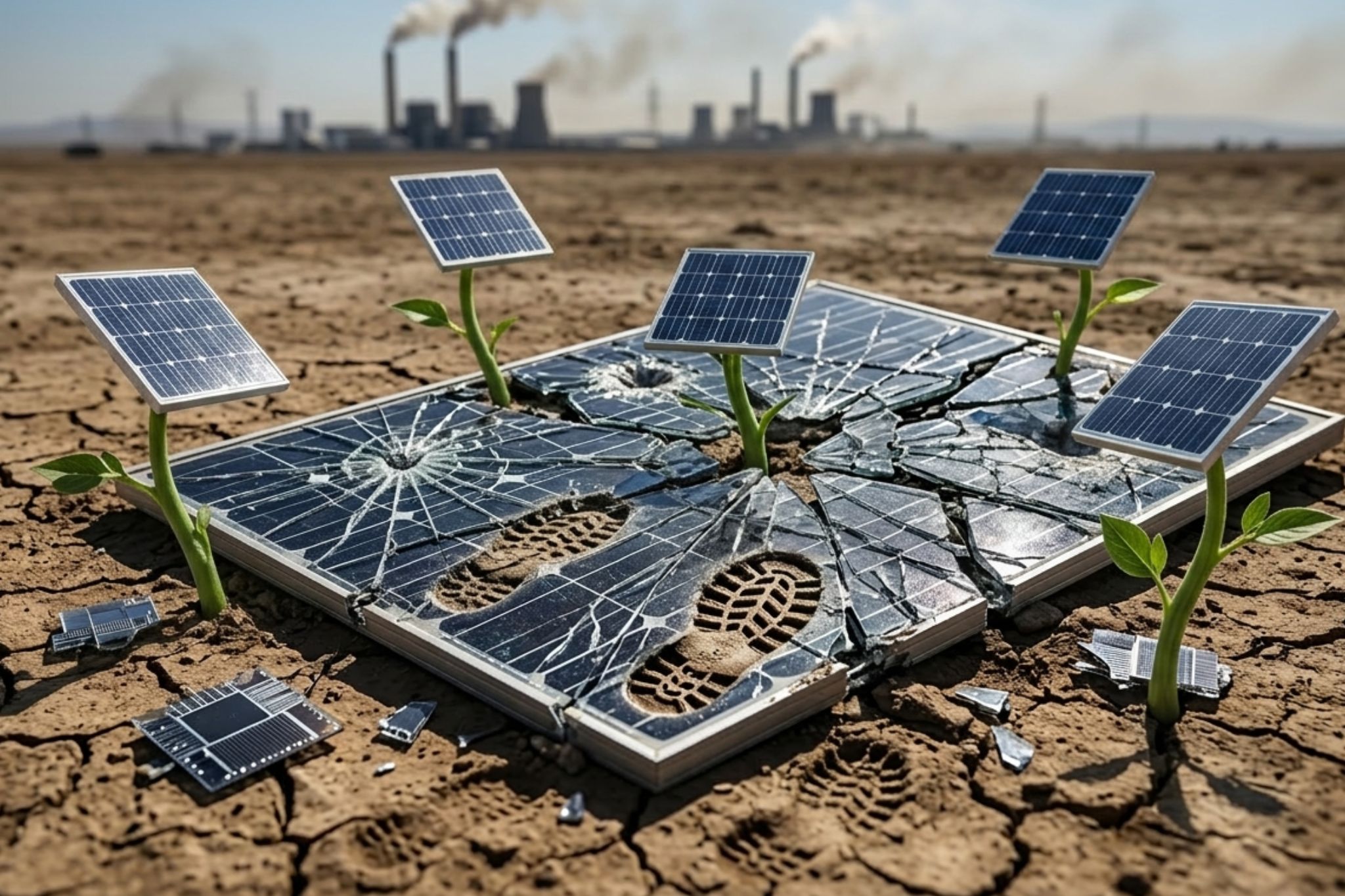

There are more ways than words in this sentence in which the Trump administration has tried to inhibit clean energy growth in the United States. The honey badger don’t care.
Despite the loss of tax incentives, the addition of last-minute tariffs, and roadblocks of all ilk set up in favor of fossil fuel interests, the U.S. solar industry installed 43 gigawatts (GW) of new capacity in 2025, remaining the primary source of new capacity added to the grid for a fifth consecutive year.
Solar and energy storage represent 79% of new capacity installed in the first year of the second Trump administration. What’s more, according to the freshly released U.S. Solar Market Insight 2025 Year in Review report, put together by the Solar Energy Industries Association (SEIA) and Wood Mackenzie (WoodMac), is that more than two-thirds of all solar capacity installed in 2025 was built in states won by President Trump. Texas, Indiana, Florida, Arizona, Ohio, Utah, and Arkansas all rank among the top-10 states for solar additions last year.
“Solar and storage continue to dominate new capacity additions to the grid despite policy headwinds. American households and businesses of all sizes are demanding solar + storage because they deliver fast, affordable power to help meet rapidly rising demand,” assessed Darren Van’t Hof, interim president and CEO of SEIA. “Washington must deliver policy certainty for the market to work and to keep pace with growing energy demands. Without this certainty, less solar will get built, and Americans will pay the price with higher energy bills.”
Texas, which is set to overtake California in 2026 as the largest energy storage market in the country, continued its dominance as the fastest-growing solar state, leading the U.S. with 11 GW of new installations. 11 states set new annual installation records in 2025, and a dozen added more than 1 GW of new solar capacity. In particular, deployment in Indiana and Utah has skyrocketed, with Indiana deploying nearly 3 GW, up from 1.6 GW in 2024.
Fast, Affordable Power to Meet Rising Demand
Despite regulatory actions targeting clean energy and changing tax policy, the economics of solar remain strong, according to SEIA and WoodMac, making the technology one of the few solutions that can quickly meet surging electricity demand driven by data center growth. The U.S. is expected to add 490 GW of new solar capacity by 2036, bringing cumulative installed capacity to nearly 770 GW.
“It’s clear that solar will continue to be the dominant source of new power capacity in the United States, even as gas generation continues to grow,” said Michelle Davis, head of solar at Wood Mackenzie and lead author of the report. “Strong demand growth combined with escalating costs of new gas plants will allow solar to remain competitive, even without tax credits.”
The report forecasts include scenarios showing how policy changes could impact the solar market. Final guidance on Foreign Entity of Concern (FEOC) provisions, the outcome of pending trade actions, and the ability to secure permits will determine how much solar capacity ultimately comes online. In particular, the residential sector is facing headwinds due to changes in tax policy in 2025.
SEIA and Woodmac predict that restrictive policy will slow solar deployment, tightening overall power supply and putting upward pressure on electricity prices. Utility-scale solar is one of the most cost-effective forms of new energy generation, they point out, and home solar and battery storage remain one of the few ways Americans can take control of their energy bills.
More in StorE?
The first year of the Trump Administration was monumental for the domestic solar and storage manufacturing industry. Solar cell production capacity continued to grow, and module manufacturing increased more than 50% with 65.5 GW of capacity online. The opening of Corning’s wafer manufacturing facility in Q3 ensured the United States now has the capacity to produce every major component of the solar supply chain.
The U.S. energy storage industry installed a record 57.6 gigawatt-hours (GWh) of new capacity in 2025, the largest single year of new battery capacity additions, per SEIA. Installations grew 30% from the previous record set in 2024, and are four times what the industry installed just three years ago. Over 600 GWh of energy storage is expected to be installed by 2030.
According to the U.S. Energy Storage Market Outlook Q1 2026 (ESMO) released by SEIA and Benchmark Mineral Intelligence, as of 2025, 137 GWh of utility-scale storage has been installed in the United States. Two-thirds of all utility-scale energy storage capacity installed last year was built in states won by President Donald Trump, including 9 of the top 15 states for new installations.
Renewables accounted for 92% of new power capacity worldwide last year, according to an analysis from the International Renewable Energy Agency (IRENA). Solar was the fastest-growing form of renewable power, amounting to 77% of new capacity globally; wind came in a distant second at 19%. China installed more renewable power than all other countries combined last year.
Source link