

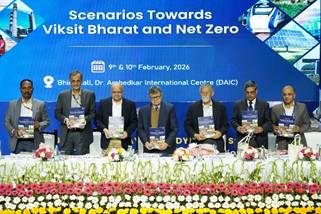

NITI Aayog has launched eleven study reports outlining scenarios for achieving Viksit Bharat 2047 while reaching Net Zero greenhouse gas emissions by 2070. The first set of three reports was released on 9th February at the Ambedkar International Centre, New Delhi.
These reports mark India’s first government-led, multi-sectoral, integrated assessment of development pathways that balance economic growth, climate commitments, and the nation’s development priorities. The study is based on a scenario-driven modelling approach, informed by ten inter-ministerial working groups, covering key domains including power, transport, industry, buildings, agriculture, financing, critical minerals, R&D, manufacturing, and social implications of the transition.
Reports Released Today Include:
- Scenarios Towards Viksit Bharat and Net Zero: An Overview (Vol. 1) – Summarises key findings and development scenarios, examining policy measures to accelerate electrification, improve energy efficiency, promote low-carbon technologies, and encourage behavioural shifts.
- Scenarios Towards Viksit Bharat and Net Zero: Macroeconomic Implications (Vol. 2) – Analyses GDP growth, investment, trade, jobs, and public finance under the assessed scenarios, highlighting both trade-offs and synergies, as well as climate-related risks to agriculture, infrastructure, and health.
- Scenarios Towards Viksit Bharat and Net Zero: Financing Needs (Vol. 9) – Projects investment requirements in power, transport, and industry, estimating a $22.7 trillion capital mobilisation by 2070 under the Net Zero scenario, including a financing gap of $6.5 trillion.
The reports were released in the presence of Sh. Suman Bery, Vice Chairperson, NITI Aayog; Dr. Arvind Virmani, Member, NITI Aayog; Sh. B.V.R. Subrahmanyam, CEO, NITI Aayog; Sh. Tanmay Kumar, Secretary, Ministry of Environment, Forest and Climate Change; and Dr. V. Anantha Nageswaran, Chief Economic Advisor to the Government of India.
The launch was followed by a panel discussion titled “Ambition to Action: Balancing Growth and Green Transition”, moderated by Dr. Nageswaran. Panelists included Dr. Kirit Parikh, Chairman, Integrated Research and Action for Development; Dr. Stéphane Hallegatte, Chief Economic Adviser, Climate, World Bank Group; and Prof. E. Somanathan, Indian Statistical Institute.
Commenting on the reports, Sh. Suman Bery said, “India’s pathways will influence the global south. The Net Zero 2070 goal guides actions beyond Viksit Bharat 2047. This detailed analysis assesses the financial, technological, and diplomatic resources needed for this journey.”
Sh. B.V.R. Subrahmanyam highlighted the strategy, stating, “Electrify energy use, green electricity, control demand through Mission LiFE, focus on circularity and efficiency, and mobilise cheaper external finance. India can leapfrog to become a global leader in clean technologies.”
Sh. Tanmay Kumar assured that India will adhere to Common but Differentiated Responsibilities while achieving Net Zero targets. Dr. Nageswaran added, “These reports provide a rigorous benchmark for policymakers and researchers charting India’s course toward Viksit Bharat and Net Zero.”
Related
Discover more from SolarQuarter
Subscribe to get the latest posts sent to your email.
Source link