

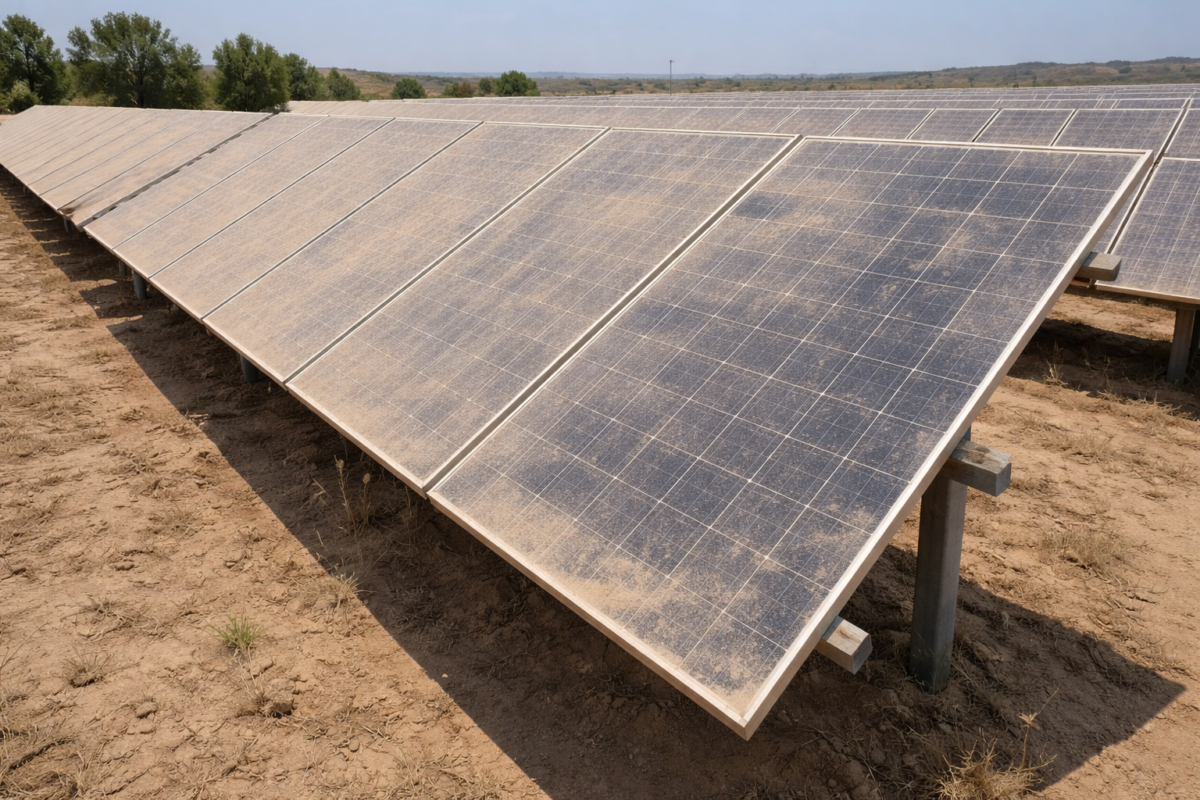
Researchers in Türkiye have developed a passive anti-soiling coating for PV panels using oleic acid–modified aluminum oxide nanoparticles applied via spray coating. Laboratory and field tests showed the coating reduced dust accumulation and initially boosted daily energy output, though performance declined under prolonged environmental stressors.
A research team from Türkiye’s Konya Technical University has unveiled a passive anti-soiling solution for solar panels. The approach relies on a thin film of aluminum oxide (Al₂O₃) nanoparticles modified with oleic acid, applied directly to the glass surface of photovoltaic modules using a simple spray-coating technique.
“The coated surfaces were characterized using scanning electron microscopy (SEM), atomic force microscopy (AFM), and X-ray diffraction (XRD) analyses, and their anti-soiling performance was evaluated under both laboratory and real-world environmental conditions,” the research team said. “This work aims to enhance sustainable and efficient energy production, particularly in arid regions where soiling presents a significant challenge.”
The team began by synthesizing their anti-soiling solutions using aluminium isopropoxide, nitric acid, acetylacetone, oleic acid, hexane, toluene, and isopropyl alcohol. Oleic acid concentrations of 0.5%, 1.5%, and 4.5% were tested, with each solution deposited onto glass substrates through spray coating. For each concentration, three spray durations were evaluated: 20, 40, and 80 seconds.
Characterization revealed that the optimal coating was achieved with a 40-second spray time and 1.5% oleic acid, producing a film thickness of 231 nm and a water contact angle of 75.47°, indicating significantly improved surface properties. In comparison, uncoated glass samples exhibited an average water contact angle of 38.04°.
After optimizing the coating, the researchers applied it to solar mini-modules in a laboratory setting. The modules featured wettability-tuned glass/ethylene vinyl acetate (EVA)/solar cell/EVA/Tedlar polyester (TPT) layers. Tests were conducted in a 1 m³ chamber with a module tilt of 32.08° and irradiance of 1,000 W/m² supplied by a halogen lamp. Environmental conditions ranged from 25–40 °C, relative humidity of 40–80%, wind speeds of 7.3–27.7 km/h, and dust loads between 0.5–5 g.
To validate performance under real-world conditions, the team installed three optimally coated mini-modules alongside two uncoated reference modules on the Konya Technical University campus. The modules, each containing a single 8 cm × 16 cm PV cell laminated with a 10 cm × 18 cm glass cover, were monitored daily between 07:00 and 18:00 from July 15 to August 12.
“Laboratory experiments demonstrated that the coated surfaces accumulated, on average, 6.9 mg/cm² less dust compared to uncoated surfaces, translating into a 0.6%–3.0% reduction in energy efficiency losses,” the researchers said.
Field tests carried out under real environmental conditions indicated that the coated panels initially achieved higher daily energy output, generating 0.5–0.8 W more power per day than the uncoated modules during certain periods. The researchers reported, however, that performance in the coated panels began to decline in early August, which they attributed to environmental stressors such as high temperatures, low wind speeds, and the presence of airborne hydrophobic pollutants.
The novel anti-soiling technology was presented in “A new anti-soiling approach based on oleic acid-modified Al₂O₃ nanocoatings for photovoltaic panels,” published in Scientific Reports. Researchers from Turkey’s Selçuk University have participated in the study.
This content is protected by copyright and may not be reused. If you want to cooperate with us and would like to reuse some of our content, please contact: editors@pv-magazine.com.
Popular content
Source link