

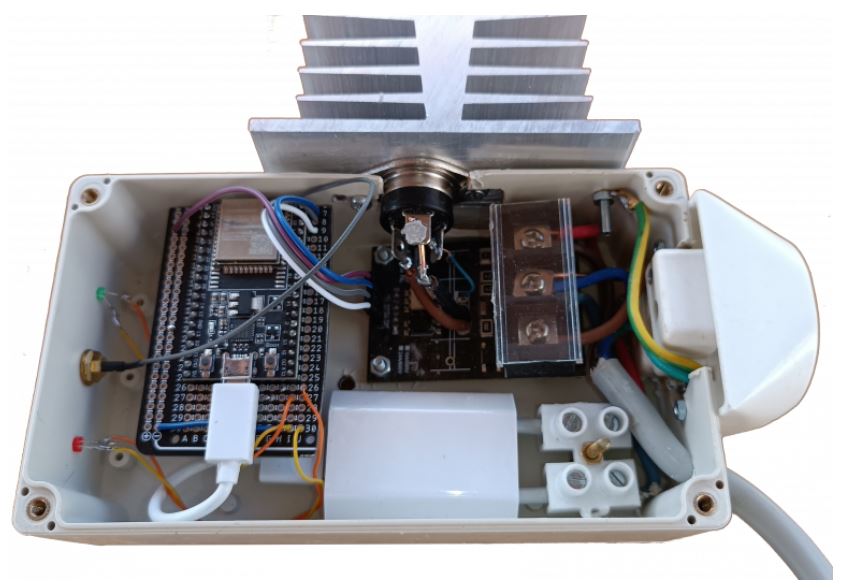

Once the measurement is complete, the data is transmitted to an ESP32 microcontroller, an inexpensive component costing around €10, which is often used in home automation. Buhart has installed a web server on this microcontroller to record historical data.
The equipment is controlled by small electrical components such as triacs or solid-state relays (SSRs), used as very fast switches. The choice of component depends directly on the power of the device to be controlled – generally between 2 and 3 kW for a water heater, but there is no specific upper limit. “It’s essential to select the right amperage and to oversize it to integrate a good cooler,” explained Buhart. For example, for a 3 kW water heater, it’s recommended to use a 60-amp SSR and adapt the power accordingly. All of these recommendations, including component selection, assembly precautions, and concrete examples, are clearly detailed on the project website.
For control, Buhart preferred to use the “multi-sine” and “sine train” approaches rather than traditional sinusoidal slicing, which tends to create interference on the network. The former involves sending only a limited number of complete sinusoids per second, for example one in five to transmit 20% power), and the latter relies on sending continuous sequences over a given period. The details are also described and available online.
Energy management
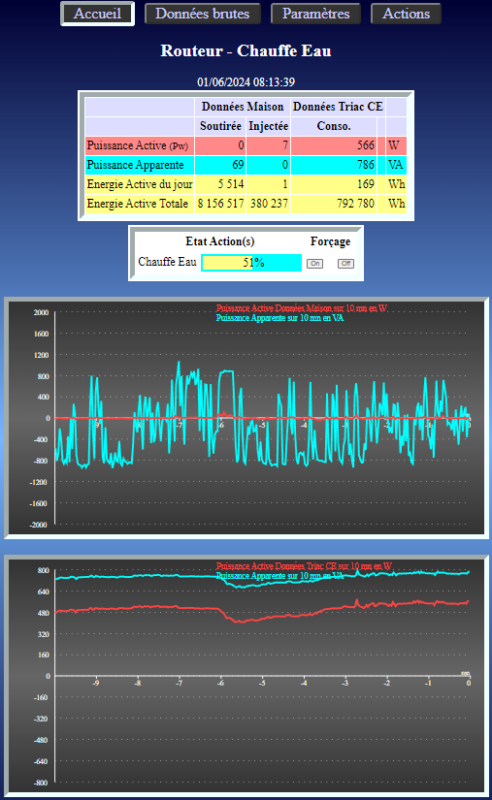
To access the data, there is no smartphone app, just a web interface accessible from a phone or computer. Key information is available in real time, including injected power, consumption, and history, among other things.
The French engineer also developed a device for live local display based on a small, 3D-printable box in the shape of a small house, which displays available power in real time. A color code allows for quick reading: red when consumption exceeds production, green when solar production is in excess.
The router’s management software can be downloaded directly from the F1ATB website, with the user connecting the router to their computer via a USB port and installing the program.
How did the idea of developing this DIY router come about? “After installing solar panels at home, I looked at the technical constraints, and, like others before me, the question quickly arose of how to improve my self-consumption,” said Buhart. “The water heater is, in itself, a super battery. The router allows it to be used during the day and not just during off-peak hours at night.” User requests and the engineer’s needs then dictated the device’s development
Going forward, Buhart said he is working on new developments and configurations for the solar router. If the device were to enter industrial production, a certification process would be required. Certification is not planned at the moment.
Source link