

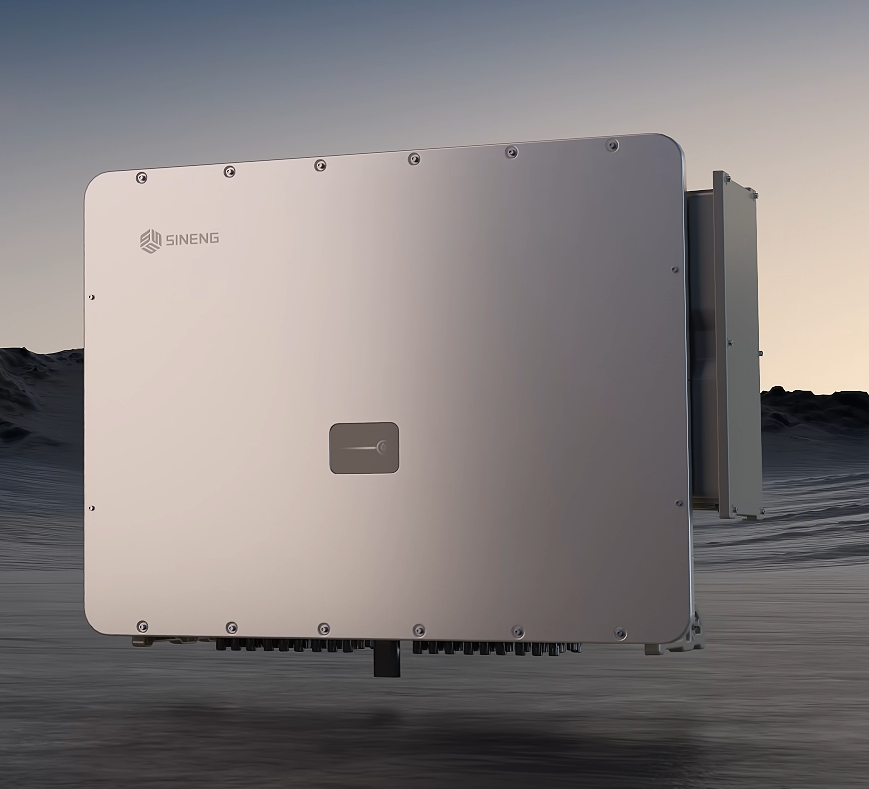
Chinese manufacturer Sineng Electric has introduced the SP-510K-H, a high-power string inverter for utility-scale solar projects.
Built for project block configurations exceeding 7 MW, the inverter measures 1,210 mm x 900 mm x 413 mm and weighs 135 kg. It supports a maximum DC input voltage of 1650 V, enabling longer string layouts—adding two to three additional modules per string—to significantly reduce mounting structure and balance-of-system (BOS) costs.
On the AC side, the inverter has a 1,000 V output rating to reduce line losses and supports aluminum cabling and power line communication (PLC) to further lower BOS costs.
The transformerless inverter offers a maximum efficiency of 99.0% and a European efficiency of 98.8%. It features six maximum power point trackers (MPPTs) supporting up to 36 strings and allows a DC/AC ratio of up to 1.8.
Sineng Electric said the SP-510K-H incorporates grid-forming capabilities for operation in weak grids with a short-circuit ratio (SCR) of 0.93 or higher. The company said the inverter supports black-start capability and wide-band oscillation suppression to improve grid restoration and stability. It also provides dynamic frequency regulation with virtual inertia adjustment from 0 seconds to 20 seconds and a reactive power response time of 10 ms.
For operations and maintenance, the inverter includes AI-based power generation forecasting, automated current-voltage (I-V) and capacitance-voltage (C-V) curve diagnostics, and MPPT-level insulation monitoring for fault detection and localization.
Safety features include AFCI 2.0 arc-fault detection, terminal temperature monitoring, millisecond-level fault isolation, and Type I+II DC surge protection.
The inverter has an IP66-rated enclosure, IP68-rated cooling fans, C5 corrosion protection, and is designed to operate at full power at altitudes of up to 4,000 m.
“MPPT-level insulation monitoring enables precise fault localization, significantly improving troubleshooting efficiency and reducing downtime. Real-time AC and DC terminal temperature monitoring provides early warning of overheating,” the manufacturer said in a statement.
Source link