

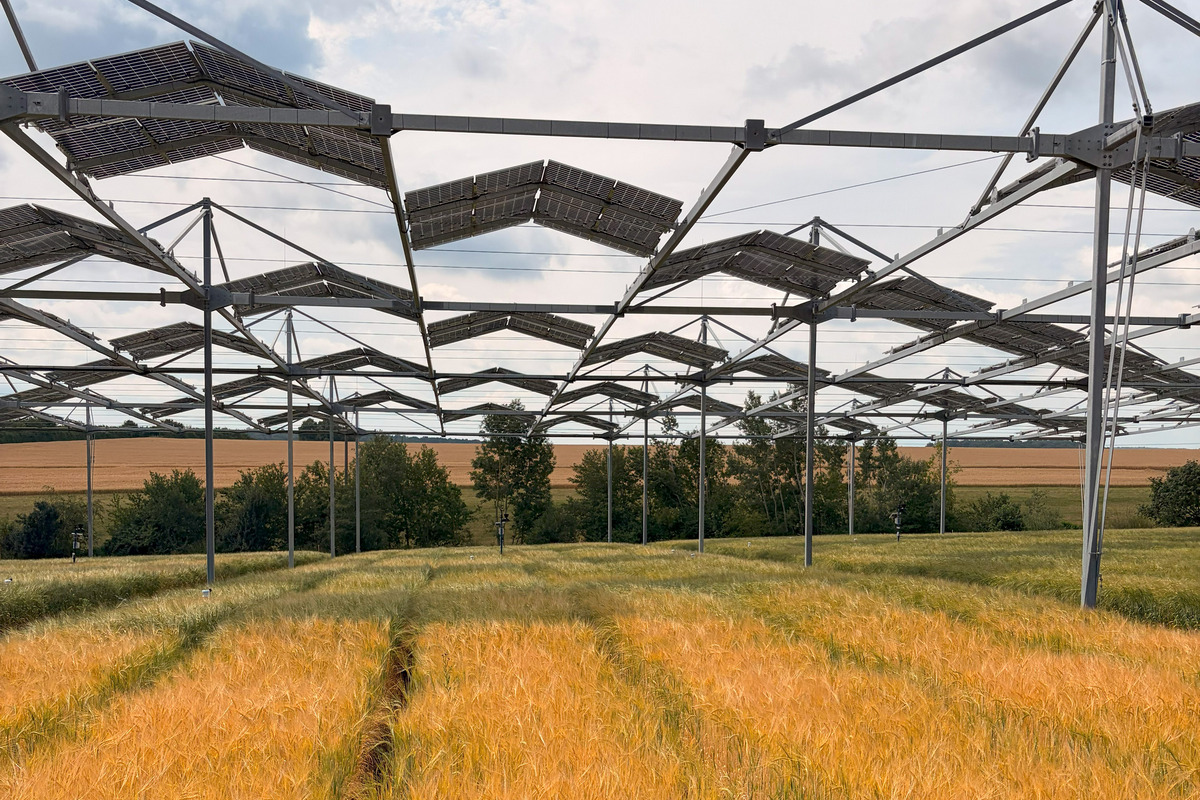
How do crops such as barley, beans, potatoes, cabbage, and maize cope when photovoltaic modules reduce the sunlight reaching them? Better than previously thought, according to a study by Germany’s University of Hohenheim and the Jülich Research Centre. The crops are able to effectively adapt their photosynthesis to altered light conditions. The same applies to agroforestry systems, where trees or shrubs grow alongside crops on the same land.
The study found that the plants’ light requirements decrease significantly under partial shade. This allows them to use CO₂ more efficiently for photosynthesis despite reduced solar radiation. The researchers aim to use this adaptability to identify and breed crop varieties suitable for agrivoltaic systems.
“Greater adaptability than previously assumed”
For the study, the research team planted crops commonly grown in Germany — barley (Hordeum vulgare), maize (Zea mays), cabbage (Brassica oleracea), potatoes (Solanum tuberosum), and field beans (Vicia faba) — at five locations across the country and installed photovoltaic modules above them. Fully sunlit reference plots served as a basis for comparison. Using a mobile photosynthesis measurement system, the researchers recorded key physiological parameters directly from the leaves.
The most significant finding was that both dark respiration and the light compensation point decreased across all the crops studied under shaded conditions. “Put simply, this means the plants lost less CO₂ through respiration while simultaneously requiring less light to fix the carbon needed for growth and fruit production,” explained lead author Jennifer Moore. This demonstrates clear physiological adaptation to partial shade.
According to co-author Andreas Schweiger, it is particularly noteworthy that the effect occurred in all the crops studied, even though they typically do not grow in shaded conditions. “They possess a significantly greater capacity for adaptation than we previously assumed,” the scientist says.
These adaptations occurred regardless of location, soil type, farming method, or shading conditions. “Arable crops do not necessarily reach their limits under moderate shading; instead, they are able to adjust their metabolic activity,” says Schweiger.
Agrivoltaics can mitigate heat and drought stress
Physiological parameters such as dark respiration and the light compensation point could be used in the future to identify more shade-tolerant varieties and select them for cultivation systems involving partial shade. “Our findings help in the more targeted planning of agroforestry and agri-photovoltaic systems,” says Schweiger. Knowing which crops can maintain productivity under specific light conditions could help better match crop varieties with land-use systems. The researchers also see new opportunities for plant breeding.
The research team believes agrivoltaic systems could play an important role in helping agriculture adapt to climate change. They can mitigate heat and drought stress by improving the microclimate, lowering soil temperatures, and helping soil retain moisture for longer periods.
“In the face of climate change, periods of extreme heat and drought are likely to limit plant growth more severely than the shade cast by agroforestry or agri-photovoltaic installations,” says plant ecologist Schweiger. Consequently, the physiological adaptability of crops could become increasingly important in the future.
At the same time, the researchers emphasize that the observed physiological adaptations do not automatically translate into higher yields. Yield data varied depending on the location and crop type, with no uniform pattern emerging. The study therefore primarily provides fundamental insights into the mechanisms by which crops respond to natural shading.
The research work was presented in “Partial shade effects of dual land use systems: Harnessing plant acclimation to drive sustainable farming solutions,” published in the European Journal of Agronomy.
Source link