

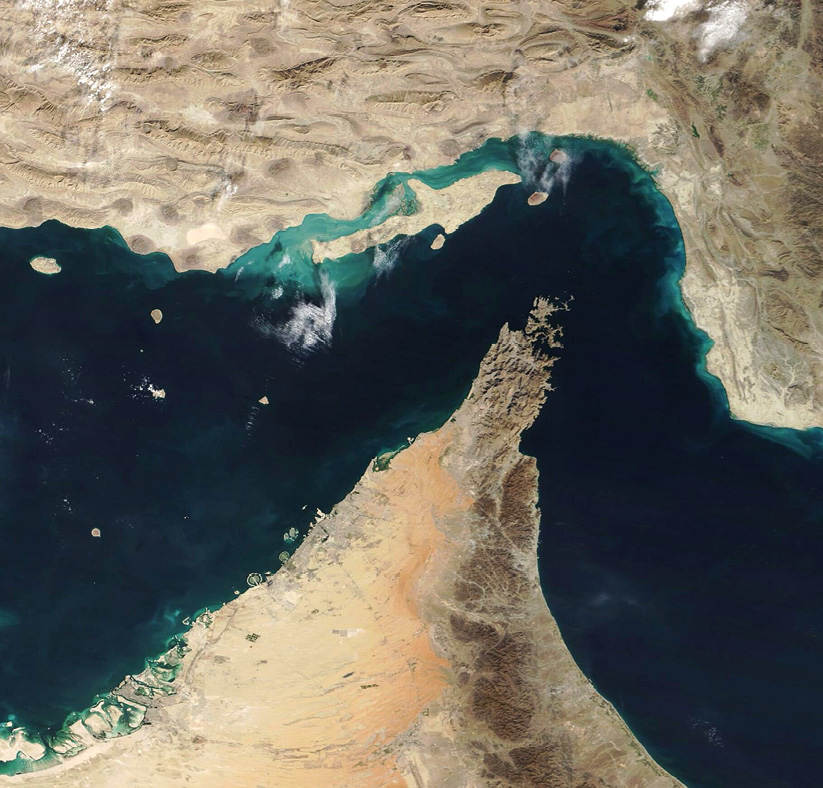
International oil and gas benchmarks have traded well above pre-crisis levels since conflict began in Iran in late February, with the sharpest reactions in European and Asian gas markets, up 40% to 60%, while Brent crude oil sits roughly 20% higher. This impact has affected power markets worldwide due to the price-setting role fossil fuels play, directly in liberalized markets and more indirectly elsewhere.
The chart below shows both the United States and Europe at multi-year highs for average first-half wholesale power prices. In Europe’s case, prices have not been higher since the 2022 gas crisis that followed Russia’s invasion of Ukraine. The US rise is more about demand, as domestic gas prices have not reacted strongly to geopolitics. The impact is far less visible in China and India, where prices have fallen steadily in US dollar terms over recent years. This is partly a currency effect, especially in India, as the rupee has weakened against the dollar, and partly because coal dominates the fossil share of both power mixes, muting the impact of higher international gas prices.

In the renewables sector, oil and gas price shocks reinforce the energy-security case for clean generation. How each country reshapes its strategy depends on where it stands on energy imports and how far it has progressed in the transition.
China, India and Europe are net energy importers, while the United States is a large net exporter. Across all four, very few new policy measures have been introduced so far. What has changed is rhetoric and signaling: the three importers lean further into the energy-security case for renewables, while in the United States, the same security framing runs toward domestic oil and gas rather than solar and wind. More important are the structural fundamentals in each market, which could translate into policy and eventually action over time.
India and China have the strongest case for reinforced renewables support, as higher solar and wind buildout directly reduces exposure to imported oil and gas. Europe sits in a similar position, but had its energy-security wake-up call in 2022 following the disruption in Russian gas flows to the continent. The United States is the counterpoint as a large net energy exporter. The immediate security-of-supply case for renewables is weaker, and current federal policy blunts the tailwinds.
We have yet to see meaningful changes in monthly solar and wind installations attributable to the conflict, and our short- to medium-term capacity-addition expectations are largely unchanged for most markets. But following the security-of-supply rationale, policy signals in that direction are likely for the markets to which this applies, namely China, India and Europe.
Gulf imports
The impact on renewables, and in particular global supply chains and trade flows, has also been measurable, particularly in the Middle East. The crisis is expected to result in a net delay of between three and 12 months across the region’s active renewable energy pipeline, while simultaneously strengthening the medium-to-long-term strategic commitment to the energy transition.
At the same time, the financial incentive for oil- and gas-exporting Gulf states like the United Arab Emirates, Saudi Arabia, Qatar, Kuwait and Iraq to adopt renewables has strengthened amid this crisis. At $89-plus Brent and $15 to $20 per million Btu liquefied natural gas, every megawatt of solar or wind deployed domestically frees up hydrocarbons for export at elevated prices. The opportunity cost of burning liquid or gaseous fuels in a domestic power station has never been higher. However, the Hormuz closure remains a significant constraint for countries reliant on the route for trade flow.
Disruption to key maritime routes is delaying solar project timelines. While other regions saw module imports surge ahead of China’s removal of the value-added tax (VAT) export rebates for PV products on April 1, the Middle East has lagged. The average monthly solar imports of Persian Gulf markets since the conflict began in March 2026 have fallen sharply from their respective 2025 averages. The UAE’s imports slid from 785 MW to 98 MW, while Saudi Arabia’s fell from 719 MW to 139 MW. Iraqi, Omani and Iranian imports also shed 105 MW, 70 MW and 47 MW, respectively.
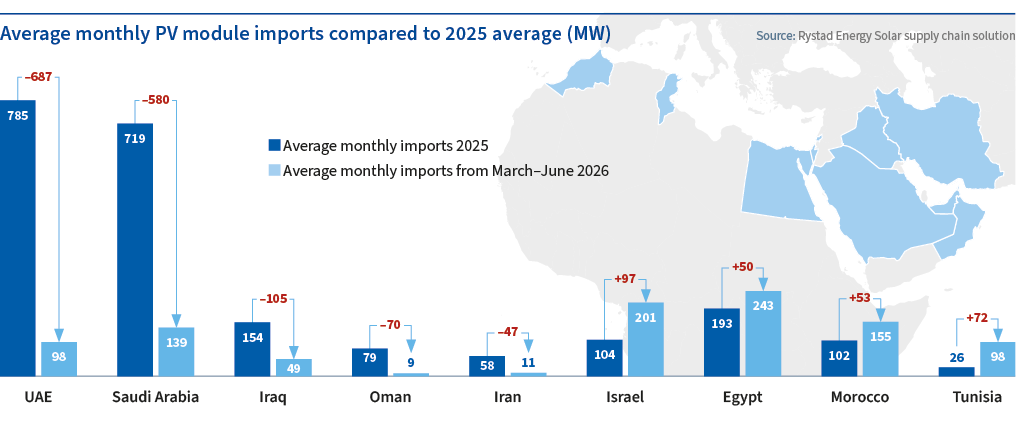
Israel and North African nations emerged as a contrast to the Gulf markets. Israel’s monthly average imports stood at 201 MW, up 97 MW from the 2025 average. In North Africa, Egypt’s average amounted to 243 MW (plus 50 MW) and Morocco’s totaled 155 MW (plus 53 MW). Tunisia’s monthly average rose to 98 MW from a 2025 average of 26 MW. This reflected the countries’ independence from routes through the Strait of Hormuz and the Red Sea.
Multiple cost pressures have also amplified the impact. Freight rates for the Asia-Mediterranean route were up 25% to 30% by early April compared to late February. China’s elimination of the VAT rebate also raised module costs by 9%. Meanwhile, elevated silver prices are pushing up cell costs, prompting original equipment manufacturers (OEM), engineering, procurement and construction (EPC) contractors, and developers to revisit signed contracts, reprice risks and consider redirecting capital toward more stable, lower-risk markets in the Middle East.
About the authors

Nishant Kumar is a senior analyst specializing in the Middle East energy market on Rystad Energy’s renewable and power research team. He has experience monitoring market trends, fostering strategic collaborations with various clients, and offering insights into the renewable and power sector.

Fabian Skarboe Rønningen is a vice president and leads the EMEA renewables and power team at Rystad Energy. He and his team are responsible for coverage of the renewables and power sector in Europe, the Middle East and Africa (EMEA), managing the renewable energy database, researching market trends, developing products, and supporting clients.
The post Strait and narrow appeared first on pv magazine Global.
Source link