
From ESS News
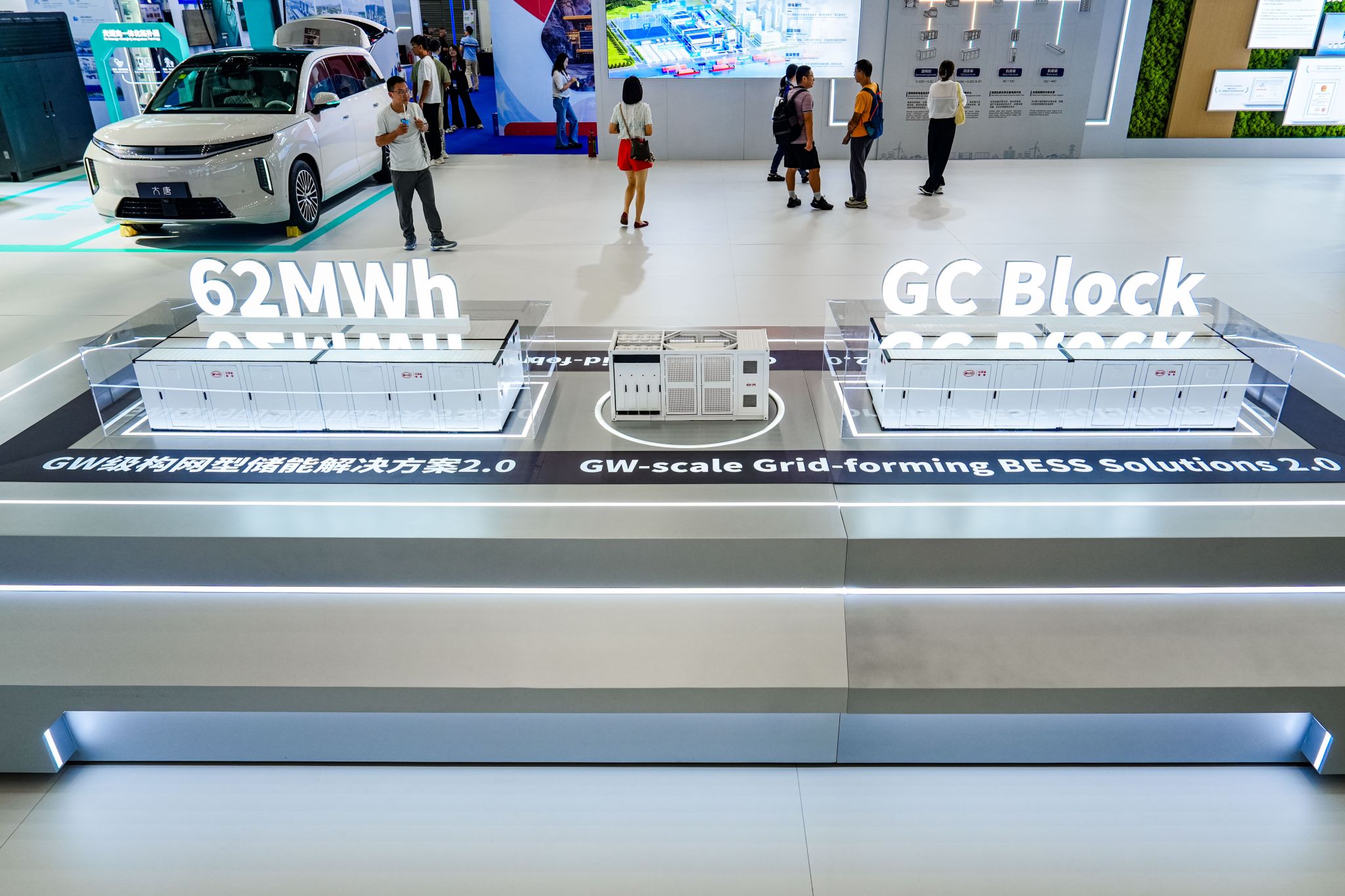
BYD Energy Storage has launched GC Block, a standardized station-level battery storage unit with configurations of up to 62 MWh, as part of its second-generation GW-scale grid-forming energy storage solution.
The company unveiled the product this week at the 2026 Energy Green Development Conference and International Digital Energy Expo in Shenzhen. It positioned GC Block as the core building block of its gigawatt-scale grid-forming energy storage solution 2.0, alongside the new GC Flux PCS 2.0 power conversion system and GC Master EMS 2.0 energy management system.
GC Block is available in three standardized configurations: 7.5 MW/15.5 MWh for roughly two-hour applications, 7.5 MW/31 MWh for four-hour projects, and 10 MW/62 MWh for six-hour storage. At the largest configuration, a 1 GWh project would require about 17 GC Blocks, according to BYD.
The system uses BYD’s 1,980 Ah energy storage Blade Battery cells manufactured using a stacking process. BYD said the architecture reduces the number of cells required in a large-scale project while simplifying cabling, foundations, battery management and maintenance. For a GW-scale plant, the company claims the design can cut battery management complexity by 69.4%, maintenance workload by more than 60%, and installation and commissioning work by more than 18%.
The company is positioning GC Block as a move beyond individual containerized storage units toward larger, repeatable power station modules. The standardized architecture is intended for utility-scale standalone storage, renewable-plus-storage projects, data center power applications, zero-carbon industrial parks, and storage supporting high-power EV charging infrastructure.
BYD also introduced GC Flux PCS 2.0, covering power ratings from 1.25 MW to 15.6 MW. A standard 20-foot PCS container can accommodate up to 10 MW, with maximum conversion efficiency of 99.5% and three-times overload capability for 10 seconds. The system supports both centralized and string-based storage architectures.
The accompanying GC Master EMS 2.0 is designed for online management of GW-scale storage fleets. BYD said the platform incorporates AI-based forecasting with 98.5% prediction accuracy and can automatically calculate and dispatch storage resources without continuous manual supervision.
One distinction is important when interpreting the headline 62 MWh figure. It does not refer to the energy capacity of a single 20-foot battery container. GC Block is what BYD calls a “station-level standard unit,” comprising a larger integrated section of a storage plant. The 62 MWh figure represents the total capacity of the largest 10 MW/62 MWh configuration. BYD has not yet publicly disclosed the exact number of battery containers, overall dimensions, or physical layout within that block.
BYD describes the 62 MWh configuration as the highest-capacity station-level standardized storage unit it has launched. The product reflects the increasing scale of utility storage projects, with system suppliers seeking to reduce engineering complexity by shifting more integration work from individual site construction toward standardized, repeatable plant modules.
Source link