

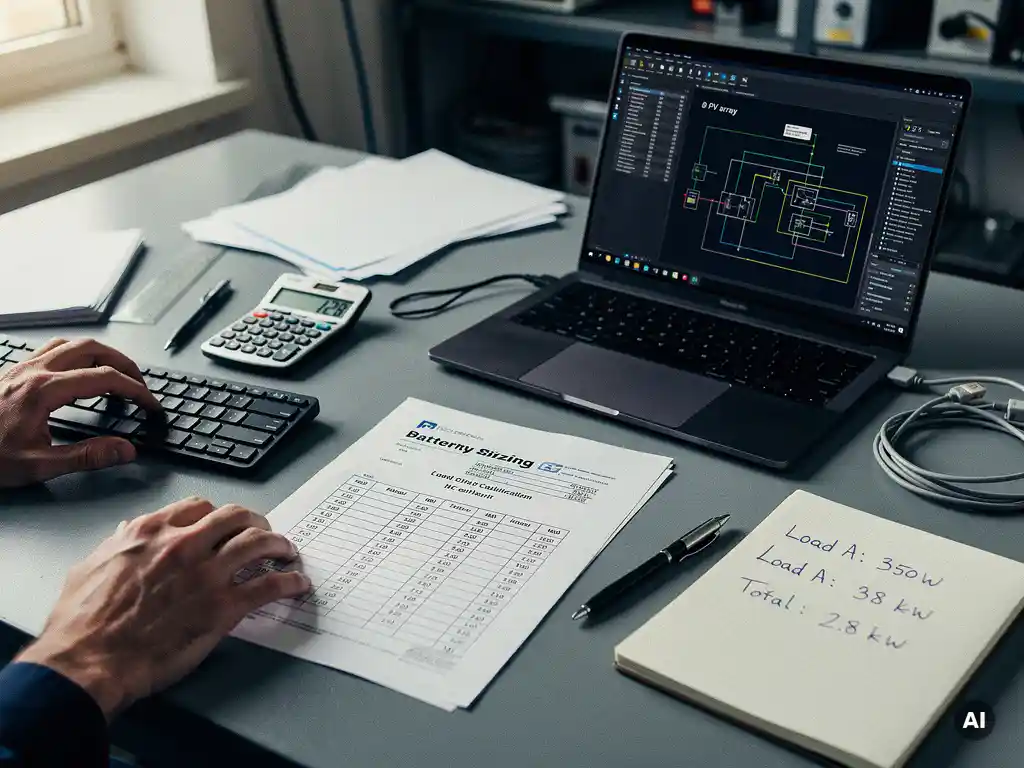
You validate battery sizing calculations before construction by cross-checking your design inputs against manufacturer specifications, running simulations with verified load profiles, and stress-testing your assumptions against best-case and worst-case operating conditions. The goal is to confirm that your chosen battery capacity can meet the system’s energy demands across its full range of operating scenarios before a single component is ordered or installed. The sections below walk through the key methods, data requirements, common errors, and decision points that make up a thorough battery sizing validation process.
What methods are used to verify battery capacity before construction?
Battery capacity is verified before construction through a combination of energy balance calculations, simulation modeling, and specification cross-checks against the battery manufacturer’s published data. The most reliable approach layers these methods together: start with a hand-calculated energy balance, run a simulation to test performance over time, and then confirm that the selected battery’s rated capacity, depth of discharge, and round-trip efficiency all support the design assumptions.
In practice, verification typically follows three parallel tracks:
- Energy balance review: Confirm that the usable capacity of the battery bank covers the required load duration at the specified depth of discharge, accounting for temperature derating and aging factors.
- Simulation modeling: Run the system through at least a full year of hourly or sub-hourly data to observe how the battery behaves across seasonal variation, peak demand periods, and low-generation days.
- Specification cross-check: Compare your design assumptions directly against the manufacturer’s datasheet: rated capacity, cycle life at the chosen depth of discharge, charge and discharge C-rates, and temperature performance curves.
Each method catches different types of errors. Energy balance calculations catch fundamental sizing mistakes. Simulations reveal performance gaps that only appear over time. Specification cross-checks catch mismatches between what the design assumes and what the product actually delivers.
What data inputs are required for accurate battery sizing validation?
Accurate battery sizing validation requires load profile data, solar generation data, battery specification sheets, and site-specific environmental conditions. Missing or estimated inputs in any of these categories introduce compounding errors that can result in a system that underperforms or fails to meet its design objectives from day one.
Load and generation data
The load profile should reflect actual or closely estimated consumption patterns, ideally at 15-minute or hourly resolution. Averaged daily load figures are not sufficient for validation because they mask peak demand events that can exceed the battery’s rated discharge rate. On the generation side, use measured irradiance data from a nearby weather station or a validated dataset rather than long-term averages alone, since year-to-year variability affects how often and how deeply the battery will be cycled.
Battery and site specifications
From the battery manufacturer, you need the rated capacity in kilowatt-hours, the maximum allowable depth of discharge, the round-trip efficiency, the charge and discharge C-rate limits, the temperature derating curve, and the cycle life at the intended depth of discharge. From the site, you need the expected ambient temperature range, since battery capacity can drop significantly in cold conditions and thermal management requirements change in hot climates. Elevation and enclosure type can also affect thermal performance and should be factored into the validation.
How do you cross-check battery sizing calculations against real-world performance specs?
You cross-check battery sizing calculations against real-world performance specs by mapping every design assumption directly to a corresponding value on the manufacturer’s datasheet or a third-party test report. If your calculation assumes 90% round-trip efficiency but the datasheet shows 88% at the operating temperature range, that gap needs to be corrected before the design is finalized.
The most important cross-checks to perform are:
- Usable capacity vs. rated capacity: Confirm that your design uses usable capacity (rated capacity multiplied by the allowable depth of discharge), not the full rated figure.
- C-rate compatibility: Verify that your peak charge and discharge rates do not exceed the battery’s rated C-rate limits, which can cause premature degradation or protection trips.
- Temperature derating: Apply the manufacturer’s temperature derating factor for the expected minimum and maximum site temperatures. A battery rated at 100 kWh at 25°C may deliver significantly less in cold climates.
- Cycle life at design depth of discharge: Check the manufacturer’s cycle life curve at your intended depth of discharge. Cycling a battery deeper than the design assumes will shorten its operational life and may invalidate warranty terms.
- State of health over time: Account for capacity fade. Most lithium battery systems lose a percentage of their capacity over their warranted cycle life, and your design should still meet performance requirements at end-of-life capacity, not just on day one.
What are the most common battery sizing errors found during validation?
The most common battery sizing errors found during validation are using rated capacity instead of usable capacity, ignoring temperature derating, underestimating peak load demand, and failing to account for battery aging over the system’s design life. These errors are individually significant and collectively capable of producing a system that falls well short of its intended performance.
Using rated capacity as if it were fully available is perhaps the most frequent mistake. Every battery has a maximum depth of discharge beyond which cycling causes accelerated degradation, and that limit must be built into the sizing calculation from the start. A 100 kWh battery with an 80% depth of discharge limit provides 80 kWh of usable energy, not 100 kWh.
Underestimating peak load is another common failure point. Sizing based on average daily consumption without examining peak demand intervals can result in a battery that meets energy targets on paper but cannot deliver the required power during high-demand periods. This is particularly relevant in commercial and industrial applications where demand spikes are frequent and significant.
Finally, many designs are validated against day-one performance without modeling end-of-life conditions. If a battery is expected to retain 80% of its original capacity after its warranted cycle life, the system must still meet its performance requirements at that reduced capacity. Designs that only validate against new battery performance will underperform in the later years of the project.
Should battery sizing validation be done in simulation software or spreadsheets?
Battery sizing validation should be done in simulation software for any project where accuracy and time-series performance matter, which includes most commercial and utility-scale installations. Spreadsheets are useful for quick sanity checks and first-pass sizing estimates, but they cannot replicate the hourly or sub-hourly dynamics that determine whether a battery system will actually perform as designed across a full year of operation.
Spreadsheets work well for static energy balance calculations: confirming that total usable capacity covers the required load duration, checking C-rate limits, and applying derating factors. These are necessary steps, but they are not sufficient on their own. A spreadsheet cannot model how the battery state of charge evolves hour by hour across seasonal variation, nor can it capture the interaction between solar generation intermittency and load demand patterns.
Simulation software handles these dynamics by running the system through time-series data, revealing performance gaps that only appear under specific conditions, such as a sequence of cloudy days following a period of high demand. For engineers working on PV-plus-storage projects, tools that integrate solar generation modeling with battery dispatch logic provide the most complete picture of system behavior before construction begins. Virto Solar’s design tools are built around exactly this kind of integrated workflow, helping engineering teams move from concept to validated design without switching between disconnected tools.
The practical recommendation is to use both: spreadsheets for initial sizing and quick cross-checks, simulation software for full validation before the design is locked and equipment is procured.
When should battery sizing calculations be revalidated during the project lifecycle?
Battery sizing calculations should be revalidated whenever a significant project input changes, including load profile revisions, changes to the selected battery product, updates to the solar generation assumptions, or shifts in the project’s operational requirements. Treating battery sizing as a one-time calculation that is fixed at the conceptual design stage is one of the more reliable ways to arrive at commissioning with a system that does not meet its performance targets.
The key revalidation trigger points in a typical project lifecycle are:
- After detailed load analysis: Early-stage sizing is often based on estimated load profiles. Once actual consumption data or a detailed load study is available, the battery sizing should be revisited against the more accurate figures.
- When the battery product changes: If the originally specified battery is substituted with a different product, even one with a similar rated capacity, the specifications may differ enough to affect the design. Depth of discharge limits, C-rates, and efficiency figures all need to be re-checked against the new product’s datasheet.
- After design revisions to the PV array: Changes to the solar array size, orientation, or shading conditions affect the generation profile that charges the battery. A significantly different generation curve can change how the battery is cycled and whether the original sizing still holds.
- Before procurement is finalized: A final validation pass before equipment is ordered is a low-cost checkpoint that can prevent expensive corrections during installation or commissioning.
- At design review milestones: For larger projects, formal design review stages are natural points to revalidate all major calculations, including battery sizing, against the most current project data.
If your team is managing multiple projects simultaneously, maintaining a structured revalidation process becomes especially important. Errors that slip through on one project have a way of repeating across others when the same spreadsheet templates or assumptions are reused without review. If you want to explore how automated design tools can help enforce consistent validation across your project portfolio, get in touch with our team to discuss your specific workflow.
Frequently Asked Questions
How do I know if my load profile data is detailed enough to support a reliable battery sizing validation?
Your load profile data is sufficient when it captures demand at 15-minute or hourly resolution across a representative period — ideally 12 months — and includes seasonal peaks, weekday-versus-weekend variation, and any known demand spikes. If you only have monthly utility bills or averaged daily consumption figures, treat your validation results as preliminary estimates rather than confirmed sizing. In that case, build in a conservative capacity buffer and plan to revalidate once higher-resolution data becomes available, such as after installing a temporary data logger on the site.
What is a reasonable capacity buffer to add on top of the calculated battery size to account for uncertainty?
A commonly applied buffer ranges from 10% to 20% above the calculated usable capacity requirement, depending on how confident you are in your load and generation inputs. Projects with well-characterized load profiles and measured irradiance data can sit at the lower end of that range, while projects relying on estimated or averaged inputs should lean toward the higher end. The buffer should be treated as a design margin for input uncertainty, not as a substitute for proper end-of-life capacity modeling — those two adjustments need to be applied separately.
Can I use the same validation approach for lithium iron phosphate (LFP) and other lithium chemistries, or does the process differ?
The validation framework is the same across chemistries, but the specific parameter values you apply will differ significantly. LFP batteries typically support deeper depth of discharge and have flatter discharge curves compared to NMC or NCA chemistries, which affects usable capacity calculations and state-of-charge estimation. Temperature derating curves also vary by chemistry — LFP tends to perform better in cold conditions than NMC. Always pull the derating factors, cycle life curves, and efficiency figures directly from the datasheet for the specific chemistry and product you are specifying, rather than applying generic lithium battery assumptions.
What should I do if my simulation results and my spreadsheet energy balance calculations disagree significantly?
Treat the disagreement as a signal to audit your inputs rather than defaulting to one result over the other. The most common causes of significant discrepancy are mismatched efficiency assumptions, differences in how depth of discharge is applied, or the simulation capturing peak demand events that the static energy balance averages out. Work through each input systematically — load profile resolution, round-trip efficiency, usable capacity, and derating factors — and confirm they are consistent between both tools. Once the inputs are aligned, the simulation result is generally the more reliable figure because it captures time-series dynamics that a static calculation cannot.
How does battery degradation affect long-term system performance, and how should I model it during validation?
Battery degradation reduces usable capacity over time, typically expressed as a percentage of original capacity retained at the end of the warranted cycle life — for example, 80% capacity retention after 6,000 cycles. To model this correctly during validation, run your performance checks against both day-one capacity and end-of-life capacity, and confirm that the system still meets its minimum performance requirements at the degraded state. If the system only passes validation at full initial capacity, you will have a performance shortfall in the later years of the project that was entirely predictable and preventable at the design stage.
Are there specific red flags in a manufacturer’s datasheet that should prompt extra scrutiny during a specification cross-check?
Yes — watch for cycle life figures that are only specified at shallow depths of discharge (such as 50% DoD) when your design intends to cycle deeper, capacity ratings tested at temperatures that do not reflect your site conditions, and round-trip efficiency values that do not specify the C-rate at which they were measured. Also be cautious when warranty terms reference cycle counts without specifying the depth of discharge or temperature conditions under which those cycles were tested. Any datasheet that lacks temperature derating curves or C-rate performance data should be followed up with the manufacturer directly before the product is incorporated into a validated design.
At what project scale does it become necessary to move beyond spreadsheet validation and invest in dedicated simulation software?
As a practical threshold, any project above roughly 50 kWh of battery storage that involves variable solar generation, time-of-use tariff optimization, or backup power requirements warrants dedicated simulation software. Below that scale, a well-structured spreadsheet with conservative derating assumptions may be sufficient for straightforward off-grid or simple self-consumption applications. For commercial, industrial, and utility-scale projects — where performance shortfalls translate directly into revenue loss, contract penalties, or failed grid interconnection requirements — time-series simulation is not optional. The cost of the software is negligible compared to the cost of a mis-sized system discovered at commissioning.
Related Articles
This content was generated with the help of AI — it may contain mistakes
Source link