
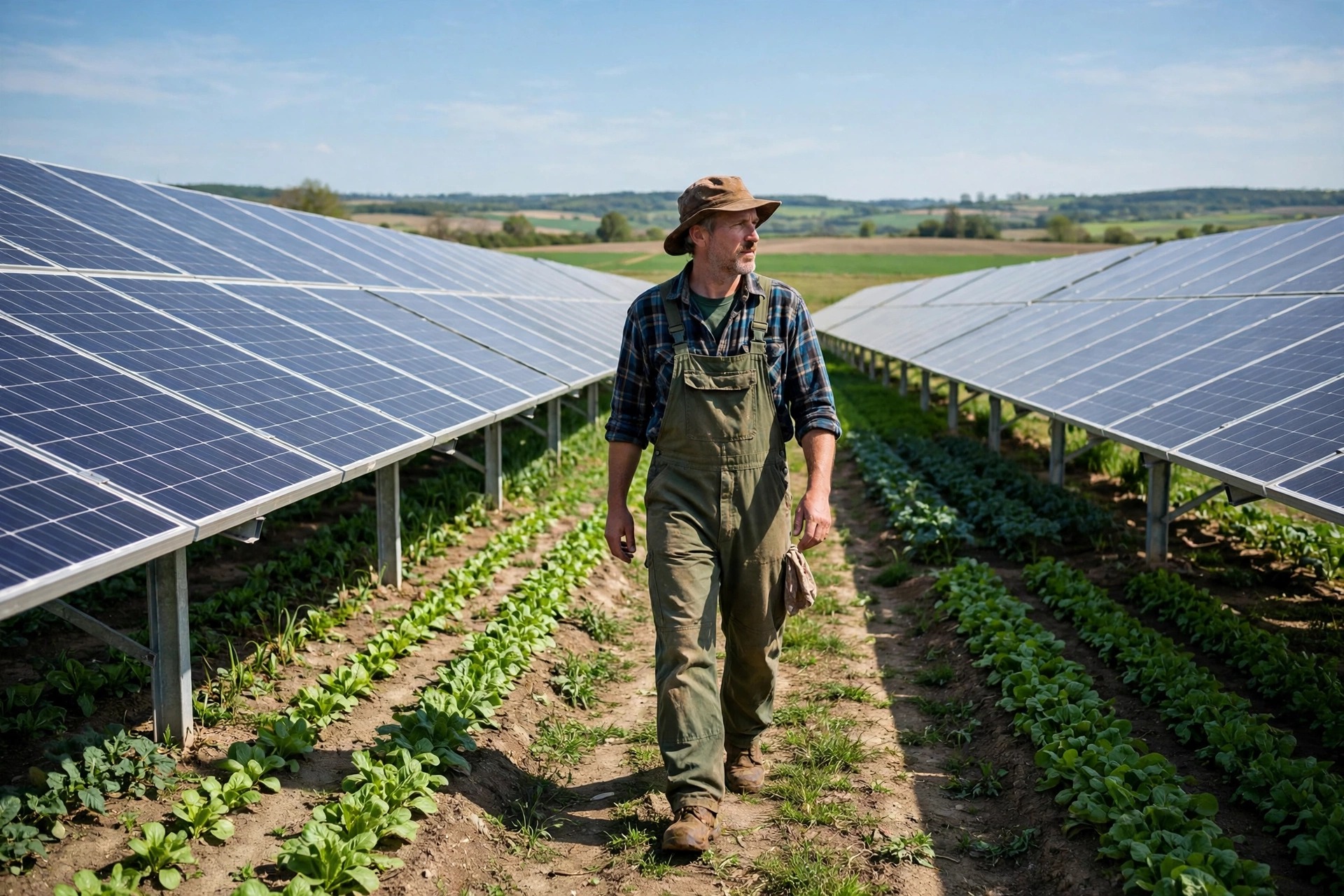
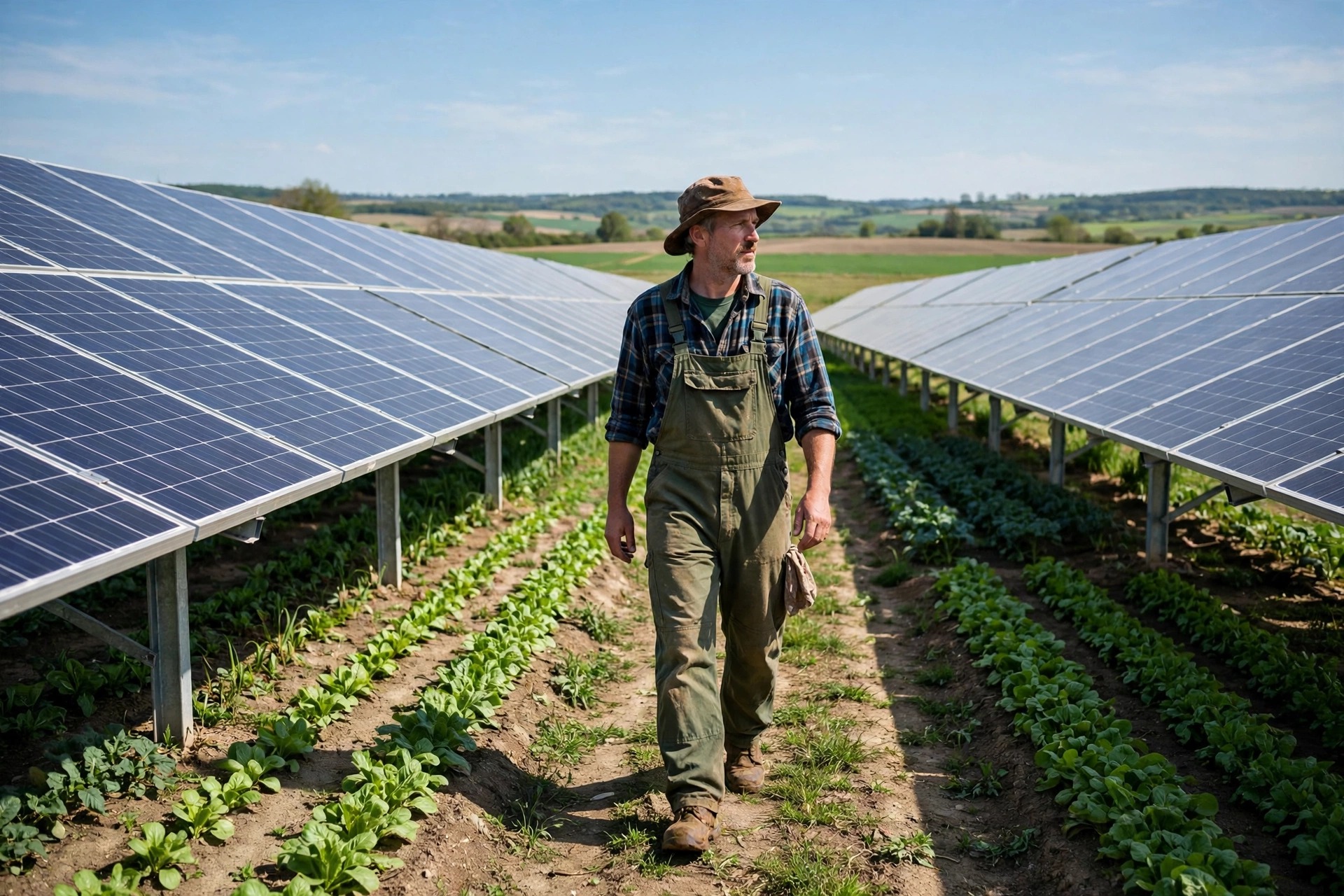
One acre of land, two harvests. That is the whole idea behind agriovoltaics — solar panels and farming on the same ground, at the same time. The panels make electricity above, and underneath them, in the rows between them, crops grow or sheep graze. The panels get a little less sun than they would on an empty field, and the crops get a little less sun than they would in an open field. But in the right place, with the right crops, both sides come out ahead — and that is why this is one of the most interesting things happening in solar right now.
This guide explains it in plain English: what agriovoltaics is, why the shade helps some crops instead of hurting them, where it is already working, and where it does not work. If you own farmland and want to know whether solar makes sense on it, get a solar quote — an installer can tell you whether your site, your soil, and your utility’s rules add up.
What agriovoltaics actually is
The U.S. Department of Energy defines agrivoltaics as a dual-use solar system: agricultural production underneath and/or between rows of solar panels. In practice it takes three main forms: crops grown under raised panels, often on trackers that tilt through the day; livestock — almost always sheep — grazing the grass between and beneath the rows; and native grasses and pollinator-friendly wildflowers planted under the panels, which feed bees and rebuild soil instead of being mowed or gravelled over.
The panels are not ordinary solar-farm panels. They sit higher — often six to eight feet up — and are spaced wider apart, so light still reaches the ground and farm workers can move underneath. That extra height and spacing costs more to build than a standard ground-mounted array, which is the first honest trade-off: an agrivoltaic system is more expensive per watt than a plain solar farm, and it only pays if the farming side earns its keep.
It is still a small niche. As of 2024, agrivoltaics accounted for less than 5% of the country’s solar power, according to reporting on National Renewable Energy Laboratory (NREL) figures. The Department of Energy’s InSPIRE research program has studied co-location at more than 25 sites across the United States. Just over a quarter of the country’s agrivoltaic sites combine solar with sheep grazing; fewer than 5% grow crops under the panels, according to the U.S. Department of Agriculture’s Economic Research Service. The grazing side is proven at scale. The cropping side is proven in trials and on a handful of working farms, and is still being figured out.
Why shade helps some crops instead of hurting them
The surprise at the heart of agrivoltaics is that partial shade can be good for plants — in hot, dry places, at least. A plant in full desert sun loses water fast, overheats, and drops its flowers. Under a panel, the air is cooler, the soil stays moister, and the plant loses less water to the air.
The clearest American evidence comes from the University of Arizona’s Biosphere 2 research site outside Tucson, where researchers led by Greg Barron-Gafford grew vegetables in full sun and under solar panels side by side, and published the results in Nature Sustainability in 2019. Cherry tomatoes grown under the panels produced about twice as much fruit as the same plants in open sun. Chiltepin peppers produced about three times as much. Jalapeño peppers produced a similar harvest while losing about 65% less water through their leaves. The soil under the panels stayed roughly 15% moister when the plots were watered every other day. These are trial results from one hot, dry site — not a promise for every farm — but they are the reason agrivoltaics gets taken seriously in the arid Southwest, where water is expensive and heat is the enemy. The panels get something back, too: they lose efficiency as they heat up, and the shade and moisture from the plants underneath can cool them, increasing their output, according to NREL.
The sheep are the quiet success story
If crop agrivoltaics is still proving itself, sheep grazing under solar panels is already a working business. Sheep are the right animal for the job: they are short enough to walk under the panels, they do not climb on equipment or chew on wires the way goats do, and they eat the grass that would otherwise have to be mowed. The sheep get shade, shelter, and grass that grows better in the partial shade. The solar operator gets vegetation management without diesel mowers.
The scale is now serious. The American Solar Grazing Association counts at least 113,050 sheep grazing about 129,000 acres of solar sites across the United States. Enel North America, which began with a small grazing pilot at its Aurora solar farm in Minnesota in 2017, announced in July 2025 what it calls the largest solar grazing agreement in the country: more than 13,000 sheep working across eight solar facilities covering 12,600 acres in Texas. Near Dunlap, Illinois, about 75 sheep graze a 7.1-megawatt community solar farm on 35 acres of former corn and soybean fields, producing enough electricity for about 1,200 homes.
What grows well — and what does not
The crops that do best under panels are the ones that suffer most in full sun and heat. Peppers and tomatoes lead the list, on the Arizona evidence. Berries, herbs, and leafy greens do well under light shade, and root crops like potatoes and celeriac have held up in the German trials.
What does not work is just as important. Full-sun row crops that need open fields and big machines — corn and soybeans above all — lose too much light under panels to make sense, and NREL is blunt that agrivoltaics probably will not be feasible for large-scale, single-crop farms that rely on heavy machinery. The panels, their posts, and the wiring get in the way of combines and sprayers, and the economics of commodity grain depend on scale that a panel field cannot give. Leafy greens are mixed, too: lettuce trials have found anything from yield losses under heavy shade to modest gains under lighter shade, so panel height and spacing matter as much as crop choice.
There are other honest complications. NREL’s recent analysis of its InSPIRE sites found that co-location can also lead to crop or financial losses — extra moisture under the panels can encourage mould and attract rodents, which can damage crops and chew through wiring, and construction equipment can compact the soil. “We know we can grow food under solar projects,” the study’s lead author, Jordan Macknick, said. “What remains to be seen is if we can scale up agrivoltaics in a way that meaningfully improves local food production and farmers’ bottom lines.” That is the right framing: this is real, and it is not yet routine.
A real farm doing it: Jack’s Solar Garden, Colorado
The best-known American example is Jack’s Solar Garden, a 24-acre family farm in Longmont, Colorado. Its owner, Byron Kominek, built a 1.2-megawatt community solar array — 3,276 panels mounted six to eight feet high on single-axis trackers — and kept farming underneath it, after the hay and alfalfa the farm had grown no longer paid the bills.
The array powers about 300 homes through Xcel Energy’s community solar program, with more than 50 residential subscribers, five businesses, and the city and county among them. In its first growing season, 2021, the farm produced more than 8,600 pounds of organic vegetables from beneath the panels, grown by the nonprofit Sprout City Farms. Around the array, more than 3,000 native trees, shrubs, and pollinator plants were planted with Audubon Rockies. It is also a research site for NREL, Colorado State University, and the University of Arizona. One farm, carefully run, does not prove the model everywhere — but it proves the model is not a theory.
What it is not
Three things agrivoltaics is not. First, it is not a rooftop substitute for homeowners. This is farm-scale and community-scale solar, on open land, with a grid connection — a homeowner’s question is still the rooftop one.
Second, it is not available everywhere or suitable for every farm. It needs the right land, enough water, a utility willing to interconnect the system, and local zoning and land-use rules that allow solar on farmland — rules that vary widely and, in some counties, forbid it outright. Check your electric utility’s interconnection rules and your county’s land-use rules before you get far into planning.
Third, it is not a free lunch. Raised panels and wider spacing cost more than a standard solar farm, the farming side needs real management, and the income depends on the lease or power-purchase terms, the crop, and the weather. The 30% federal Residential Clean Energy Credit (Section 25D) does not apply to expenditures after December 31, 2025, so a system bought in 2026 gets no 25D credit — and there is no single federal incentive for agrivoltaics to plan around. Incentives vary by state and utility, so check the solar rebates and incentives directory for your area, and confirm any program figure with the program itself. A battery can also change the farm math — storing midday solar to run irrigation pumps or cold storage in the evening — so start with our guide to sizing a battery for the loads you actually need before you price one in.
Checklist
- Check whether your county’s land-use and zoning rules allow solar on farmland — some do not.
- Confirm your utility will interconnect a ground-mounted system at your site, and what that will cost.
- Match the crop to the shade: heat-stressed vegetables, berries, herbs, and leafy greens first; commodity row crops last.
- If grazing, plan for sheep — not goats or cattle — with fencing, water, and predator protection.
- Price the raised, wider-spaced array against a standard solar farm; the farming side has to earn the extra cost.
- Get the lease or power-purchase terms in writing: length, payment, who maintains what, and what happens to the land at the end.
- Plan for the downsides: extra moisture, mould, rodents, and soil compaction during construction.
- Ask what happens to the soil and the land when the panels come out — a solar array is a 25-year-plus commitment.
- Talk to your local extension service and to a farmer already doing it before you sign anything.
Bottom line: Agrivoltaics is the rare solar idea that is genuinely better than the sum of its parts — in the right place. Shade-tolerant crops grow better and use less water under panels, sheep keep the grass down and earn their keep, the panels run a little cooler, and the farmer gets a second income from the same acre. It will not save every farm, and the crop side is still young. But on the farms where it fits, one acre really can produce two harvests.
This is general information, not agricultural or financial advice. Agrivoltaics depends on your land, climate, crops, utility, and local rules — talk to your extension service and get competing proposals in writing before you decide.
Source link