

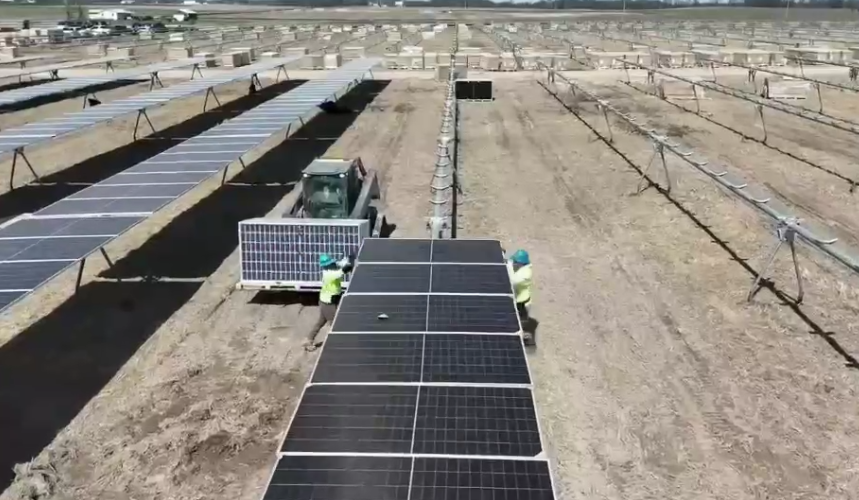
Effective scheduling of materials, workers and equipment can have a major impact on utility-scale solar building costs.
Schedule predictability has become one of the industry’s most valuable commodities. What keeps builders up at night is timing, whether the project will connect when the interconnection agreement says it will, and whether everything between groundbreaking and commercial operation will stay within its schedule.
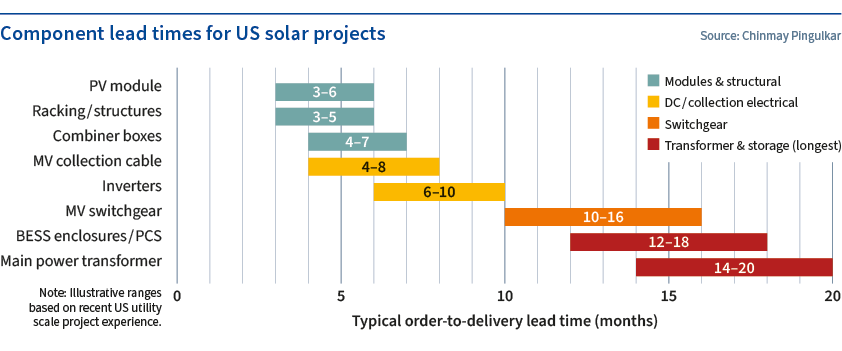
Shortages of items such as main power transformers, medium-voltage switchgear, collection system materials, storage enclosures, and their controls are impacting timelines.
There are projects where the modules were staged and ready months before the equipment needed to generate and distribute power showed up. On a project in California’s Central Valley, the main power transformer landed roughly 12 weeks behind its original promised date. The modules were already staged and the DC field was tracking ahead.
Rather than let the whole site stall, the team re-sequenced, pushing hard on the DC blocks, collection system, and inverter pads that didn’t depend on the transformer, and holding the connection-related work until the gear arrived. It kept the crews productive, but it also meant compressing commissioning into a much tighter window than anyone wanted once the transformer finally showed up. When that happens, you lose entire weeks at the worst possible time, right when commissioning and interconnection are supposed to start, and there’s no float left to absorb it.
The teams handling this well aren’t doing anything magic. They are procuring the long-lead electrical equipment absurdly early, often before the design is fully locked. They’re managing those orders like critical-path activities, with real dates and real follow-up, not line items buried in a procurement log. They are also building the schedule backward from connection, not forward from the notice to proceed. It sounds obvious. Most schedules still don’t do it.
Domestic content
Domestic content has changed math and paperwork for the US market. The Inflation Reduction Act’s domestic content bonus put real money on the table, and that changed procurement behavior almost overnight. But chasing that adder isn’t just a purchasing decision you make once.
To claim the bonus, you need traceability, cost breakdowns and manufacturer certifications that stand up to scrutiny, sometimes months after the material is installed. If the tracking isn’t set up before the first delivery, you are reconstructing it after the fact, which is sometimes impossible. Projects getting this right are treating domestic content as an early design-and-procurement workstream, with someone accountable for the paper trail, instead of as a box to check at the end.
Interconnection has become the item most likely to blow up a connection date, and a lot of it – like utility study timelines, upgrade requirements, witness testing availability, and protection and relay coordination – is outside the EPC’s direct control.
What is in our control is readiness. Teams that energize on time treat the utility relationship as a real part of the project from day one, not a formality at the end. They understand the testing and documentation the utility will require and when the interconnection window opens, they are ready instead of scrambling to schedule tests and chase paperwork.
Some scheduling issues can arise from constraints that aren’t even in the EPC’s scope. On one project, the overhead medium-voltage tie into the substation was carried by a separate subcontractor outside the EPC’s contract. When that work slipped, it held up backfeed, and because backfeed is the gate that everything downstream runs through, every commissioning activity behind it was dragged back along with it.
Onsite, lean management practices can be useful to make schedules more predictable. Instead of receiving a baseline schedule from the corporate office, superintendents, foremen and craft workers should get together to plan the work. They should look at the next few weeks and identify obstacles that could stop the work before those things become challenges.
Obstacles such as a submission that hasn’t come back, a delivery that’s slipping, an inspection nobody scheduled, or an area that isn’t released yet should be identified and assigned an owner who can clear it up by a pre-determined date. Because the energization date is fixed by the interconnection agreement, the teams that can hit this target have planned backward from that milestone, pulling each preceding activity to a real need-by date rather than forward from NTP.
On a project running thousands of repeatable pier-to-panel cycles, keeping the crews in continuous, unobstructed flow is worth far more than any single productivity trick. For example, the civil team has to finish the site access roads before the racking, DC wire, combiner boxes, and piles arrive. Those roads are what enable material to be stored out at the arrays where it’s needed. Without the access roads, everything gets staged somewhere else and moved again later, which leads to double handling, added cost and avoidable rework.
The teams that do this well treat closeout as a continuous process alongside the physical work, so that when mechanical completion arrives, the documentation is already prepared. Nothing to reconstruct, nothing to chase down. It is an easy thing to deprioritize when you are heads-down building, because the pain doesn’t show up until the very end. But that’s exactly why it matters. By the time closeout problems surface, the interconnection clock is running and there’s no schedule left to absorb them.
A little discipline early on and capturing the paperwork as the work happens are what keep those final weeks from turning into a scramble. On these projects, a clean, well-documented turnover isn’t housekeeping, it’s a critical part of hitting the date.
Projects that consistently meet their energization dates aren’t necessarily those with the fastest crews. They are the ones that integrate procurement, engineering, construction, commissioning, and documentation into a single, disciplined execution strategy.

Chinmay Pingulkar is project manager II with Mortenson Construction, where he oversees the execution of utility-scale solar and BESS projects across the United States. His experience spans field engineering, project controls, and project management, with a focus on delivering large-scale renewable energy projects safely, efficiently, and profitably.
The post Adapt to deliver appeared first on pv magazine Global.
Source link