

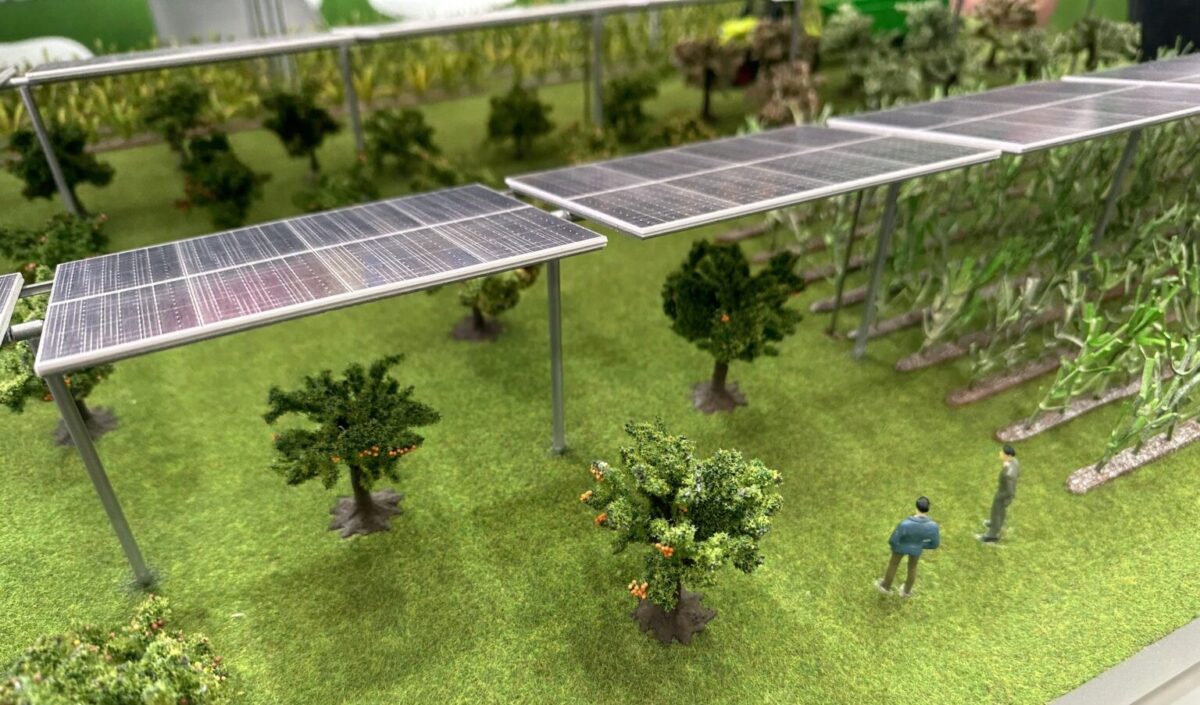
Scientists have conducted a six-sphere literature analysis of agrivoltaics, considering sustainability, soil–crop productivity, socioeconomic resilience, solar power generation, spatial efficiency, and species. They found that, under optimal terms, agrivoltaics may generate over $1 trillion in added global agricultural income.
Researchers at Western University in Canada have conducted a multidimensional study of agrivoltaics and have concluded that this form of energy production could help add over 1,800 million tonnes to global crop yields annually.
“This research looked at agrivoltaics studies between 2018-2024 and synthesized them across six interconnected spheres (6S) of impact: sustainability, soil–crop productivity, socioeconomic resilience, solar power generation, spatial efficiency, and species,” corresponding author Uzair Jamil told pv magazine. “It showed agrivoltaics not just as a land-sharing concept, but as a systems-level solution to some of the world’s most pressing challenges.”
The researchers synthesized findings from prior studies to consider the spectrum of ecological, economic, and social benefits, rather than focusing solely on energy yield and food output. The insights were categorized into six interconnected spheres, known as the Six Spheres (6S) of agrivoltaics. “By organizing findings into six spheres, the paper shows that agrivoltaics is not merely a technical innovation, but a multidimensional strategy capable of addressing food insecurity, climate stress, land-use conflicts, and economic vulnerability simultaneously,” explained Jamil.
The study used the Preferred Reporting Items for Systematic Reviews and Meta-Analyses (PRISMA) framework to review the literature. As part of this, they initiated a Google Scholar search using a three-level keyword structure. Level 1 was “Solar,” level 2 included “Agrivoltaic(s)” and “Agri-volatic(s),” and level 3 was “Agriculture.”
The timeframe for included studies spanned from January 2018 to April 2024. Initial results yielded 1,599 studies, but after excluding duplicates, non-English articles, and conference papers, they were left with 135 papers. Those were fully read, but only 88 remained after full-text evaluation. Following that, they have separated the findings into the different spheres.
As expected, the literature analysis found that yield enhancement is a primary benefit of agrivoltaics. The increased yield percentage was then used as the baseline to project national and global yield increments. However, the researchers noted that the projections should be considered optimistic scenarios and that agrivoltaics could yield significant benefits if implemented globally.
“These projections should be interpreted as scenario-dependent upper bounds rather than predictive forecasts, intended to illustrate the magnitude of agrivoltaics’ potential under favorable but non-universal conditions,” they said.
“Among key insights from the review are that up to 1.8 billion tonnes of additional global crop production annually in a maximum-potential scenario. That represents sufficient calories to feed over 2.1 billion people per year, highlighting major implications for food security,” Jamil further explained. “Economically, the increased agricultural output could generate over $1 trillion in potential added global agricultural income, strengthening rural livelihoods and national economies. In addition, we found reduced water demand and CO₂ emissions through partial shading, climate buffering, and clean energy generation; and improved land productivity by co-optimizing agriculture and solar energy on the same land base.”
The research work was presented in “Agrivoltaics as a systems innovation: Multidimensional benefits from global studies across climate, agriculture, energy, and ecosystems,” published in Renewable and Sustainable Energy Reviews.
This content is protected by copyright and may not be reused. If you want to cooperate with us and would like to reuse some of our content, please contact: editors@pv-magazine.com.
Popular content

Source link