

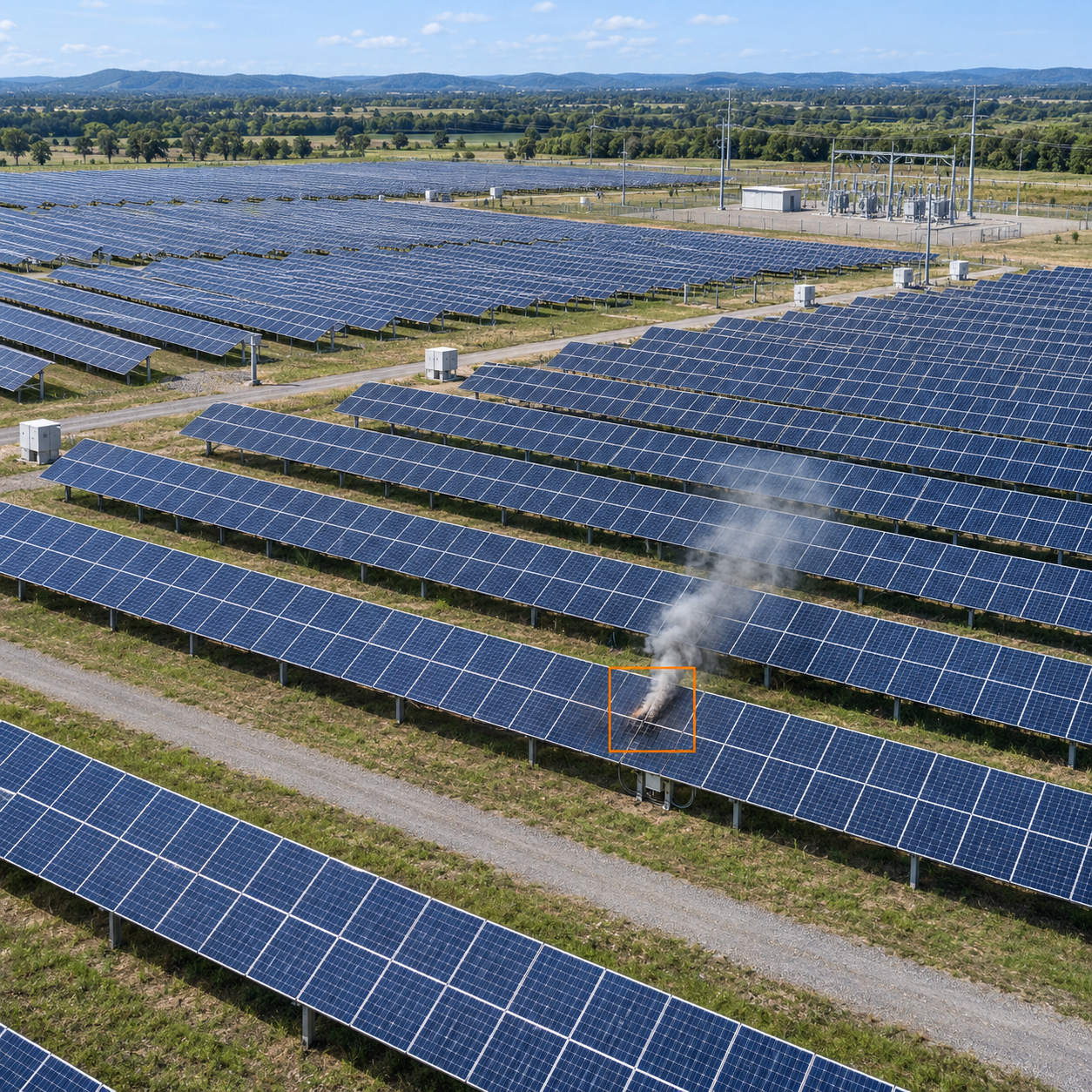
A research team from Chinese state-owned utility China Huaneng Group has developed a new deep-learning framework for real-time fire and smoke detection in PV power plants.
Dubbed PVFire-YOLO, the system is designed to detect small flames and smoke plumes while reducing false alarms caused by sunlight reflected from PV module surfaces.
“For the specific domain of PV inspection, deep-learning research has concentrated on three problems: electroluminescence (EL) crack detection, infrared (IR) hot-spot localization, and panel-level visible-light anomaly detection such as surface defects and soiling,” the researchers said. “Fire detection in PV environments has, by contrast, received almost no dedicated treatment.”
The researchers said they compiled the first annotated flame-and-smoke dataset specifically designed for PV environments.
“The new annotated corpus, PV-Fire, combines surveillance and unmanned aerial vehicle (UAV) imagery from operating utility-scale plants with controlled outdoor burns staged among real PV modules,” they added.
The proposed method is based on the YOLOv12 real-time object detection model and incorporates three additional components to improve fire detection in PV environments. A patch-aware attention block enhances weak flame and smoke features, while a gather-and-distribute mechanism combines information across four feature levels. An adaptive fusion head adds a high-resolution detection branch to identify small targets.
The researchers assembled the PV-Fire dataset, comprising 5,824 images with 9,107 annotated flame and smoke objects. The dataset combines surveillance and drone imagery, controlled outdoor burns, and synthetic images. They allocated 4,070 images for training, 870 for validation, and 884 for testing. They also separated scenes across the three subsets and restricted synthetic images to the training set.
The team compared PVFire-YOLO with 14 existing detection models using the PV-Fire dataset, including Faster R-CNN, transformer-based models, and several YOLO variants. They also benchmarked it against 13 alternative models using the publicly available D-Fire dataset.
The tests assessed detection accuracy, small-target performance, false alarms caused by reflections, cross-dataset generalization, and processing speed on desktop and embedded hardware. The results were averaged across three training runs.
PVFire-YOLO achieved a mean average precision of 87.4% at an intersection-over-union threshold of 0.5 (mAP@50) on the PV-Fire dataset. The figure was 85.0% when testing was restricted to footage from operating PV plants and 84.4% on the D-Fire dataset.
Compared with the baseline YOLOv12 model, the proposed method improved small-target average precision by 5.2 percentage points. It also reduced the reflection-related false-positive rate to 3.1% while detecting a higher proportion of actual flame and smoke targets.
“Running at 79 frames/s on an RTX 3090 desktop graphics card and 21 frames/s on a Jetson Orin Nano compact AI computer, the model meets the latency budget for real-time edge deployment in distributed plant monitoring,” the researchers concluded. “Future work will extend the corpus to plants in diverse climates, incorporate temporal filtering to suppress isolated false positives, and fuse visible light detection with infrared thermal imaging to enhance robustness under adverse illumination.”
The findings are presented in the study “Real time small target fire detection in photovoltaic plants using attention enhanced multiscale fusion,” published in Scientific Reports.
Source link