

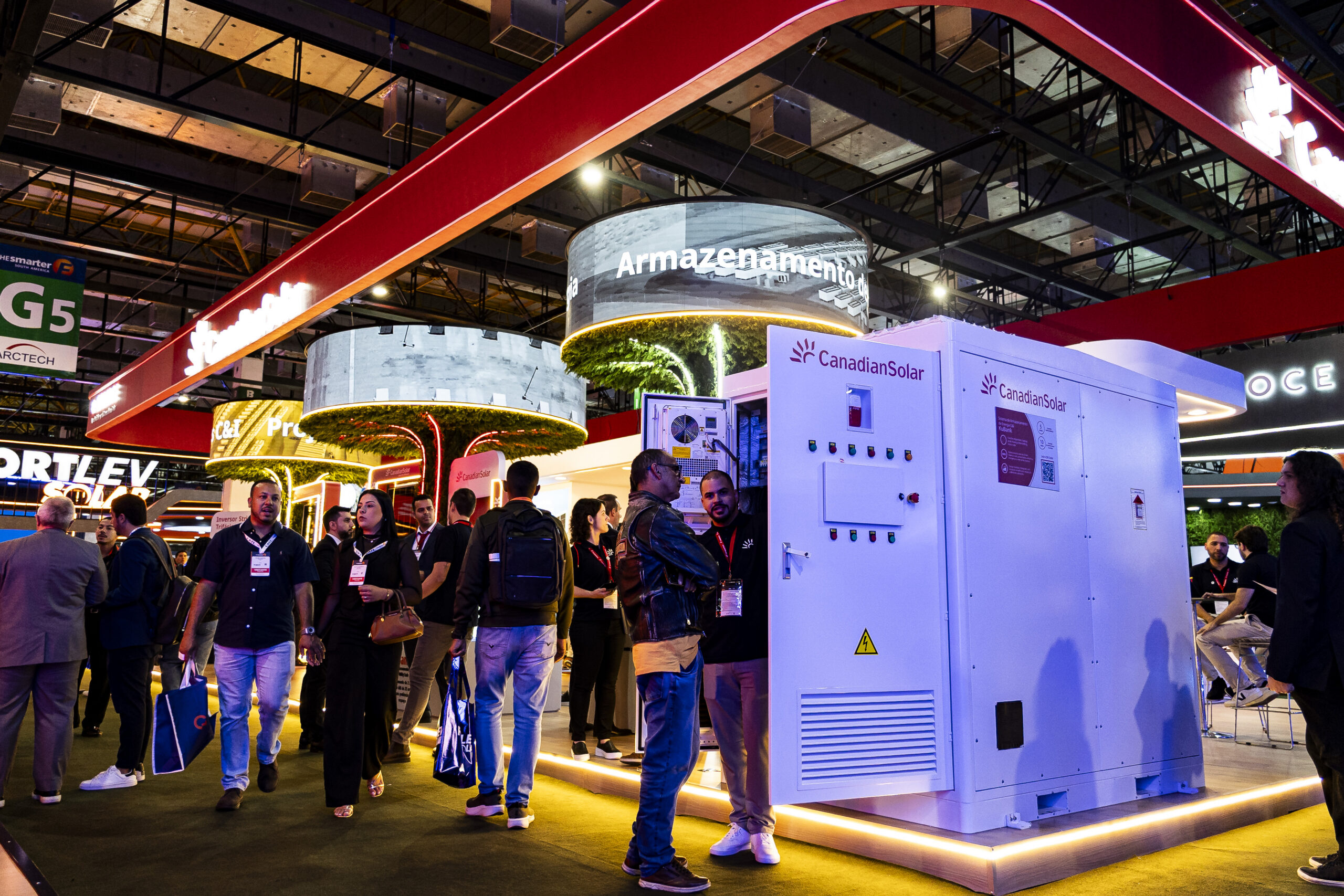
The growing role of energy storage in reviving business for solar companies was evident at Intersolar South America 2026, part of The smarter E South America. Major module suppliers including Trina, Jinko, JA Solar and Risen showcased their BESS solutions at the event.
The first three also announced plans or studies to develop local partnerships to meet domestic content requirements for Brazil’s first battery capacity reserve auction (LRCAP Nacional), scheduled for Dec. 2. Longi showcased a solution for the commercial and industrial (C&I) market, available through agreements with distribution partners.
Among inverter suppliers, companies including WEG, Fox ESS and Dyness also strengthened their focus on storage, showcasing hybrid solutions, batteries and all-in-one systems.
Supply still needs to translate into demand
Despite renewed optimism around batteries, sales have yet to keep pace with the expansion in supply. A source told pv magazine Brasil that hybrid inverters with integrated storage accounted for only about 15% of inverter imports into the Brazilian market in the first half of the year. Other sources said leading suppliers are selling between 40 MWh and 100 MWh of storage per month. A Greener survey found that more than 500 MWh of storage systems were sold in the first quarter alone.
Battery sales in Brazil have so far been driven by energy and tariff management applications for commercial, industrial and rural consumers, as well as efforts to expand electricity access in remote areas. However, the December auctions are expected to usher in a new phase for the market, with the Brazilian Energy Storage Solutions Association (Absae) forecasting demand of between 4 GW and 5 GW.
Partnerships between international suppliers and Brazilian manufacturers were among the most frequently discussed topics at the event. Trina Storage and JA ESS said they are studying potential local partnerships to meet the requirements of the first auction. CATL reinforced its partnership with Moura, while Jinko ESS announced a memorandum of understanding with UCB.
“Trina understands that being there on the first day of the auction, Dec. 2, is key. The Dec. 4 auction may not even take place. So this is a very important point, and we understand that we need to be in the Dec. 2 auction, no matter what, with competitive equipment,” Mariana Goudel, sales manager for Trina Storage in Latin America, told pv magazine Brasil.
The large-scale adoption of batteries is one of three measures identified by the Brazilian PV association ABsolar as necessary to restore growth in Brazil’s solar sector, which is going through a period of deceleration. The country is expected to add around 10 GW of solar capacity in 2026, down from 13 GW in 2025 and 16 GW in 2024, according to the association’s latest figures.
Paths to renewed solar growth
In addition to deploying batteries capable of absorbing solar generation during periods of daytime surplus, ABsolar has proposed stimulating new electricity demand by attracting green hydrogen plants and data centers and promoting the electrification of industry. The association also advocates universal access to electricity through solar-plus-storage systems.
The push to attract new large electricity loads to Brazil was underscored by one of the few module supply agreements for utility-scale projects announced this year. The deal covers 413 MW of Jinko modules for a Casa dos Ventos solar project that will supply Omnia data centers at the Pecém Complex.
At the opening of The smarter E South America 2026 conference, which includes Intersolar South America, ABsolar presented its proposals for Brazil’s presidential candidates covering these three areas.
The battery manufacturers’ pavilion was one of the areas that expanded compared with the 2025 edition. In addition to solar companies bringing their storage solutions to the event, established battery suppliers such as CATL and Great Power, as well as Brazilian companies focused exclusively on storage, including Power Safe, occupied some of the largest stands.
By contrast, fewer equipment distributors and smaller stands reflected the slowdown in the PV market.
Several sources who spoke with pv magazine Brasil said the PV equipment distribution market is likely to change over the coming years as a result of several trends. Some distributors are clearing inventories and selling below market prices. At the same time, Chinese government efforts to improve the efficiency of PV manufacturing lines and solar modules could help Tier 1 module suppliers regain market share in the distribution segment, which primarily serves smaller systems and has proved more resilient to the broader slowdown.
Until the new rules take effect, however, Tier 2 manufacturers could redirect excess inventory to markets such as Brazil, potentially delaying a recovery in market share for Tier 1 suppliers.
A new phase of development
Over three days, The smarter E South America brought together more than 500 exhibitors from the solar, energy storage, energy management and electric mobility sectors at Expo Center Norte in São Paulo. The event comprised four concurrent exhibitions – Intersolar South America, ees South America, Power2Drive South America and Eletrotec+EM-Power South America – and attracted around 50,000 visitors. Conferences, short courses and workshops running alongside the exhibitions drew approximately 3,000 participants.
The exhibition area for ees South America increased by 30% from the previous edition, while Power2Drive South America doubled in size.
Electric mobility was another prominent theme. The segment offers a potential avenue for business diversification for companies and suppliers active in Brazil’s solar industry and is expanding rapidly. More than 270,000 electrified vehicles were registered between January and July, bringing the total number on Brazilian roads to 700,000, according to the Brazilian Electric Vehicle Association (ABVE).
Rafael Cunha, a consultant for the Power2Drive South America conference, said that while the electricity sector faces challenges related to generation and grid capacity, electric mobility could eventually contribute to grid stability through technologies such as vehicle-to-grid (V2G). The technology enables vehicle batteries to draw electricity from or feed it back into the grid, potentially providing frequency and power support.
“Brazil remains the largest renewable energy market in the region, with more than 74 GW of installed solar capacity, consolidating solar as one of the pillars of the country’s energy market. Without a doubt, Brazil remains one of the world’s most attractive markets for the solar sector. I think it is important to emphasize that,” Florian Wessendorf, executive director of Solar Promotion International, one of the event organizers, said during a press conference.
“Of course, the market has entered a new phase of development, driven by growing demand for flexibility services, energy backup, energy arbitrage and, naturally, greater integration of renewable energy sources,” Wessendorf added. “Brazil is establishing itself as one of the world’s most dynamic renewable electricity markets.”
Source link