


June 24, 2026
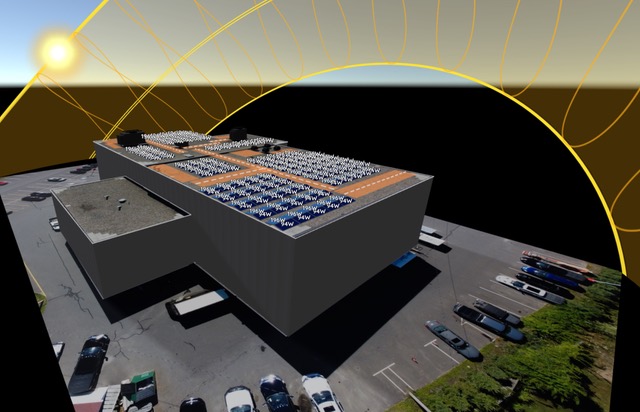
A recent Canadian entrant into the highly contested North American solar software market is aiming to provide Canadian solar installers with a full-suite solution that fills in “gaps” left by various U.S. solar software companies. Powerlily, which has been in a commercial version for two years, was developed by the founders of Watts Up Solar, a Wilmot, Nova Scotia-based installation company. The software is priced at a low fixed cost unlike competitors with endless add-on fees, according to Tom Rendle, the founder and director of Watts Up, in an interview with SB.
Canada-specific solar software is crucial, given several limitations of competing software serving Canadian installers, says Rendle. One shortcoming of the competition is that U.S. permitting rules are not the same as those in Canada, not covered by other software.
Another shortcoming among the competitors is that there is no financial network in Canada similar to that in the United States, so financing options for Canadian projects are more difficult to meld into quotes with competing software, he says. And some commonly used international satellite imagery services fail to refresh much of rural Canada more frequently than once a month, or once a quarter, he points out.
Incorporating installer feedback
One thing that makes Powerlily different from other solar software solutions is frequent version upgrades. “We work directly with solar companies whose crews are on roofs every day. They shape the roadmap, run the software on live deals, and tell us the moment something slows them down. That feedback loop is what makes Powerlily feel different the first time you use it,” the website suggests.
By working with installers to enhance the software, the time between version releases is dramatically reduced from the monthly or quarterly updates competitors roll out. Powerlily provides “new capability shipping every week against live customer feedback,” the company says.
The advantages of the software can be tangibly measured, as demonstrated by user teams at Watts Up. “Users report speeding up design/quote workflows from 20 minutes to under 5 minutes, while achieving a high 30% close rate,” asserts Rendle.
Powerlily core capabiliites
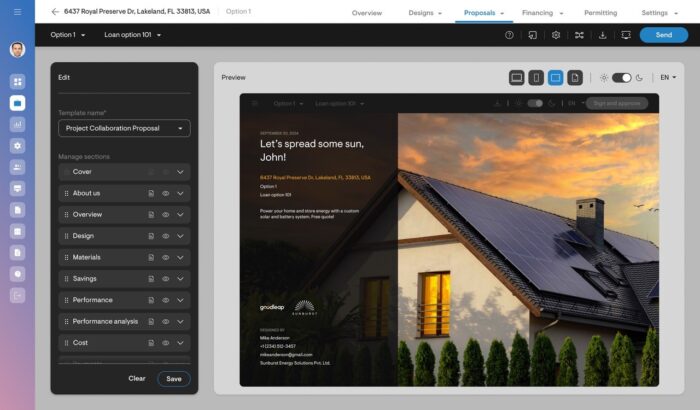
Among the many capabilities of Powerlily are sets of features for design and sales, for customer success, and for business. Design and sales features include 3D design tools and interactive proposals, a CRM and pipeline management feature, and native mobile apps for field teams. The software provides integration with AP Systems, Enphase and SolarEdge inverters, with more integration expected.
To enhance local imagery resources, Powerlily offers the use of Google and Bing maps, Google HD imagery, EagleView pictometry integration, Nearmap HD and True Ortho imagery, a digital surface module (DSM) and the capability of importing installers’ drone imagery, Rendle says. Competitors typically use two or three of these databases.
The design tool utilizes a detailed shading engine that traces rays through 3D scenes — including trees, chimneys and buildings — for more accurate production estimates. Powerlily was recently enhanced to handle complex commercial solar designs using custom drone imagery, the company notes.
Customer success features in Powerlily include a branded client portal, fleet management, monitoring, and re-marketing for upsales and referrals. Unlike some solar monitoring companies that charge close to $100 per installation plus a monthly fee, Powerlily includes the service within the overall subscription price.
Among the Powerlily business tool features is a billing and payments module, an equipment library of catalogs and documentation with unlimited file storage, and a knowledge base of company articles and resources. One key differentiator is that “Powerlily Lead lets you create your own mix of available incentives [municipal, provincial and federal] with a simple calculus structure, so you choose how it’s set up,” Rendle says.
Facing big solar software competition
While Powerlily was conceived and designed to be an easy-to-use uber solar software, the same idea is now common in the industry. Bhavani Radhakrishnan, the GM of Solargraf, in San Francisco, notes that “Once Enphase acquired SolarGraph back in 2021, we really focused on a providing a tool that is not only simple to use but also a bankable one. So you could pull someone from off the street and train them within half an hour but still provide confidence to installers and financiers in the accuracy of the system designed,” she suggests in an interview with SB.
“A lot of it is actually AI-powered so when you go into the tool, you can quickly design a system within two minutes,” Radhakrishnan says. “We also have a really good advantage in our ability to connect to Enlighten, the Enphase monitoring platform. Whatever you design in Solargraf, you’re able to create in Enlighten as well. We have access to the production numbers of the millions of sites that Enphase has actually set up, so we know how a design compares to actual production,” she says.
When it comes to financing solar in Canada, the lack of national financing networks that U.S. installers can tap is an opportunity for improvement in solar software used in Canada. “The challenge with finance in Canada is that it is actually a lot more fragmented than in the United States,” Radhakrishnan says. “However, we have prepaid lease modeling and loan modeling capabilities on the platform that covers pretty much all of the things that you would need to send out a quote to the homeowner,” she adds.
Imagery capture can also be a challenge in Canada if refresh rates are infrequent. “We have high definition imagery provided by Nearmap, Google and Azure built into the platform. What we have recognized is that image refresh frequency is higher in densely populated areas, but beyond those, the frequency has issues. So we use LiDAR data to supplement the imagery to create the 3D rendering,” Radhakrishnan says.
Differences between Canadian and U.S. standards for permitting is also a challenge for solar software. “We have a team that scrubs the AHJ [Authority Having Jurisdiction] data, which is very, very critical because rules keep changing every year. We have a database of more than 28,000 AHJ records that is constantly upgraded,” Radhakrishnan says. “We’ve also got standard industry accepted source for tariffs and utilities integrated, which some of the other platforms do not have,” she adds.
Size and experience are very difficult advantages for newer and smaller solar software companies to duplicate. “Solargraf has done well over three million proposals and one million permits. The homeowner can select which language they want to see the proposal in and view it. Not many of our competitors can make that kind of a claim!” Radhakrishnan points out.
Bridging the gap between residential and commercial designs is also a challenge for solar software. “Our platform is being extended to do commercial designs up to 5 megawatts. Installers should be able to use a single platform for both,” Radhakrishnan says. Adapting software through installer feedback is also a critical exercise. “We continuously take feedback and are releasing updates every month,” she adds.
Recent updates in U.S. solar software
Powerlily faces a rapid evolution of capabilities and tools within U.S. solar software. Solargraf, for example, recently began to offer more robust single line drawing (SLD) sets for electrical design and complete permit plan sets. One new tool is the ability to switch from solid copper to aluminum wire for higher voltage projects, as well as user-defined conduit sizes. Solargraf also now enables site-specific markers in plan designs, including the front of house, street location, roof access points, gas meter and heat alarm locations. Property line indication is also standard now.
Solargraf has also improved the integration of equipment suppliers’ product descriptions in plans, with automatic SKU IDs for Enphase and Tesla products. Similarly, the software now enables designers to select the amperage of breakers for combiner boxes, rather than a default to 20 Amps.
Aurora Solar updates released on April 2 include: “Updates to Sales Mode Customization (for Admins); Multiple Template Support; New Out-of-the-Box Templates; Template Editor UI Improvements; Updates to Sales Mode (for Reps); New Database > Proposal Templates Page; Template Selection in Sales Mode; Updated Storage section in Standard Template; and Updated Financing section in Standard Template,” a website blog indicates. A shared-screen style tutorial of these updates is also available on the website. Aurora declined an interview for this story.
Differing pricing strategies
Powerlily has pursued an all-in approach to pricing, to simplify an installer’s expanding use of the software. It offers “one price for your whole team. Unlimited users, unlimited quotes. No hidden fees, no per-seat charges,” the website indicates. “One price gets you access to all of our imagery, with Eagleview, Nearmap, Google and Bing; there’s no extra charge like other companies demand,” says Rendle. The company also offers installers a free trial, safeguarding user data for 90 days.
Powerlily delivers many of the same tools to installers as Aurora and Solargraf, but at a lower price, Rendle suggests. Powerlily Pro is priced at $184.99 per month, with unlimited users, unlimited quotes, and all features. “If you have a sliding scale for what it’s going to cost to do a project, it’s a lot harder to try and plan, so with a one-cost, everything-included solution, they automatically know what the what the overhead is going to be,” Rendle stresses.
In comparison, Solargraf’s Starter subscription is priced at $2,799 for two users and support for 240 projects, according to the website. Additional user subscriptions cost $1,440 each, and additional projects cost $11 each, the website indicates.
Similarly, Aurora Basic pricing begins at $159 per user per month, supporting 50 projects per month, with overage fees for additional use, according to the website. Aurora’s Premium subscription is $259 per user per month, with support for 50 projects. Premium also includes several functionalities not offered in Basic, including: LiDAR-assisted modeling; bankable shade reports; and battery storage modeling for backup, self-consumption, and arbitrage. Aurora Enterprise is also offered for an unlimited number of users with a custom fee per project, with another two dozen or so capabilities — some at an extra cost —than the Premium subscription. The cost for Enterprise is not listed on the website.
Charles W. Thurston is a regular contributor to Solar Builder.
Source link