

August 26, 2026
Residential and commercial battery storage is warming rapidly in Canada, thanks in part to utility strategies of offering very low or “ultra” low rates overnight compared to daytime peak rates. Current battery ownership remains low at around 2.4% of homeowners, according to Solar X Canada, a Toronto-based solar installer. However, roughly 43% of Canadian homeowners now express intent to purchase a home battery setup in the near future, the installer reckons.
The total number of residential and commercial battery adoptions thus far is a small fraction of the country’s roughly 100,000-plus residential, commercial and industrial solar installations, according to the Canadian Renewable Energy Association (CanREA). But that is changing.
“There’s a huge interest in energy storage now, and they’re selling a lot of systems,” says Phil McKay, the senior director of member programs for the association, in an interview with SB.
Electricity rates drive battery adoption
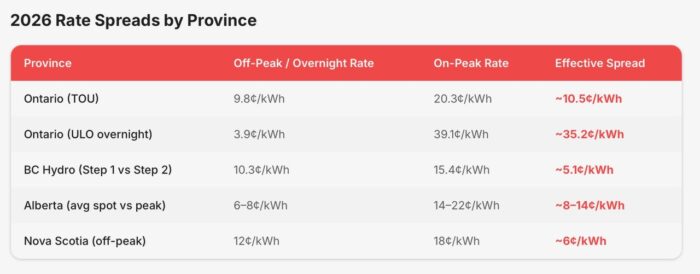
Battery adoption on the residential and commercial level is driven in part by the difference between peak and overnight rates in each province. The average residential cost of electricity in Canada is $0.192 per kWh based on an average monthly consumption of 1,000 kWh, according to EnergyHub. But peak pricing can be as high as $0.391 per kWh in Ontario, and in more remote provinces like Northwest Territories, for example, the cost is $0.41 per kWh, due to the high cost of diesel generation.
To encourage lower consumption during peak hours through battery storage, the Ontario Energy Board (OEB) launched its ultra-low overnight rate of $0.039 cents in early 2023. The difference between peak and overnight there is a whopping 10X factor. Across Canada, the average peak rate is closer to double or triple the overnight rate, according to Toronto Hydro.
The spread between peak and overnight in Alberta is between $0.08 and $0.14 per kWh, in Nova Scotia it is $0.06, and in British Colombia it is $0.051 cents, all of which can contribute to healthy returns, according to Solar X.
“The farther part that spread is between daytime and night-time prices, the stronger that driver becomes,” says McKay.
Thus the savings from battery adoption, which varies widely by province, means the investment is recovered quickly on a national average, faster than average in the United States, according to one industry guesstimate.
Incentives add to return on investment
As was the case in the United States, federal and provincial incentives for battery storage are readily accessible, providing up to a combined $10,000 when paired with solar. On a federal level, a 30% tax credit is still available for solar and battery systems under the Clean Technology Investment Tax Credit (ITC).
On the provincial level, most provinces have substantial incentives. Ontario’s Independent Electricity System Operator (IESO), for example runs the $10.9 billion Home Renovation Savings Program, offering up to $5,000 for the installation of battery systems (see SB Canada, March 23, 2026). However, homeowners or companies that opt for the incentive are barred from exporting to the grid in the province.
Elsewhere in Ontario, Hydro Ottawa began operating GridFlex, a voluntary rewards program in June, offering a $500 battery system enrollment reward and a $250 annual reward for existing systems. New GridFlex battery storage system incentive terms are expected shortly. The program is funded by Natural Resources Canada (NRCan).
British Colombia also offers up to $5,000 through the BC Hydro Battery Storage Rebate program, refocused as of April to focus on battery systems. In Nova Scotia and Alberta, rebates for batteries go up to $3,000 per system. Efficiency Nova Scotia operates a province-wide program, and in Alberta various municipalities like Banff offer a rebate in the absence of a provincial program. And in Quebec, various rebates are available varying by program.
Peak shaving spurs commercial adoption
While most of Canada’s battery storage is utility-scale thus far, commercial adoption is rising quickly, according to a Mordor Intelligence forecast to 2031. “Commercial and industrial deployments [especially mining] are expected to expand at 29.5% compounded annual growth rate, or CAGR,” the report states.
CanREA agrees. “We’re actually been seeing a lot more battery storage uptake in the commercial and industrial segment over the past couple of years,” says McKay.
“As industrial facilities electrify, automate, and scale, energy flexibility is becoming a competitive advantage for large industrial operators,” according to Derek Lim Soo, CEO of Peak Power Energy, a Toronto-based battery system provider, in a recent company statement. Peak Power in July completed a 3.6 MW / 7.2 MWh lithium-ion battery storage system at Vuteq Canada’s manufacturing facility in Woodstock, Ontario.
A Grandview Research report notes that data centers are a major factor driving the battery storage market. “Data center was the largest [battery adoption] commercial market segment with a revenue share of 47.19% in 2024,” the report stated.
Rising costs one limit to growth
Among limits to battery storage adoption on the residential and commercial level, pricing is one rapidly escalating factor.
“Price sensitivity is certainly driving the market right now, making it more difficult to compete with Asian manufacturers selling directly. Our key advantages are in-house design, product features aimed at serving the installer community based on decades of experience, strong product support, and direct handling of warranty claims,” observes Jeff Myles, the marketing manager for Rolls Battery, a battery manufacturer based in Springhill, N.S., in an email to SB.
“LiFePO4 cell prices were at a low mid-2025 but have risen considerably since due to increasing raw material costs. At the beginning of this year we saw a 10% to 30% jump in cell pricing, varying between cylindrical and prismatic cells, with smaller but steady increases since then,” Myles says.
Charge Solar, a national solar and battery distributor, early this year suggested that “Based on current industry feedback … we anticipate a modest increase (~3%) following the April 1 reduction in export incentives. A further upward step (~5–8%) [is expected] as the final rebate phase-out completes in early 2027,” the company blog states. “Across the full year, combined effects of tariff policy and raw material costs could meaningfully raise the landed cost of battery packs and storage systems relative to late 2025,” Charge summarizes.
Lead batteries are less price sensitive, as a mature technology. “As a manufacturer serving the renewable energy industry for several decades, we offer both deep cycle lead-acid and LiFePO4 lithium solutions for residential and commercial use. With that experience and a broad product range, we can offer an unbiased opinion to help residential and C&I customers choose the best energy storage solution for each application,” Myles adds.
“It’s a really uncertain time, so we’ve been doing some work to try to get the numbers on the supply chain, determining what needs to happen [on a policy level], and providing some advice to the government on how best to tackle tariff impacts on battery prices,” notes McKay.
“We certainly don’t want to see this industry chopped off right at the time when the federal government has been pushing for the electrification of the entire economy,” McKay says. “We’re sitting on what we estimate to be around a $200 billion dollar opportunity for wind, solar, and storage in Canada.”
Tags: batteries, Canada, CanREA, energy storage, home storage, Rolls Battery
Source link