
Ground truth findings from a multi-site study
Contributed by Lowell Woock, Joseph Anderson, Max Rünzel | HiveTracks and Maria Morales Ferrebus | Skyview Ventures
As agrivoltaics gain momentum across the United States, developers, landowners, and policymakers are increasingly asking a critical question: Are solar projects delivering measurable ecological benefits alongside clean energy generation? With dramatic decreases in photovoltaic costs and growing interest among policymakers, solar installations are projected to rise by 57% in 2030 compared to 2024.
Agrivoltaics has emerged as a way to optimize land use by creating spaces where solar energy production and agriculture can coexist. Solar developers have been observing the rise in agrivoltaic practices across the United States and understand the value they bring to landowners, local communities, and ecosystems.
Greenfield ground mount solar panels provide an untapped benefit for crop growth, sheep grazing, and pollinator habitat as the shade generated by the panels creates a microclimate that provides relief from the elevated solar irradiance and thermal stress conditions, reducing air and soil temperatures by 1 to 4 °C. While agrivoltaics continues to gain traction, the industry still lacks consistent methods for measuring whether these projects are improving biodiversity and ecosystem health over time.
The Challenge
Distributed-level solar development in the U.S. is subject to environmental review requirements designed to prevent disturbance to endangered species and sensitive habitats, with specific regulations varying by state and project size. While these requirements provide a first layer of ecosystem protection, they are not designed to optimize ecological outcomes or generate extensive biodiversity data. Once a site is operational, there is typically no standardized mechanism for tracking whether vegetation, wildlife, and broader ecological communities beneath and around solar panels are recovering, degrading, or remaining unchanged.
Furthermore, bringing a distributed solar project to operation involves significant competing pressures, including interconnection delays, evolving state regulations, and unpredictable development timelines that strain both budgets and attention. Against this backdrop, engaging on-site trained ecologists to establish ecological baselines and support ongoing land management is rarely prioritized. As a result, ecological management at most distributed solar sites rarely progresses beyond standard seeding plans and mowing schedules, practices that maintain basic ground cover but fall short of the site-specific knowledge needed to actively and most cost-efficiently improve habitat function or support native biodiversity over time.
HiveTracks’ Solution
Capitalizing on the potential of agrivoltaic sites depends on having reliable ecological data and insightful management, both of which can be hard to obtain. New monitoring approaches and AI advancements are making biodiversity data collection more accessible by enabling local stakeholders, including beekeepers and land stewards with minimal training, to contribute ecological observations at scale. Agrivoltaic systems present measurable economic opportunities alongside their role in supporting natural landscapes. Increased electricity generation was observed in agrivoltaic systems compared to ground-mounted PVs, due to plants’ ability to lower solar panel operating temperatures.
To evaluate this approach, HiveTracks partnered with Skyview Ventures to monitor biodiversity across multiple solar sites in the United States and assess how land management practices influence ecological outcomes. Rather than asking developers to hire ecologists or add headcount, HiveTracks acts as a turnkey partner: it supplies a network of trained beekeepers, designs a monitoring plan tailored to each site’s habitats, and runs the program on the ground. This turns biodiversity from a compliance cost into a measurable, reportable asset that developers can track and report over time.
Beehives were installed at each site, where participating beekeepers used the HiveTracks platform to collect ecological observations throughout the growing season. Laboratory analysis of honey samples added another layer, together building a detailed picture of plant diversity, pollinator activity, and habitat conditions across the sites.
Pairing beekeepers with solar farms through agrivoltaics generates ecological insight alongside additional value from the same land. This includes honey production, biodiversity data for compliance reporting, and emerging opportunities such as biodiversity credits.


Images courtesy HiveTracks, Marc Rousavy
Methodology
During the onboarding process, the HiveTracks platform helped create unique monitoring plans tailored to each site’s distinct features and habitats. By segmenting the site or adding pins for different habitats, the best areas to visit throughout the year are identified and communicated for data collection in the app.
HiveTracks Bio allowed the on-site beekeepers to collect data with their phones through three different methods:
- Quadrats: 1×1 meter spaces where flora species were documented and tracked
- Transects: 10-meter paths designated for capturing pollinators
- Observations: documentation of unique or important species not found within the designated quadrats and Transects
Images captured using these three methods are pre-analyzed by AI and then either provided to independent ecologists or reviewed by site managers, ensuring that each species is correctly identified.
Over time, the information was used to generate management recommendations and live dashboards that track drought tolerance scores, species nativity, flora and pollinator diversity indices, habitat breakdowns, and more. The platform then produced nature reports and data-driven insights designed to improve the habitat function of the solar sites, without compromising green energy production.
PReliminary Results
In 2025, biodiversity monitoring began across seven sites with Skyview Ventures, covering 500+ acres, and identified around 200 unique flora species. Floral Shannon Diversity Index values at most sites were above 3, indicating that many were recovering ecosystems. These first-year findings directly informed initial site management plans, including:
- Reductions in mowing frequency
- Seeding native wildflower mixes
- Identifying abundant invasive species such as Johnson grass (Sorghum halepense), Chinese bushclover (Lespedeza cuneata), and thistle species (Cirsium arvense)
- Identifying threatened and imperiled species across sites
- Enhancing habitat corridors using native riparian species along water features
- Establishing forest edge buffers
- Minimizing soil compaction
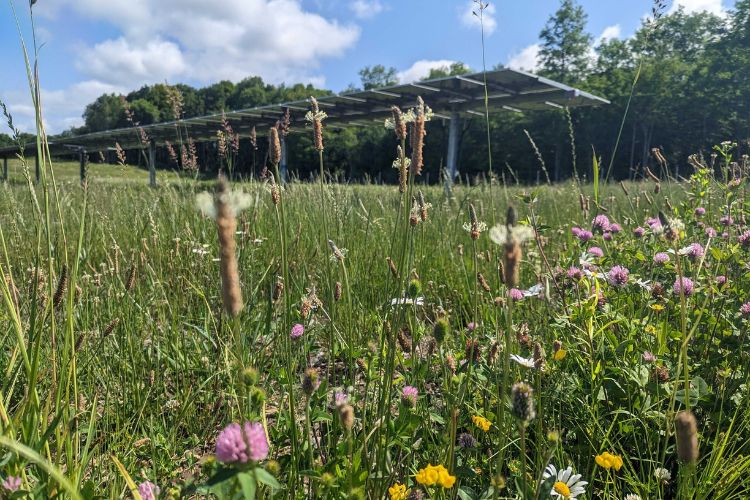
Many of the sites demonstrated potential for clear progression towards stable, mixed grassland communities. These findings also highlighted the benefits of adjacent forests and hedgerow edges, underscoring the presence of healthy habitats and ecological niches.
Invertebrate and floral eDNA analysis from honey provided insight into pollinator activity across the sites. Many of the sites indicated a strong concentration of pollinators in only a few foraging groups. Other results helped determine bloom patches in the landscapes and active herbaceous production in relation to the presence of moths and other insect species. The analysis suggested that 30–50% of the forage reflected in the honey eDNA could plausibly originate within the farm footprint and its immediate edges, with ~50–70% coming from the surrounding landscapes. Understanding how far the honeybees had to travel for forage helps us understand how well the site itself supports pollinator communities.
Collector feedback was used to develop HiveTracks Bio and build a stronger, more streamlined approach to biodiversity monitoring. For the 2026 season, 469 quadrats and 231 transects are planned, with findings from certain sites already revealing dominant species such as red clover (Trifolium pratense) and White crownbeard (Verbesina virginica).
Findings at the Davis Hill Development Solar Sites
While the available data is only baseline, as data collection began in 2025, the hives and monitoring were placed at solar projects varying in size, location, development stage, and project type, providing a broader picture for comparing the findings.
| Site | Status | SDI | Flora Species | Nectar Sources | Key Characteristic |
| Christiano, NY | Operational greenfield solar | 3.2 | 103 | 41 | Highest species richness, strong native pollinators |
| Lapp, NY | Operational greenfield solar + hay | 0.67 | 14 | 5 | Lowest diversity, management-driven |
| St. Croix, NY | Pre-Operational solar + sheep | 3.4 | 82 | 31 | Highest native bee diversity, model site |
| Oak Tree & Bramble, WV | Rooftop solar | * | * | 37 | Edge habitat focus |
| Mt. Joy, NY | Pre-construction | 3.1 | 60 | 22 | Brownfield baseline, threatened species present |


Images courtesy HiveTracks, Marc Rousavy
Lessons Learned
The most instructive comparison in this dataset is between the Christiano and Lapp sites: both ground-mounted solar installations between 2–7 MW in size, located in similar geographical and climatic conditions in New York State. Despite these similarities, their ecological outcomes diverge dramatically: Christiano recorded a Shannon Diversity Index (SDI) of 3.2 across 103 flora species and 41 nectar sources, supporting a strong native pollinator community, while Lapp recorded an SDI of 0.67 across just 14 flora species and 5 nectar sources, with honeybees observed foraging predominantly off-site.
With such similar sites in size, geography, and solar technology used, we found that what makes the difference in ecological biodiversity at ground-mount solar energy sites is not the solar technology itself (racking system and photovoltaic cells), but the land management practices implemented. The Lapp solar site was designed to sustain hay production, with mowing cycles scheduled to prevent the hay from growing too tall and diminish the solar generation with its shade. These mowing cycles prevented the clover from reaching peak bloom during the June–July pollination window, effectively eliminating the site’s primary nectar source for most of the growing season. Christiano, by contrast, benefited from native seeding and reduced mowing frequency, allowing a diverse plant community to establish naturally. The data makes a clear case that at distributed solar sites, land management decisions — not solar technology — determine ecological outcome.
Leveraging baseline data supplied by HiveTracks, Skyview Ventures can make informed land management decisions year over year. The data will help shine a light on whether sites can achieve higher biodiversity outcomes through less intervention, not more, using reduced mowing and targeted native seeding. This would suggest that the ecologically better path can also be the more cost-effective option. The data collected will thus be used to identify practices that support on-site biodiversity while reducing O&M costs by promoting low-maintenance, natural habitats around the panels. Beyond those potential savings, robust biodiversity data can protect lease value, unlock stalled permits, and position developers to capture emerging revenue as biodiversity credits and incentive programs increasingly demand auditable, longitudinal data.
Why Biodiversity Measurement Matters
What you don’t measure, you don’t manage. Management begins with an understanding of the site, and by making data collection more accessible, HiveTracks helps solar farms function as ecosystems alongside their green energy production. In 2024 and 2025, solar panels were projected to occupy around 550,000-600,000 acres of land across the United States. As this number will continue to grow in the coming years, it’s vital to ensure these areas do not detract from local ecosystems but instead support them.
Biodiversity monitoring offers the green energy industry a sustainable, cost-effective way to ensure solar installations actively support local ecosystems.
About HiveTracks
HiveTracks is building the data infrastructure layer for biodiversity. It enables landowners, developers, and agricultural operators to measure and improve biodiversity on-site, turning nature from a compliance cost into a measurable, reportable asset.
As regulatory frameworks (e.g., TNFD, CSRD, ISSB, etc.) and consumer and corporate demand accelerate, biodiversity data is becoming essential, yet remains low-granularity and too costly to collect frequently at scale. HiveTracks solves this by combining community-driven and smartphone-based data collection (beekeepers and land stewards) with AI-powered image analysis. Fast and standardized data collection protocols generate comparable, auditable, and longitudinal plant and pollinator trend data across habitats, site portfolios, and regions.
About Skyview Ventures
Skyview Ventures has three operating businesses: Skyview Finance Company, one of the largest merchants of Environmental Attributes; Davis Hill Development, which develops, owns, and operates solar and battery storage facilities; and Skycharger, which develops, owns, and operates electric vehicle charging infrastructure. In addition, Skyview Ventures has more than 30 venture investments in its portfolio. The company owns 70 MW of solar assets across 15 states and over 600 EV charging stations. Headquartered in Nashville, TN, with additional offices in Greenwich, CT, and Sacramento, CA, Skyview Ventures is a national leader in clean energy.
About the Authors

Lowell Woock is a biodiversity research analyst at HiveTracks, where he has spent over two years working across the company’s core beekeeping platform and biodiversity services. He supports the testing, development, and research of ecological and environmental tools within HiveTracks’ products. He is experienced with field data collection and analyzing patterns in species populations.

Joseph Anderson has been working in sustainability for 14 years, with an emphasis on nature-based solutions and ecosystem services. As the HiveTracks biodiversity specialist, he works to translate biodiversity data from diverse sites and habitats into standardized metrics that can drive data-driven actions for habitat improvement. His background includes public policy, consulting, and research roles focused on improving the integrity of nature.

Max Rünzel is co-founder and CEO of HiveTracks, where he leads the commercialization of biodiversity data as the ground-truth standard for the emerging global nature-risk market. He came to HiveTracks after his appointment with the Food and Agriculture Organization (FAO) of the United Nations, where he focused on technology adoption among smallholder producers and on distributed ledger technology across the cocoa and coffee value chains. Fluent in six languages and educated in rural development and food economics across Europe and Korea, Max believes in truly global solutions to pollinator health and biodiversity.

Maria Morales Ferrebus is a solar developer on the greenfield team at Davis Hill Development, a Skyview Ventures company, where she has spent the past four years supporting the development of distributed-scale community solar projects across the United States. She collaborates closely with HiveTracks to integrate biodiversity initiatives across Skyview’s solar portfolio, coordinating site selection and collaboration with development teams, on-site partners, and honey production efforts. Originally from Venezuela, Maria is passionate about advancing agrivoltaics and demonstrating how solar development can create value for both communities and ecosystems.
Source link