

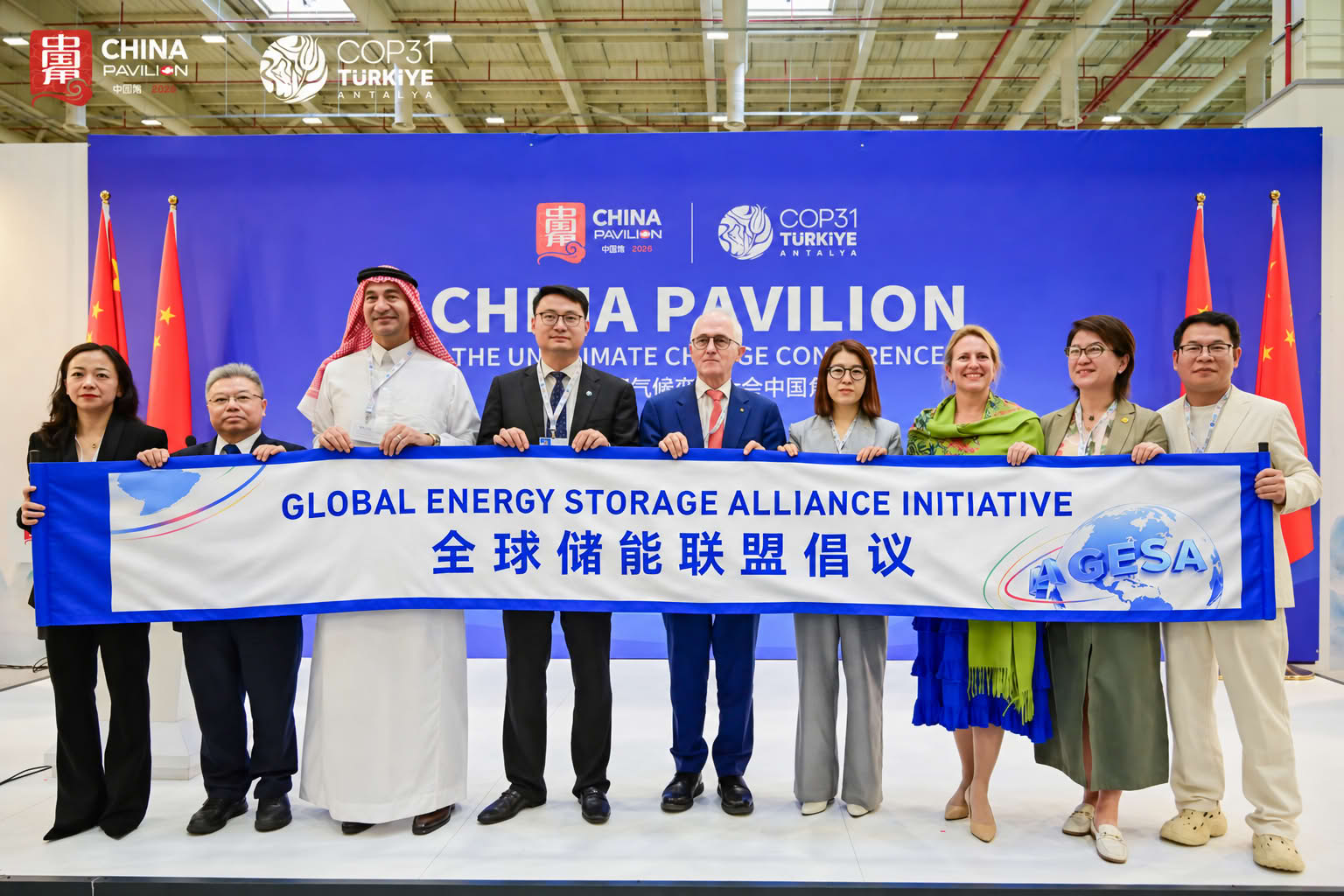
The Global Energy Storage Alliance, known as GESA, was launched on Nov. 13 at the China Pavilion during COP31 in Antalya, Turkey, bringing together 27 co-initiating organizations spanning battery manufacturers, power utilities, state-owned enterprises, and research institutions from China and several other countries.
The three founding organizations are the China Energy Storage Alliance, the China Renewable Energy Engineering Institute, and China Southern Power Grid Energy Storage Co. The co-initiator list includes battery and system manufacturers such as CATL, BYD Energy Storage, EVE Energy, Hithium, and Sungrow, alongside state-owned energy groups including CGN Energy International and POWERCHINA International. Saudi Arabian utility developer ACWA Power is among the international co-initiators. Seven organizations — including the Long Duration Energy Storage Council, the International Hydropower Association, Energy Storage Europe, and the World Resources Institute are listed as interested in exploring participation in GESA.
The launch event was attended by Liu Zhenmin, China’s Special Envoy for Climate Change; Francesco La Camera, Director-General of the International Renewable Energy Agency; Armida Salsiah Alisjahbana, UN Under-Secretary-General and Executive Secretary of ESCAP; and Xiong Minfeng, Deputy Director-General of the International Cooperation Department at China’s National Energy Administration.
GESA’s founding declaration outlines six areas of focus: facilitating international dialogue, building a global storage project and standards database, supporting research and technology deployment, improving market mechanisms, strengthening supply chains and trade, and mobilizing investment for projects in developing economies. The initiative describes itself as open, technology-neutral, and market-oriented, and states it will respect different national regulatory models.
Speaking at the launch, Sun Liqun, Deputy General Manager of China Southern Power Grid Energy Storage, identified three structural barriers the initiative aims to address: inadequate market mechanisms for valuing both short- and long-duration storage, fragmented technical standards and regulatory frameworks across countries, and financing and development barriers in emerging economies. These are widely recognized constraints on storage deployment. However, how the degree to which a voluntary industry alliance can move them will depend on the engagement it obtains beyond the launch.
Beyond industry coordination, the alliance carries weight in the UN-led climate process. Storage underpins the global push to triple renewable capacity by 2030, and GESA’s focus on technical assistance, capacity building and de-risked financing for developing economies speaks directly to the Paris Agreement’s call for an equitable transition. By channeling South-South cooperation toward emerging markets in Southeast Asia, the Middle East and Latin America, where financing costs remain the biggest obstacle to deployment, the initiative could help narrow the energy access gap between developed and developing countries.
For China, it marks a step from exporting storage products toward shaping global standards, extending its climate diplomacy from setting targets to building a system that deliver them.
From ESS News
Source link