

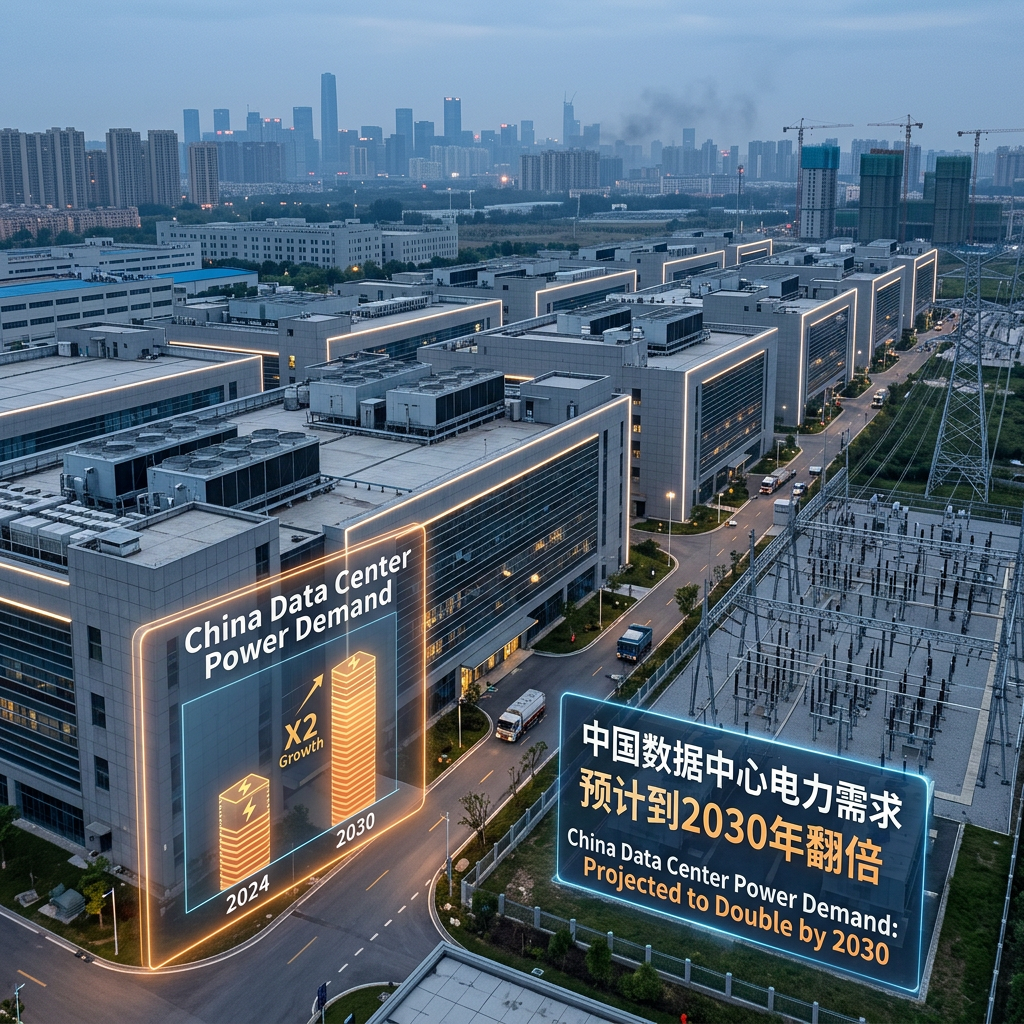

China is rapidly expanding its data center industry, with total capacity expected to exceed 60 gigawatts (GW) by 2030, according to analysis by Rystad Energy. The country already had about 32 GW of installed capacity by the end of last year, and another 28 GW of projects are planned over the next five years. This strong pipeline reflects growing demand for digital infrastructure, especially driven by artificial intelligence and high-performance computing.
As capacity grows, electricity consumption from data centers is also set to rise sharply. Power demand from this sector is projected to reach 289 terawatt-hours (TWh) by 2030, more than double current levels. This would account for around 2.3% of China’s total electricity use. Data centers are expected to become the fastest-growing source of power demand in the country, with consumption increasing at an annual rate of about 19% between 2025 and 2030.
The pace of development is already visible. Installed capacity is likely to reach 40 GW by the end of this year, up from 32 GW in 2025. A large share of this growth is coming from AI and high-performance computing facilities, which are more energy-intensive than traditional data centers. These advanced facilities are expected to make up nearly half of total capacity by 2030, compared to around 39% this year.
Government policy is playing a key role in shaping this expansion. The “East Data West Computing” strategy, launched in 2022, aims to shift data center development toward western regions where land and renewable energy resources are more available. This has led to the creation of major computing hubs in areas such as Inner Mongolia, where companies like Huawei, ByteDance, and 21Vianet are developing large-scale projects. In Ulanqab alone, around 10 GW of data center capacity has been planned.
While overall electricity demand in China is expected to grow more slowly in the coming years, the contribution from data centers will increase significantly. Total power demand is forecast to grow at a compound annual rate of 3.9% through 2030, lower than previous years due to efficiency improvements. However, data centers will stand out with much faster growth, increasing their share of national electricity consumption from 1.2% last year to 2.3% by the end of the decade.
The government is also focusing on improving energy efficiency and sustainability. Under the 15th Five-Year Plan for 2026 to 2030, data center operators are required to meet strict performance targets. A key measure is power usage effectiveness (PUE), which tracks how efficiently energy is used. New large facilities must achieve a PUE of 1.25 or lower, while those in national computing hubs must meet an even stricter target of 1.2.
Renewable energy integration is another important priority. New data center projects in national hubs must source at least 80% of their electricity from renewable sources. To meet these goals, operators are using a mix of approaches, including green electricity certificates, direct renewable power purchases, and onsite generation.
Several projects already show how this model works in practice. Facilities are combining wind and solar power with battery storage to reduce emissions while maintaining reliability. Examples include large-scale projects using hundreds of megawatts of renewable energy alongside energy storage systems, helping China move toward greener digital infrastructure while supporting its growing data needs.

Related
Discover more from SolarQuarter
Subscribe to get the latest posts sent to your email.
Source link