

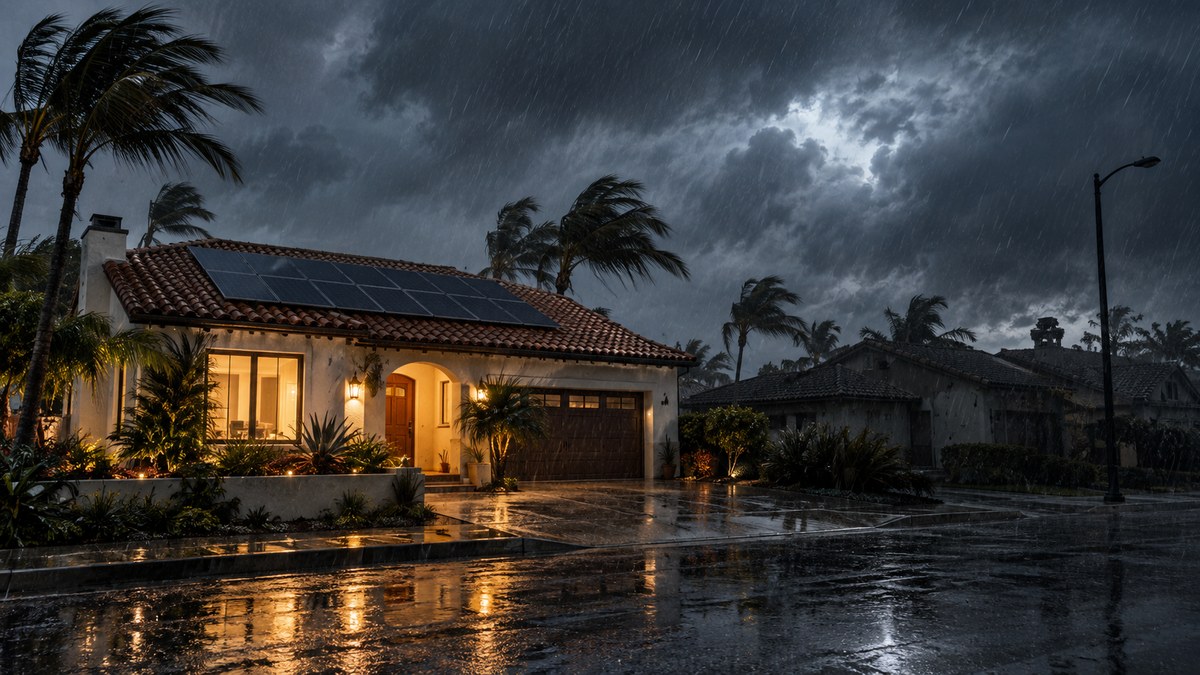
NOAA expects a strong El Niño this winter, and that usually tilts Southern California toward a wetter season. Here’s what a rainy winter actually does to a San Diego solar system, and why it doesn’t break the math.
Key takeaways
- NOAA’s Climate Prediction Center says El Niño continues to strengthen, with a strong-to-very strong event likely through January to March 2027, and NOAA’s winter outlook favors wetter-than-average conditions from California to Florida.
- A wetter winter isn’t guaranteed. The National Weather Service in San Diego notes that the strong El Niño of 2015-16 was drier than normal in Southern California.
- Winter is already the low season for solar. In the federal PVWatts model, a San Diego system produces about 103 to 107 kWh per kW in December through February, versus about 158 to 160 in July and August.
- Panels keep producing on cloudy and rainy days from diffuse light, just at reduced output. Production estimates are built on a typical year of weather, so wet and dry years average out.
- SDG&E bills solar on an annual true-up, so spring and summer production carries the winter months. A battery adds backup for storm outages.
Frequently asked questions
Do solar panels work in the rain?
Yes, at reduced output. Thick clouds block direct sunlight, but panels still produce from the diffuse light that gets through. Output picks back up as soon as a storm clears.
How much less do solar panels produce in winter in San Diego?
In the federal PVWatts model, a 1 kW south-facing system in San Diego produces about 103 to 107 kWh a month from December through February, roughly two-thirds of a July or August month. The three winter months together are about 20 percent of the year’s production.
Will El Niño affect my solar savings?
Somewhat, but less than you might think. Winter is already a small share of the year’s production. As an illustration, if December through February came in 20 percent below normal, annual production would fall by about 4 percent, and the rest of the year is unaffected.
Is a strong El Niño coming this winter?
NOAA’s Climate Prediction Center said in October 2026 that El Niño continues to strengthen, with a strong-to-very strong El Niño likely through January to March 2027. Its next update is due November 12, 2026.
Should I wait until spring to go solar?
There’s no production reason to wait. A system that turns on in winter starts producing right away, and the long days of spring and summer build up credits under SDG&E’s annual true-up. If storm outages worry you, a battery installed before the wettest months adds backup.
Stellar Solar has been talking about El Niño a lot this fall, and for good reason: NOAA expects a strong one. A strong El Niño often means more storms for Southern California, and a natural question follows. If it rains all winter, do solar panels still pay off?
They do. Here’s why, with the numbers.
What NOAA is forecasting
NOAA’s Climate Prediction Center publishes its ENSO outlook monthly. Its October 2026 discussion kept an El Niño Advisory in effect and said El Niño continues to strengthen, with a strong-to-very strong El Niño likely through January to March 2027. The next update is due November 12.
NOAA’s winter outlook, released October 15, says wetter-than-average conditions are likely across the southern U.S., from California to Florida.
What El Niño has meant for San Diego
El Niño tilts the odds toward a wet Southern California winter, but it doesn’t guarantee one. The three strongest El Niños on record before this one show the range. Rainfall at San Diego’s Lindbergh Field, measured over each October-to-September water year by the San Diego County Water Authority, came in at:
| Water year | Lindbergh Field rainfall |
|---|---|
| 1982-83 | 18.49 inches |
| 1997-98 | 17.16 inches |
| 2015-16 | 8.18 inches |
San Diego’s normal is about 10 inches a year. The National Weather Service in San Diego points out that 2015-16 was drier than normal here despite a strong El Niño. So a very wet winter is possible this year, but not certain.
Winter is already the low season
Solar panels produce less in winter in every year, wet or dry. Days are shorter and the sun sits lower in the sky. The federal PVWatts calculator estimates that a 1 kW south-facing system in San Diego produces:
| Month | Production |
|---|---|
| December | 103 kWh |
| January | 107 kWh |
| February | 107 kWh |
| July | 158 kWh |
| August | 160 kWh |
| Full year | about 1,600 kWh |
The three winter months together are about 20 percent of the year. Even in winter, a San Diego month produces roughly two-thirds of a summer month.
What clouds and rain do
On a stormy day, thick clouds block the direct beam of sunlight, as the U.S. Department of Energy explains, and on a clear day that direct beam is most of the energy panels capture. What’s left is diffuse light scattered through the clouds, and panels keep producing from it at a fraction of their clear-day output. Storms in San Diego also come in waves, and production rebounds on the clear days in between.
The important part: the production estimate you get from an installer is already built on a typical year of weather. PVWatts uses a “typical meteorological year” assembled from many years of data, so it includes rainy winters and dry ones.
Why a wet winter barely moves the annual number
Here’s a simple illustration. Suppose El Niño storms cut December through February production 20 percent below normal. Those three months are about 20 percent of the year, so the hit to annual production is about 4 percent. The other nine months are unaffected.
And SDG&E’s billing is designed for this. Both NEM 2.0 and the Solar Billing Plan settle on an annual true-up. Under the Solar Billing Plan, export credits roll over from month to month until they’re used, so credits earned in sunny spring and summer months help cover the winter. We walk through how the plans compare in SDG&E net metering in 2026.
The real El Niño risk is outages
Big winter storms bring wind, falling trees and downed lines, and that means power outages. Grid-tied solar shuts off when the grid does, by design, so panels alone won’t keep the lights on during a storm. We explain why in does solar work when the power goes out?
A battery is the piece that turns solar into backup. It carries the house through the outage, and on the clear days between storms the panels recharge it. If you’re weighing a battery against a generator for storm season, see solar plus battery vs. a generator.
Get ready before the storms
A wet winter won’t undo the savings from solar, but it’s a good reason to add backup. Stellar Solar can show you a production estimate for your roof, month by month, and design a battery system that keeps your home running through storm outages. Stellar Solar has been San Diego’s trusted solar installer since 1998, A+ rated with the BBB and a repeat winner of San Diego’s Best Solar in the Union-Tribune Readers Poll. Call 866.787.6527 for a free evaluation, or get your free quote here.