


Europe’s national power system could deploy 614 GW of solar, equivalent to around 678 TWh of electricity annually, without any hour of overproduction, according to new research.
The research paper Assessment of Solar Energy Capacity Across Europe: Comparative Analysis of Production and Consumption Data, published in the journal Land, quantifies how much solar 38 European countries could realistically absorb when generation is matched to demand on an hour-to-hour basis.
The paper’s author, Hassan Gholami, a senior consultant at Norway’s Multiconsult and researcher at the University of Stavanger, utilized hourly electricity consumption data from the ENTSO-E transparency platform together with PVsyst generation simulations for each of the 38 countries studied.
This analysis allowed for an assessment of the maximum feasible solar capacity, defined as the largest PV fleet whose output never exceeds national electricity demand in any hour of the year. “This contrasts with prior studies that have generally relied on annual or seasonal averages, which tend to overestimate integration potential by overlooking intra-day variability and curtailment risk,” the research paper says.
Gholami told pv magazine that the key takeaway from his research is that the real ceiling on solar is not how much sunlight or land a country has, but how well solar generation lines up with electricity demand hour by hour.
“When you enforce that match strictly, Europe can still absorb around 614 GW of PV and 678 TWh a year purely within demand,” Gholami explained. “That figure is a conservative floor, not a ceiling – it excludes storage, demand-side flexibility, electrification of heat and transport, battery systems, exports and building-integrated PV, all of which would push the feasible potential significantly higher.”
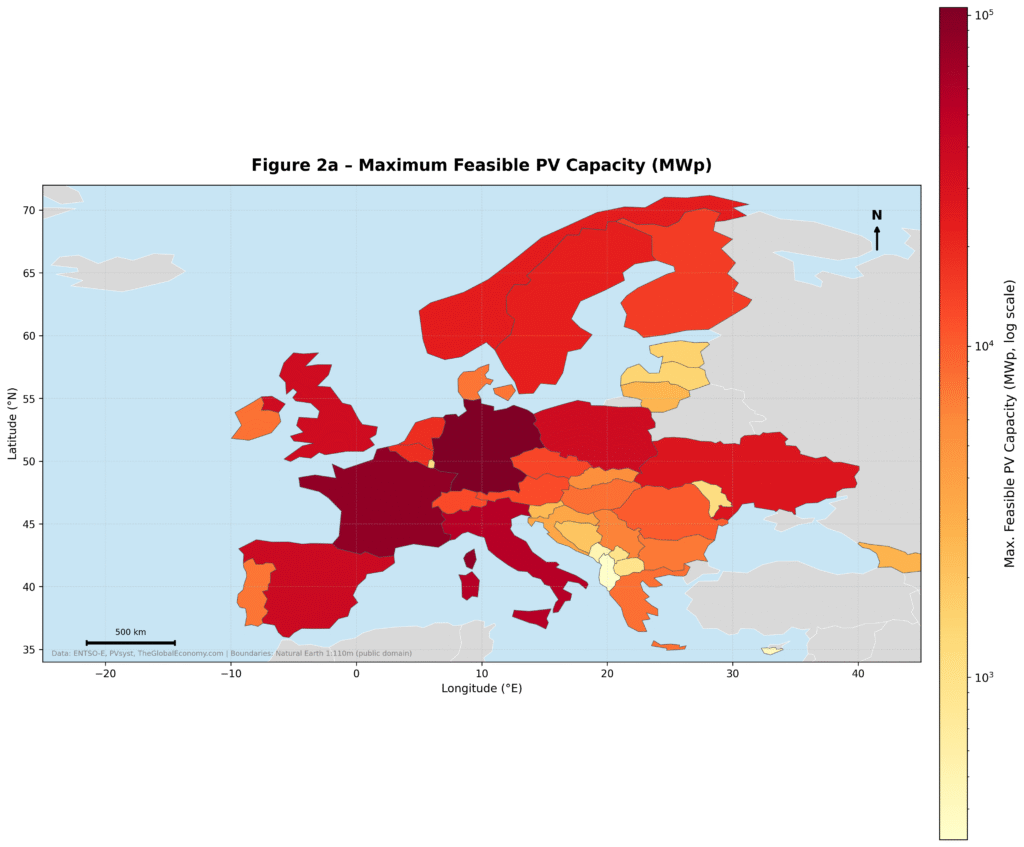
According to figures from the research paper, Germany has the highest feasible PV capacity of the countries analyzed, at around 106 GWp, followed by France (85 GWp), Italy (54 GWp), Spain (39 GWp), Poland (37 GWp) and the United Kingdom (36 GWp). Together, these countries account for over half the continental total.
Across the 38 countries, two were found to have already exceeded their feasible PV capacity as of 2023 installation figures. The Netherlands had installed 23.9 GW of solar by 2023, compared to a modeled cap of 18.6 GW, while Cyprus had installed 606 MW against a modeled cap of 414 MW.
In the research paper, Gholami says any further PV expansion in these two countries will now depend on the success of demand-side and storage measures rather than on raw installation rates. The countries next closest to their modeled caps are Greece (87%), Germany (77%), Spain (74%) and Hungary (72%).
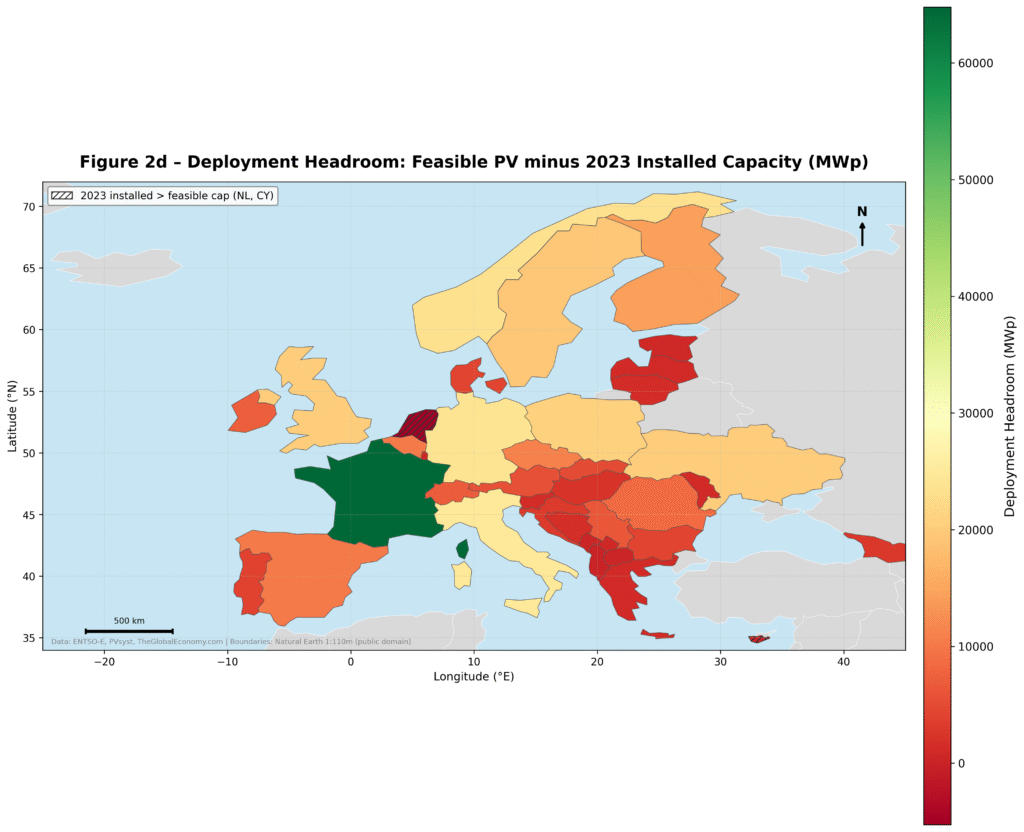
On the other end of the scale, smaller Balkan and Eastern European systems with low installed bases – namely Serbia, Bosnia and Herzegovina, Moldova, Georgia and Kosovo – retain large headroom for solar deployment. Gholami says realizing this potential will depend primarily on financing, permitting and integration with the wider European market, rather than on physical resource.
The research paper also calculated the share covered by feasible PV capacity in each country’s total national consumption. Spain and Georgia lead the dataset, at 27%, followed by Portugal and Italy at 25% and a group of countries – Greece, Switzerland, Ireland, Luxembourg, Romania, Moldova, Austria and Bosnia and Herzegovina – at around 23-24%.
Cyprus recorded the lowest share of the analyzed countries, at 15%, with Finland and Estonia in the penultimate position, at 18%.
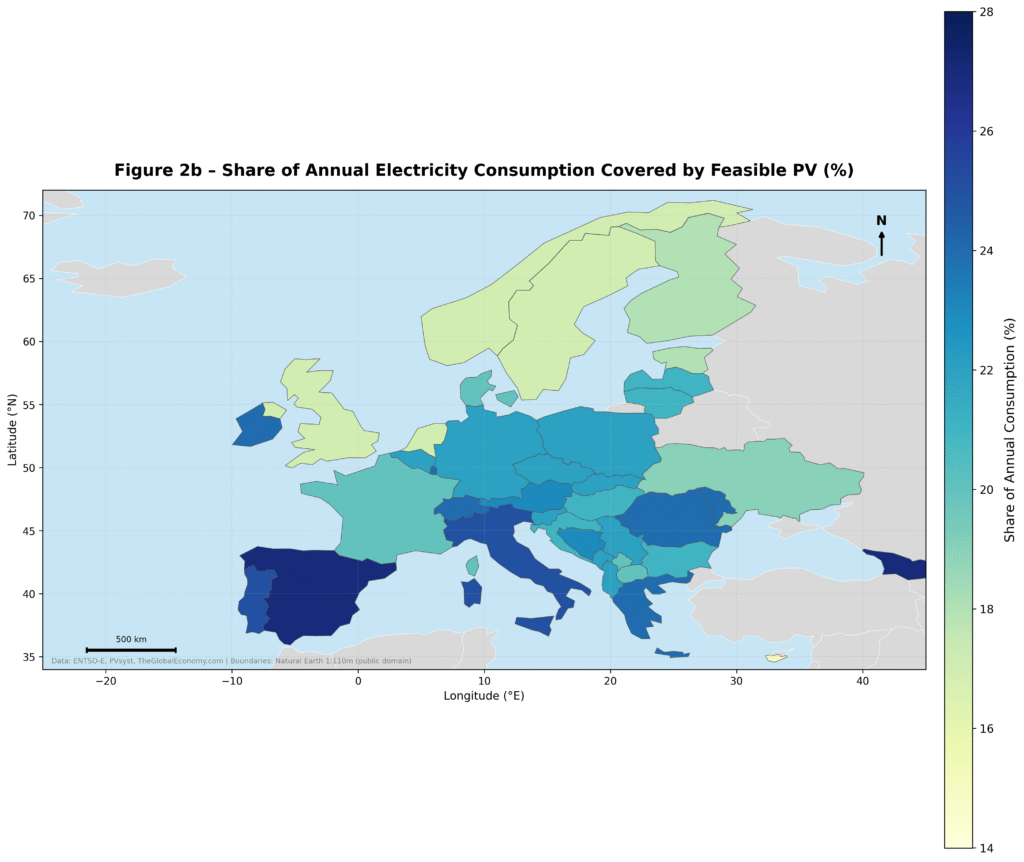
Gholami explained that the research uncovered pronounced regional differences from across the continent, with Southern European systems, led by the Iberian Peninsula, found capable of absorbing proportionally more solar, thanks to stronger and more consistent irradiance. In contrast, Northern and Eastern European systems face tighter limits driven by seasonal mismatch between summer generation and winter demand, as well as infrastructural constraints.
He added that the country-by-country results are intended as a transparent, comparable baseline for planning.
“Policymakers and grid operators can use these numbers to see where the largest deployment headroom still exists today, and where systems are approaching the point at which additional solar starts to spill beyond demand,” Gholami explained. “It helps set realistic national ambitions and target grid investment where it delivers the most value, rather than treating Europe as a single uniform market.”
Gholami also suggested there are a number of measures that can lift the amount of solar that systems can usefully consume.
“To go beyond this demand-constrained baseline, the priorities are grid modernization and stronger cross-border interconnection, clear incentives for energy storage and demand-side flexibility, and the electrification of heating and transport, which grows daytime demand and lets the system absorb more solar,” he told pv magazine.
“Market and tariff reforms that reward flexible consumption, alongside continued support for distributed and building-integrated PV, would all help convert physical potential into delivered generation.”
Source link