

A lot of startups and researchers are looking at putting data centers in space. Why the ocean? And how do you plan to power them?
For the same reasons as you’d think to put them in space, I guess. I don’t know what those people say exactly, but big companies can’t get enough compute and the main reason for that is power. A data center can be built in under two years but they’re looking for 500 MW to 1 GW of power from the grid, and that’s the size of a small town. The grid connections and upgrades needed take years and the power supply can’t keep up. Another issue is the community pushback. It’s important that data center development is done with clean energy and not impinging communities and resources. That’s why we’re putting them offshore. If they come up with their own power supply, it addresses that power constraint issue.
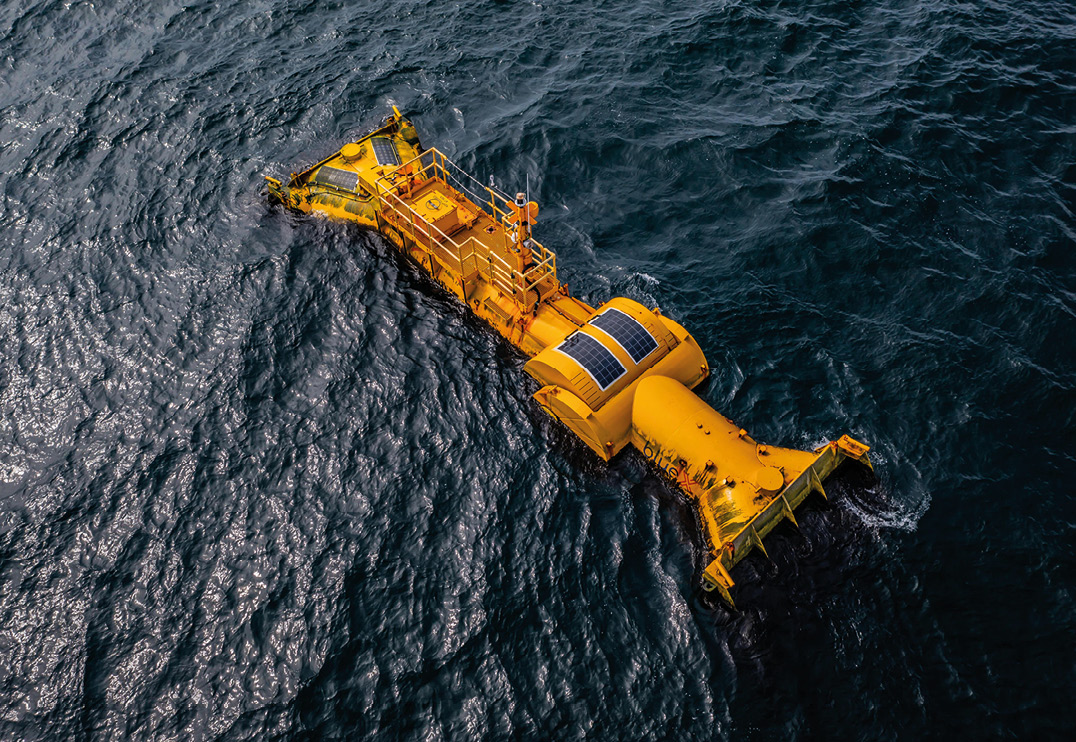
Our data center model, Blue Core, will be floating on the surface. Our systems will be big, but they won’t be as big as oil rigs or anything.
It generates renewable energy from the waves. It will be like an offshore microgrid with built-in solar panels and battery storage and this technology and its deployment offshore have been demonstrated. What we have yet to demonstrate is the integration of that with the data center side of things in a marine environment.
How will GPU racks cope at sea?
Corrosion can be addressed by putting everything inside sealed containers, which is one idea we’re working on. This container would be filled with nitrogen. That’s what Microsoft did with their subsea data center, Project Natick, which was not subjected to wave motions and had eight times better reliability than the equivalent onshore. Microsoft attributed this to the fact there was no oxygen, and because there was no oxygen, they didn’t use fan/air cooling so there was no air blowing over the system which means there was no moisture present. Being at a consistently cool temperature in the sea also helped. Data centers get really hot and the constant temperature fluctuation is what causes components to fail.
With our deployments we’ve had seals climbing on our machines. We’re getting rid of gearboxes in our machines, and we’ll have liquid cooling instead of fan cooling, so there will be less noise. Electromagnetic radiation can be addressed with Faraday boxes. It might be possible to even have a net positive environmental impact if we make that intentional.
How would maintenance and security be managed?
Well, there are still challenges to be addressed around operations and maintenance but none of them are insurmountable, and we are addressing all these risks in the design process. It’s hard doing maintenance at sea. The base case, except probably in exceptional circumstances, is to bring the machine back to shore. There’s a vessel called the Multicat that we’ve used before and is capable of towing our machines. Ultimately, we see being able to use autonomous vessels.
We will do things differently from onshore data centers by necessity. Onshore, if a GPU breaks, you’re right there and you can go in and fix it but that won’t be as practical for our system. We’ll design in redundancy and build in back ups. Maintenance will happen on a scheduled basis in line with expected GPU failure rates. The system, including the batteries and solar panels, will be designed to last for 25 years. It’s the compute that is challenging because the industry is talking about two-year refresh periods.
The Blue Core data center system will be containerized and modular so we can bring the sections back to shore, take out old components and that allows us to decouple the 25-year lifetime infrastructure from the much shorter data center infrastructure that needs to be refreshed more frequently.
How might costs compare with land-based data center construction projects?
Based on our reference design and analysis, it’s much closer than you would think to cost parity with onshore data centers. We estimate that by the time we’ve installed 25 MW, we’ll have reached cost parity with onshore data centers. The benefit of our approach is that the Blue Core units will be manufactured in an already established manufactured process, so the learning rates are good. Our system is an offshore data farm: a collection of smaller units of around 1 MW worth of power in compute linked together with fiber optic cables. The cost of the GPUs and data center side of things dwarfs the infrastructure. The vision is to have Blue Core data farms deployed at megawatt and gigawatt-scale all over the world. We don’t have to have it all in one place either. Western coastlines tend to be great places for wave energy, so Ireland, Scotland, Portugal, Chile, Western Australia, there’s plenty of sites. By having farms around the world, we’ll provide a consistent level of compute and send workloads to different places.
What kind of customers and partners are you hoping to attract to your funding round?
We want to be a neocloud ourselves eventually. We’re partnering with neoclouds and selling to them and to governments. We need to show them that our system works. We have a demonstration next year for Blue Star and we’re also raising investment for the Blue Core data center model with a Pre-Series A.
The post Floating renewables to power data centers appeared first on pv magazine Global.
Source link