

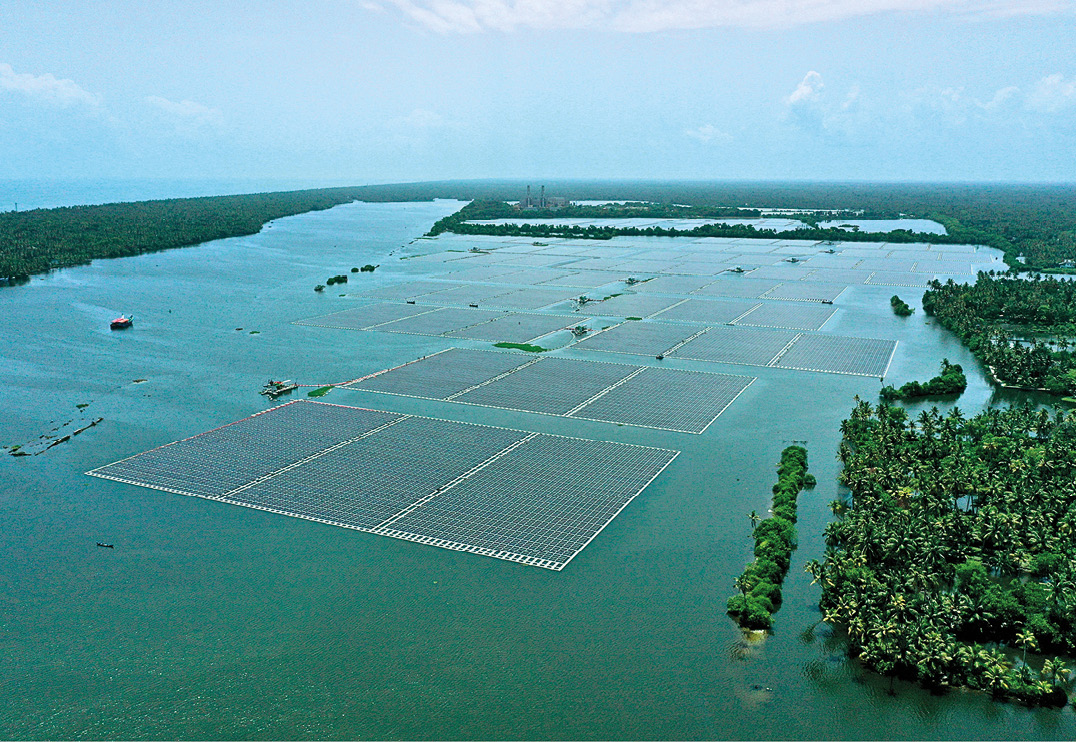
India’s federal government has decided it wants more floating solar and is backing its ambition with investment and incentives.
Deployed floating solar capacity in India stands at roughly 700 MW in 2026, but a new support mechanism approved by India’s cabinet in July aims to see that expanded by 5 GW in a five-year period. The Pradhan Mantri Surya Sarovar Yojana (PM-SSY) scheme is a program for floating solar projects co-located with two-hour energy storage. India’s federal government has budgeted INR 50.7 billion ($530 million) to support projects sanctioned between 2026-27 and 2030-31 fiscal years, with financial support continuing up to 2032-33.
Under the scheme, central financial assistance of INR 10 million per megawatt is promised for eligible floating solar projects, but only after successful commissioning. An additional INR 5 million is being made available for feasibility studies, including hydrography assessments and environmental studies. The central government has committed to supporting all states and union territories in India through the program, which it expects to generate 16,000 to 17,000 jobs, while also promoting domestic manufacturing of components such as floating systems – and of course the country’s growing domestic supply chain for PV cells, modules and energy storage systems.
So if everything goes to plan, the program should result in a fivefold increase in floating solar capacity. It’s a big percentage change but compared to the rate of deployment for ground-mounted capacity, floating solar would remain a drop in the ocean.
State support
“The addressable market size is smaller,” explained Uttamarani Pati, analyst for new energies at Rystad Energy. “It’s not very viable compared to ground-mounted solar. It could have been if at all India was lacking in terms of land resources for ground-mounted solar installations but it’s not the case”
Inland water bodies in India have potential to host 206.7 GWp of solar capacity, according to a 2024 report by the Indo-German Technical Cooperation on Innovative Solar (IN Solar), which forecast 30 GW of floating solar additions by 2040 in its moderate scenario. India’s National Institute of Solar Energy (NISE) has estimated floating solar potential of around 102 GW across reservoirs and other inland water bodies in the country, roughly 3% of the 3,343 GWp of potential ground-mounted PV capacity identified by NISE in a September 2025 assessment.
It’s also possible that financial support is not the main policy lever that India’s government needs to pull. As Pati explained to pv magazine, a disconnect between federal and state government policy on floating solar means that a cash injection does not address the primary risks facing private sector developers. The funding for floating solar may come from central government, but the permissions required to build the project will come from local authorities. For developers, the process can be complex.
“Developers will need to work with state governments and coordinate with the water resource body. Apart from that, there are a bunch of environmental clearances. They’ll need to coordinate with the fishery department which is under the state government. There is definitely project development risk even though there is financial assistance. The government still needs to do more clarification in its policy because the risk right now is more associated with regulations than with the finances.” Pati said.
At the same time, the financial support on offer is significant. Pati said that in her analysis, it could assist developers with close to 20% of a project’s cost, “so definitely a big plus for floating solar developers.”
Proven technology
Arun Kumar, professor of hydro and renewable energy at the Indian Institute of Technology (IIT) Roorkee and lead author of an August 2026 study of India’s floating solar potential, agreed that the key to unlocking more capacity on water bodies partially lies with state governments. But Kumar also pointed to successful large-scale deployments already operating in India as evidence that if state governments and India’s local distribution companies (DISCOMs) get on board, floating solar projects (FPV) can work.
“The technology itself has already demonstrated that large-scale floating PV is possible in India,” Kumar told pv magazine. “We have projects such as Omkareshwar and Ramagundam FPV projects, so basic technology readiness is not the primary barrier. The lack of clear and uniform regulations, overlapping jurisdiction between water, environment, land and fisheries departments and uncertainty around water-use permissions and power evacuation need to be addressed.”
The 100 MW Ramagundam FPV plant is an integrated solar-hydro system that was commissioned in July 2022, while the 278 MW Omkareshwar plant in Madhya Pradesh was commissioned progressively from June 2024 to October 2024. As Kumar’s 136-page Scaling up Floating Solar Photovoltaic Systems report noted, Omkareshwar is already India’s largest floating solar park developed to date. Planned capacity for the reservoir site is 600 MW, if all proposed phases are completed.
Because FPV projects of this size are already advancing, Kumar said the 5 GW capacity target for the PM-SSY support program was not only achievable but could be deployed ahead of schedule, provided the main points of friction were overcome. “These projects will be in the range of 50 MW to 500 MW,” Kumar explained. “To my mind this can be done much earlier than five years.”
Permitting and risk sharing are the immediate bottlenecks to floating solar deployment in India, according to Kumar, although he added that project economics remain an underlying commercial challenge.
Where FPV can be deployed effectively is also a question of geography and state government support. There is large technical potential for floating PV projects – in the range of 100 GW to 200 GW according to Kumar’s assessment – but forecasts depend on a number of variables, including availability of suitable water bodies, restrictions on the percentage of a water body that can be covered by an FPV installation, regulatory clarity, environmental considerations, cost competitiveness, and access to financing. Kumar argued that the important question is whether a predictable framework can be created to convert potential resources into bankable projects.
Business case
Despite the many challenges, there are financial arguments in favor of floating PV that might make reform worth the effort. Avoiding land competition with agriculture and other industries is one benefit, but it’s not the only reason to develop. Floating PV installations have also been shown to reduce water evaporation losses, which has real monetary value in parts of India where drought is an important consideration.
“We’re able to save the water because evaporation reduction is there. If you’re able to sell this point to the politicians because farmers and urban areas [are] getting more water, this will become an overall selling point,” he said.
“In general, in India our evaporation rate is about 1.5 m to 4 m per year. For example, in western India where it is very hot the rate is about 4.5 m. If we talked about more humid areas, it is 1.5 m to 2 m.” With such high volumes of evaporation under the status quo, covering 20% of a reservoir’s surface area with FPV can have a marked impact on water savings, one which scales in hotter regions where it is most needed. And with FPV system efficiency also benefiting from the cooling effect of water, its a win-win situation.
“It’s a very simple calculation. If you’re able to monetize [the saving of water] then all will be encouraged.”
That selling point should be pressed upon state governments, Kumar suggested, as the owners of India’s numerous large dams and reservoirs. Their approval is needed, but there’s a positive business case that can be made.
There’s also scope to integrate with existing hydropower projects, adding new solar and storage resources that can help shape the output of these large generators while also making use of existing infrastructure. Installing FPV on water bodies where existing infrastructure makes deployment easier can also make the case stronger for floating solar.
“Hydropower reservoirs are particularly interesting because FPV can potentially be integrated with existing hydro infrastructure. Prioritizing reservoirs, hydropower dams, irrigation tanks and abandoned mine pits would be a good strategy,” Kumar said. “On the other hand, a project can struggle if it has difficult grid access, complicated water-use rights, high environmental or social sensitivity, significant engineering challenges, or uncertain evacuation and offtake arrangements.”
Energy storage
The real sweetener might be the energy storage mandate included in PM-SSY. India’s DISCOMs are licensed utilities in India that act as the offtaker for large FPV projects and, like offtakers in any maturing solar market, adding battery storage creates opportunities to shift daytime generation to more profitable tariff windows.
“They’ll be ready to go for floating solar because the cost of the project with energy storage will be much cheaper than what they pick up from the market for peak power,” Kumar said.
There are still open questions, and final guidance on how the PM-SSY program will operate was still to be published as pv magazine went to print. What is clear is that the technical capabilities are there, the federal government support exists, and a case can be made that FPV could be an attractive option for state governments and India’s licensed utilities, with benefits beyond the simple generation of electricity. The remaining factors that will make the federal government’s plans to scale FPV a reality include interest from the private sector, regulatory clarity at the state and local level, and the pace of deployment.
The post Government backs Indian floating solar appeared first on pv magazine Global.
Source link