

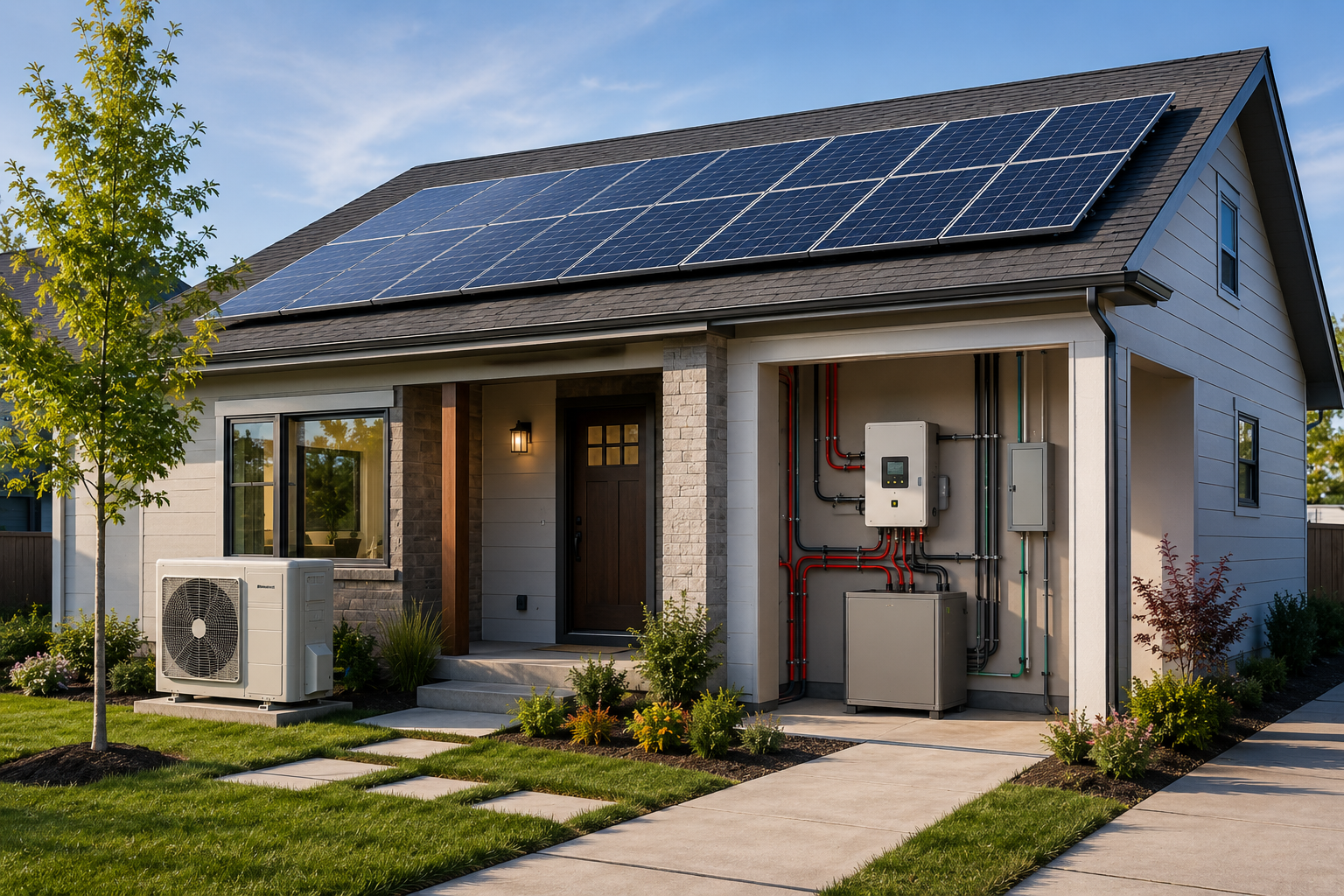
A research team from the University of Liège in Belgium has investigated residential energy renovations and found that adding a 5 kWh battery to a heat pump and rooftop PV system can reduce household grid electricity imports by 17% compared with a configuration without storage.
The findings suggest that residential batteries could help households lower their electricity costs by storing surplus solar generation for use during periods when electricity would otherwise be purchased from the grid.
“We selected a representative Belgian semi-detached home from 708 audited dwellings and calibrated its energy model against four years of measured gas and electricity use,” corresponding author Shady Attia told pv magazine. “We found that adding battery storage reduced annual grid electricity purchases from 40.0 kWh/m² with solar alone to 33.2 kWh/m² with a 5 kWh battery. This represents a reduction of 6.8 kWh/m² annually, without changing the amount of electricity generated by the rooftop solar installation.”
“The three solar configurations had exactly the same net annual energy use. Yet adding a 5 kWh battery reduced grid imports by 17% and operational emissions by 14% compared with solar alone,” Attia added. “The annual balance hides when the home draws power from the grid.”
Battery sizing
The researchers also examined whether increasing battery capacity delivers proportional benefits. “The batteries charged only from surplus rooftop solar and discharged to meet household demand,” Attia explained.
The simulations compared 2 kWh and 5 kWh batteries, revealing diminishing carbon savings as storage capacity increased.
“The first 2 kWh of capacity saved 0.43 kg CO₂e per square meter per year. Increasing capacity from 2 to 5 kWh saved a further 0.31, so the carbon benefit per added kWh of capacity had already declined over that range,” Attia said.
Although the figures refer to emissions rather than electricity costs, they raise questions about whether the reduction in grid electricity purchases from additional storage capacity would justify the higher investment.
“At 5 kWh, the home used 95% of its own solar generation, leaving little annual surplus for a larger battery to capture under the same control strategy,” Attia said. “We tested two sizes, so we can show diminishing returns without locating a precise threshold.”
The findings suggest that larger batteries would not necessarily deliver proportional reductions in electricity bills, as their ability to reduce grid imports would remain constrained by the availability of surplus solar generation.
The researchers modeled a battery operating strategy in which storage was charged exclusively with surplus rooftop solar electricity. However, systems operating under dynamic electricity tariffs could potentially generate additional savings by charging during low-price periods and discharging when electricity prices are higher.
Attia said alternative control strategies could also affect battery performance. “A carbon-aware controller could also charge from the grid in low-emission hours, including in winter, provided the difference in emissions intensity is large enough to offset storage losses,” he said.
Heat pumps
The researchers also found that replacing a conventional gas boiler with a heat pump delivered the largest individual reduction in operational carbon emissions.
“Replacing the gas boiler with a heat pump delivered the largest operational carbon reduction, at 67%,” Attia said. “Adding rooftop PV and a 5 kWh battery brought the total reduction to 75%, from 18.46 to 4.64 kg CO₂e per square meter per year.”
However, grid electricity imports remained concentrated in winter and evening periods, when solar generation was insufficient to meet household demand.
Attia said the results depend on the characteristics of individual buildings and their energy systems. “The percentage depends on the dwelling’s heating demand, the fuel being replaced, heat pump efficiency, solar output, and the local grid’s hourly emissions profile,” he said.
The findings show that residential battery storage can reduce grid electricity purchases even when annual net energy consumption remains unchanged. However, the study did not quantify electricity bill savings or investment payback periods.
The researchers presented their findings in “Decarbonizing residential buildings: Evaluating heat pump solar and battery renovation pathways,” published in Applied Energy.
Source link