

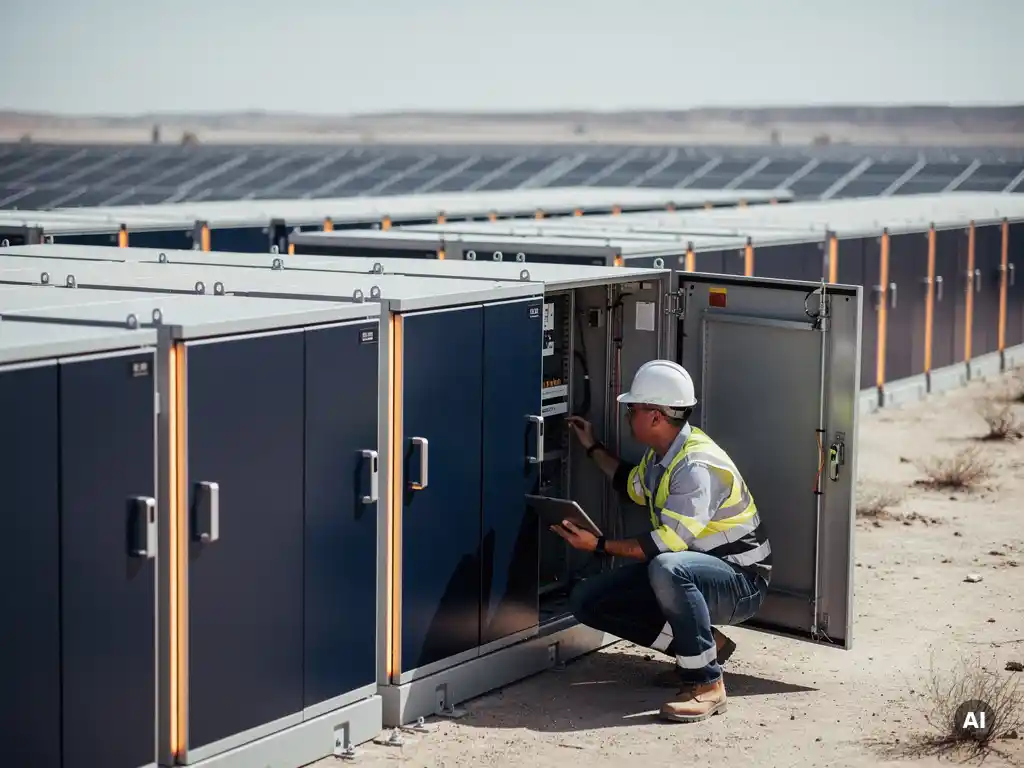
To calculate BESS capacity for peak shaving, multiply your target peak reduction (in kilowatts) by the duration of the peak demand window (in hours). That gives you the minimum energy capacity in kilowatt-hours. From there, you adjust upward to account for depth of discharge limits, system efficiency losses, and whether you’re sizing for average or worst-case demand peaks.
The exact figure depends on your load profile, utility tariff structure, and the battery chemistry you’re working with. Getting the sizing right matters because undersizing leaves demand charges on the table, while oversizing inflates capital costs without proportional benefit.
The sections below walk through each factor in detail, from the core calculation to the data and tools you need to do it properly.
What factors determine how much BESS capacity you actually need?
The BESS capacity you need for peak shaving is determined by four core factors: the magnitude of your demand peaks, the duration of those peaks, your target demand reduction, and the operational constraints of the battery system itself. No single factor works in isolation; all four interact to define the final sizing requirement.
Starting with demand peaks: you need interval-level load data, typically at 15-minute or 30-minute resolution, to understand when peaks occur, how high they reach, and how long they last. A site that spikes to 500 kW for 20 minutes has very different BESS requirements than one that sustains 400 kW for two hours, even though the peak magnitude is lower.
Your target demand reduction is the next variable. If your utility tariff charges demand fees above a specific threshold, you’re sizing the BESS to shave everything above that threshold. If you’re trying to reduce peak demand by a percentage, you need to translate that percentage into kilowatts and then into kilowatt-hours based on peak duration.
Finally, battery system constraints, round-trip efficiency, depth of discharge limits, and degradation over the system’s lifetime, all reduce the usable capacity relative to the nameplate figure. These constraints mean the installed capacity must always exceed the theoretical minimum calculated from load data alone.
How do you calculate the required BESS capacity for peak shaving?
The core formula for BESS peak shaving capacity is: Required Energy (kWh) = Peak Reduction Target (kW) × Peak Duration (hours) ÷ Depth of Discharge (%) ÷ Round-Trip Efficiency (%). This gives you the nameplate capacity the battery system needs to deliver the target reduction reliably.
Here is how to work through it step by step:
- Identify your peak reduction target. From your interval load data, determine the kilowatts you want to shave. For example, if your site peaks at 600 kW and your demand threshold is 400 kW, your target reduction is 200 kW.
- Determine peak duration. Measure how long the peak exceeds your threshold. If the site runs above 400 kW for 90 minutes, your duration is 1.5 hours.
- Calculate raw energy requirement. 200 kW × 1.5 hours = 300 kWh of energy needed at the point of discharge.
- Adjust for depth of discharge. If your battery operates at a maximum DoD of 80%, divide by 0.80: 300 ÷ 0.80 = 375 kWh.
- Adjust for round-trip efficiency. If the system’s round-trip efficiency is 90%, divide by 0.90: 375 ÷ 0.90 = approximately 417 kWh of nameplate capacity required.
This is the minimum nameplate capacity for that specific peak scenario. In practice, you would run this calculation across multiple peak events in your load data and size for the scenario that produces the largest requirement, unless you’ve made a deliberate decision to size for average conditions instead.
What’s the difference between power capacity and energy capacity in BESS sizing?
Power capacity (measured in kilowatts or megawatts) defines how fast the BESS can charge or discharge, while energy capacity (measured in kilowatt-hours or megawatt-hours) defines how much total energy it can store and deliver. For peak shaving, both matter, but they constrain the system in different ways.
Power capacity determines whether the battery can respond fast enough to suppress a demand spike. If your site experiences a sudden 300 kW surge, your BESS needs at least 300 kW of discharge power capacity to counteract it in real time. A battery with 500 kWh of energy storage but only 150 kW of power output cannot shave a 300 kW peak, regardless of how much energy it holds.
Energy capacity determines how long the battery can sustain that discharge. A 300 kW system with 150 kWh of usable energy can only maintain full output for 30 minutes. If your peak lasts 90 minutes, you need at least 450 kWh of usable energy at that power level.
The ratio between power and energy capacity is often expressed as the C-rate. A 1C battery discharges its full energy capacity in one hour. A 0.5C system takes two hours. For peak shaving applications where peaks last one to four hours, a 0.25C to 0.5C configuration is typically appropriate. For short, sharp demand spikes, a higher C-rate system may be needed even if the total energy requirement is modest.
How does depth of discharge affect BESS peak shaving performance?
Depth of discharge (DoD) directly reduces the usable energy available from a BESS relative to its nameplate capacity. A battery rated at 500 kWh with a maximum recommended DoD of 80% delivers only 400 kWh of usable energy per cycle. Exceeding the recommended DoD accelerates cell degradation and shortens the system’s operational lifespan.
For peak shaving, DoD affects sizing in two ways. First, it increases the nameplate capacity you need to install to meet your energy target, as shown in the calculation above. Second, it affects how many peak shaving cycles the battery can perform before capacity degrades to a point where it can no longer meet the demand reduction target.
Lithium iron phosphate (LFP) chemistries, which dominate commercial and utility BESS deployments in 2026, typically support DoD values of 80% to 90% with cycle counts in the thousands. NMC chemistries may offer higher energy density but often carry more conservative DoD recommendations to preserve cycle life.
A practical approach is to design for 80% DoD as a baseline, then model how capacity degrades over the system’s warranty period. If the battery degrades to 80% of its original capacity over ten years, your effective usable energy at end of life drops further, which means your peak shaving capability diminishes unless you account for this in the initial sizing.
Should you size BESS for average peaks or worst-case peaks?
Whether to size for average or worst-case peaks depends on your utility tariff structure and your risk tolerance for demand charge exposure. If your tariff sets demand charges based on the single highest peak in a billing period, worst-case sizing is the safer approach. If demand charges are averaged across multiple interval readings, sizing for typical peaks may be more cost-effective.
Worst-case sizing ensures the BESS can suppress even the most extreme demand events in your historical load data. The downside is that you’re paying for capacity that sits idle during the majority of operating hours. For sites where a single demand charge event can cost tens of thousands of dollars, that insurance premium is often justified.
Average-peak sizing reduces capital expenditure but accepts that some demand spikes will exceed the battery’s output capacity. This approach works best when peaks are relatively consistent in magnitude and duration, or when the financial penalty for occasional missed peaks is modest relative to the cost of additional battery capacity.
A middle-ground approach is to size for the 90th or 95th percentile of peak demand events rather than the absolute maximum. This covers the vast majority of peak scenarios while avoiding oversizing for rare outlier events that may never recur. Reviewing at least 12 to 24 months of interval load data gives you enough statistical range to make this judgment with confidence.
What tools or data do you need to size a BESS for peak shaving?
Accurate BESS sizing for peak shaving requires interval-level load data, utility tariff documentation, battery specification sheets, and either dedicated energy storage software or a well-structured spreadsheet model. Without granular load data, any sizing calculation is an approximation at best.
Here is what you need to gather before starting the sizing process:
- Interval load data: At least 12 months of 15-minute or 30-minute interval meter data from the site. This reveals seasonal demand patterns, peak timing, and the statistical distribution of peak magnitudes.
- Utility tariff schedule: The exact demand charge structure, including the measurement interval, ratchet clauses, and any time-of-use demand windows that affect when peak shaving delivers value.
- Battery specification sheets: Nameplate capacity, usable capacity, maximum DoD, round-trip efficiency, C-rate limits, and degradation curves from the manufacturer.
- Site load forecast: If the site’s load is expected to grow, size the BESS against projected future peaks, not just historical ones.
- Inverter and BMS specifications: Power conversion efficiency and battery management system response time affect real-world performance, particularly for fast-ramping demand events.
On the software side, dedicated energy storage simulation tools allow you to model dispatch strategies, test different sizing scenarios against real load data, and calculate projected demand charge savings over the system’s lifetime. For solar-plus-storage projects specifically, integrating BESS sizing with PV generation modeling is essential, since the solar output directly affects how much grid demand the site places and when the battery needs to be charged and ready.
If you’re working on solar projects that combine PV design with storage integration, Virto Solar’s engineering tools are built to handle the complexity of combined system design within the CAD environments that engineers already use. For project-specific guidance on sizing and system design, reaching out to our team is a practical next step.
Frequently Asked Questions
How often should you recalculate BESS sizing as your site’s load changes?
You should revisit your BESS sizing whenever there is a significant change in your site’s load profile, such as adding new equipment, expanding operations, or onboarding EV charging infrastructure. As a general rule, reviewing your interval load data annually and comparing it against your original sizing assumptions helps you catch drift before it erodes peak shaving performance. If your site load has grown beyond the original forecast, you may need to augment the system or adjust the dispatch strategy to maintain the same demand reduction target.
What happens if the BESS doesn’t fully charge before the next peak demand event?
If the battery hasn’t fully recharged between peak events, its available energy will be less than the system was sized to deliver, which means it may not suppress the next peak to the target level. This is a real operational risk on sites with multiple demand peaks within a single day or billing period. To mitigate it, your battery management system (BMS) dispatch strategy should prioritize recharging during low-demand windows, and your sizing should account for the minimum recharge time available between consecutive peak events, not just the energy required for a single discharge cycle.
Can a BESS sized for peak shaving also handle other use cases like backup power or frequency regulation?
Yes, but stacking use cases requires careful coordination to avoid conflicts that degrade performance across all applications. For example, if the battery is partially discharged for frequency regulation, it may not have sufficient state of charge to execute a full peak shaving cycle when needed. The key is to define a clear dispatch hierarchy in the BMS, where peak shaving takes priority during demand charge windows, and secondary use cases operate within the remaining capacity headroom. Some projects size the battery with additional capacity specifically to accommodate multiple use cases without compromising the primary peak shaving function.
How do ratchet clauses in utility tariffs affect BESS sizing decisions?
Ratchet clauses set a minimum billable demand based on a percentage of your highest recorded peak over a rolling period, often 11 to 12 months. This means a single unmitigated demand spike can inflate your demand charges for an entire year, which significantly increases the financial penalty for undersizing or a missed peak shaving event. If your tariff includes a ratchet clause, worst-case sizing becomes much more financially defensible, since the cost of one missed peak can easily exceed the incremental cost of additional battery capacity. Always review the ratchet terms in your tariff schedule before finalizing your sizing strategy.
What is a common mistake engineers make when sizing BESS for peak shaving for the first time?
One of the most common mistakes is sizing based on peak kilowatt demand alone without adequately accounting for peak duration, which leads to a system that can respond at the right power level but runs out of energy before the demand window closes. Another frequent error is using nameplate capacity figures directly without adjusting for depth of discharge and round-trip efficiency, which results in a system that underperforms from day one. Always work through the full capacity formula, including DoD and efficiency derating, and validate the result against multiple peak events in your load data rather than a single worst-case snapshot.
How does battery degradation over time affect long-term peak shaving performance?
As a BESS ages, its usable capacity decreases due to electrochemical degradation, meaning the system delivers less energy per cycle than it did at installation. For a battery warranted to retain 80% of its original capacity over ten years, a system initially sized at 417 kWh of nameplate capacity will effectively behave like a ~334 kWh system by end of warranty. To maintain consistent peak shaving performance throughout the system’s life, you should either size the initial installation with an end-of-life buffer built in, or plan for a capacity augmentation at a defined point in the project timeline. Reviewing the manufacturer’s degradation curve and warranty terms during the design phase is essential for accurate long-term performance modeling.
Is 12 months of interval load data always enough, or are there cases where you need more?
Twelve months is the minimum recommended baseline because it captures a full seasonal cycle, but it may not be sufficient for sites with significant year-over-year load growth, irregular operational schedules, or recent changes in equipment or occupancy. For sites that have undergone major operational changes in the past year, the historical data may not represent future conditions, making a load forecast more important than the raw historical record. Where possible, using 24 months of data gives you a stronger statistical basis for identifying outlier peaks and seasonal patterns, which directly improves the reliability of your worst-case and percentile-based sizing decisions.
Related Articles
This content was generated with the help of AI — it may contain mistakes
Source link