

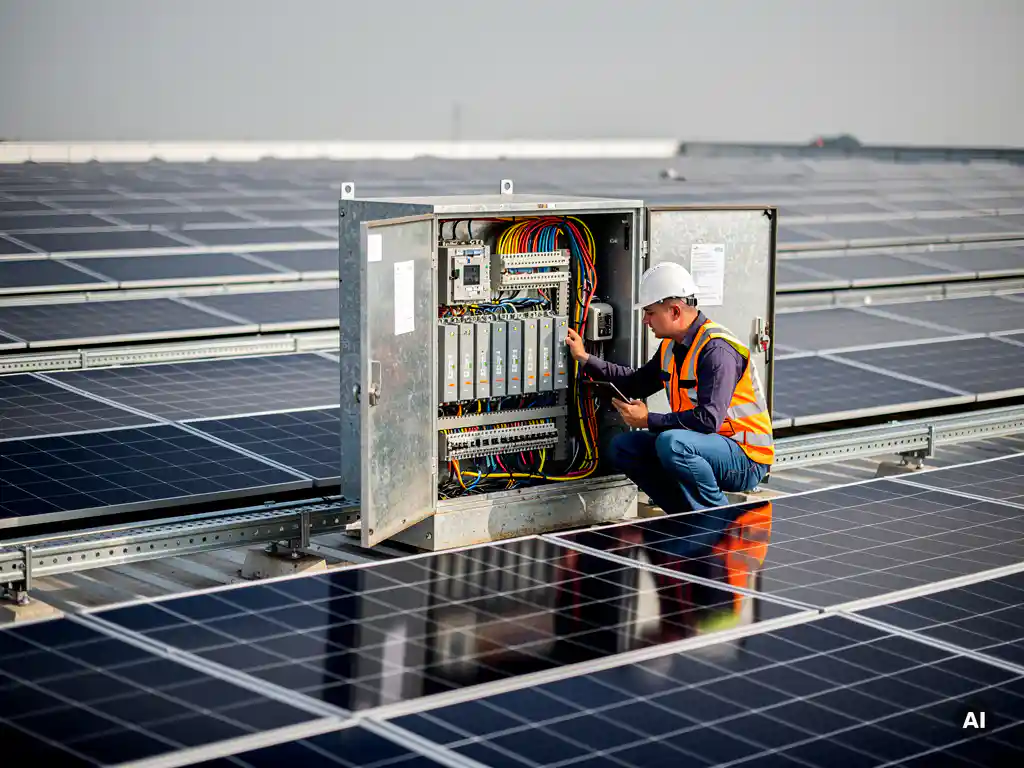
To size a battery for a commercial rooftop project, calculate your target usable energy capacity in kilowatt-hours based on your primary use case, then select a battery system that meets both that energy requirement and the peak power demand of your loads or grid export limit. Most commercial rooftop BESS installations fall between 50 kWh and 500 kWh, though the right size depends on your load profile, PV system output, and project goals. The sections below walk through every key factor, from capacity calculations to the most common sizing errors engineers make on real projects.
What factors determine battery size for a commercial rooftop system?
Battery size for a commercial rooftop system is determined by four core factors: the daily energy you want to store or shift, the peak power demand your system must meet, the depth of discharge your chosen battery chemistry supports, and the primary use case driving the project. No single factor works in isolation, and getting the balance wrong between them is the most common source of oversizing or undersizing errors.
Starting with energy demand, you need a clear picture of the site’s hourly load profile, not just its peak or average consumption. A building that draws 200 kWh per day but concentrates 80% of that load in a four-hour evening window has very different storage requirements than one with a flat, distributed load curve.
Peak power capacity is equally important. A battery bank sized for energy alone may not be able to deliver the instantaneous kilowatts needed during demand spikes, which is a critical consideration for demand charge reduction strategies. Your inverter and battery management system must both be rated to handle the discharge rate your use case requires.
Battery chemistry affects usable capacity directly. Lithium iron phosphate (LFP) systems typically support 80 to 90 percent depth of discharge, while older lead-acid technologies may only allow 50 percent. This means a 100 kWh nominal LFP battery delivers significantly more usable energy than a 100 kWh lead-acid system, and your sizing calculation must account for this difference from the start.
How do you calculate the usable capacity you actually need?
To calculate the usable capacity you need, divide your target daily energy storage requirement by the depth of discharge rating of your chosen battery technology. For example, if you want to store 80 kWh of usable energy and your battery supports 90% depth of discharge, you need a nominal system capacity of at least 89 kWh. Always add a buffer of 10 to 15 percent for system losses and degradation over time.
The calculation follows a straightforward sequence:
- Identify your target usable energy in kWh based on your load analysis or use case
- Divide that figure by the battery’s depth of discharge (as a decimal, e.g., 0.9 for 90%)
- Add 10 to 15 percent to account for round-trip efficiency losses and capacity degradation over the system’s lifetime
- Cross-check the result against the peak power rating to confirm the system can deliver the required kilowatts at the required discharge rate
Lifetime degradation is a factor many engineers underweight at the design stage. A lithium battery that starts at 100 kWh nominal capacity may retain only 80 percent of that after several years of cycling. If your project economics depend on consistent performance over a 10-year horizon, sizing to the end-of-life capacity rather than the day-one rating is the more defensible engineering approach.
What’s the difference between energy capacity and power capacity in BESS sizing?
Energy capacity, measured in kilowatt-hours, defines how much total energy a battery system can store and deliver over a full discharge cycle. Power capacity, measured in kilowatts, defines how fast that energy can be delivered at any given moment. These are independent specifications, and a system that meets your energy requirement may still fail if its power rating is too low for your peak demand events.
Think of it this way: energy capacity is the size of the tank, and power capacity is the size of the pipe. A large tank with a narrow pipe cannot fill a high-demand load quickly, regardless of how much energy is stored inside.
When energy capacity drives the sizing decision
Self-consumption optimization and time-of-use arbitrage are primarily energy-driven use cases. Here, the goal is to store as many kilowatt-hours of cheap or free solar generation as possible and discharge them during high-tariff periods. The discharge happens gradually over several hours, so peak power requirements are relatively modest. A system with a C-rate of 0.5 or lower is often sufficient.
When power capacity drives the sizing decision
Demand charge reduction and backup power for critical loads are power-driven use cases. Demand charges are typically calculated on the highest 15-minute or 30-minute average power draw recorded during a billing period. To shave that peak, your battery must discharge at a rate high enough to offset the spike, which may require a C-rate of 1 or higher. In backup scenarios, the battery must instantly supply the full rated load of the circuits it protects, regardless of how long the outage lasts.
On commercial rooftop projects, most BESS specifications list both figures. Always verify that both the energy and power ratings meet your project requirements independently before finalizing a system selection.
How does the PV system size affect battery sizing?
The PV system size directly limits how much energy is available to charge the battery each day, which sets a practical ceiling on useful storage capacity. Oversizing the battery relative to the solar array means the battery will rarely reach full charge, reducing both the economic return and the effective utilization of the asset. A general rule of thumb is to size the battery to store one to two hours of the PV system’s peak output.
For a 200 kWp rooftop system generating roughly 800 to 1,000 kWh on a good production day, a battery in the 100 to 200 kWh usable range is typically well matched. Going significantly beyond that without a corresponding increase in array size or a grid-charging strategy will result in chronic undercharging.
The DC/AC ratio of your inverter configuration also plays a role. Systems with a high DC/AC ratio clip more generation at peak irradiance, and that clipped energy represents a natural opportunity for battery storage to capture what would otherwise be lost. In these configurations, a slightly larger battery relative to the inverter AC rating can be justified on energy yield grounds.
Seasonal variation matters too. A battery sized to capture surplus generation in July may sit underutilized in December if the site is in a temperate climate with significant seasonal irradiance swings. Reviewing monthly production profiles, not just annual averages, gives a more accurate picture of how the battery will actually cycle across the year.
Should you size the battery for self-consumption, backup, or demand charge reduction?
You should size the battery for the use case that delivers the strongest financial return for the specific site, which varies depending on the local tariff structure, grid reliability, and load profile. Self-consumption optimization suits sites with high daytime solar generation and evening loads. Demand charge reduction suits sites with sharp, predictable consumption peaks. Backup power sizing is driven by critical load requirements rather than economics.
These use cases are not mutually exclusive, but they pull the sizing decision in different directions, and trying to optimize for all three simultaneously often results in a system that is oversized and underperforming on every metric.
Sizing for self-consumption
The target is to store enough solar surplus to cover evening and overnight loads. Start with the average daily solar surplus, which is the generation that exceeds on-site consumption during daylight hours, and size the usable battery capacity to absorb that surplus. This is a relatively straightforward calculation once you have an accurate hourly load profile and a production simulation from your design tool.
Sizing for demand charge reduction
This requires identifying the magnitude and duration of the peak demand events you want to shave. If your site regularly hits a 150 kW demand peak for 30 minutes each afternoon, you need a battery capable of delivering 150 kW continuously for at least that duration, which translates to 75 kWh of usable capacity at a minimum, before accounting for depth of discharge and losses. The power rating of the inverter and battery must both support this discharge rate.
Sizing for backup power
Backup sizing starts from the critical load list, not the solar array. Sum the wattage of all loads that must remain operational during a grid outage, then multiply by the required backup duration in hours. Add a safety margin for motor starting currents and system inefficiencies. The result is your minimum usable capacity, and the battery’s power rating must match the maximum simultaneous load of all critical circuits.
What are the most common battery sizing mistakes on commercial rooftop projects?
The most common battery sizing mistakes on commercial rooftop projects are using peak load instead of average load for energy calculations, ignoring round-trip efficiency losses, failing to account for battery degradation over the project lifetime, and mismatching the power rating to the actual discharge requirement of the chosen use case. Each of these errors can result in a system that underperforms from day one or fails to meet its economic targets within a few years.
Using nameplate capacity without applying depth of discharge is another frequent error. Engineers who specify a 100 kWh battery expecting 100 kWh of usable storage will find the system cycling into its protection limits, accelerating degradation and triggering warranty concerns.
Neglecting the load profile in favor of a simple daily average is equally problematic. A building that consumes 400 kWh per day but draws most of that in a concentrated evening peak needs a battery sized for the peak power demand of that window, not just the total daily energy figure. Sizing to the average will leave the system unable to meet the actual discharge rate required.
Finally, treating battery sizing as a one-time calculation rather than an iterative design decision is a mistake that surfaces late in projects. As module selections change, inverter configurations shift, or load assumptions are refined, the battery specification should be revisited. Tools like Virto Solar’s design platform allow engineering teams to update system parameters and immediately see the downstream impact on sizing, reducing the risk of late-stage rework that costs time and money.
If you are working through a complex commercial rooftop project and want to discuss the right approach for your specific site conditions, get in touch with our team for a direct conversation.
Frequently Asked Questions
What software tools can help with commercial battery sizing calculations?
Several industry-standard tools support BESS sizing for commercial rooftop projects, including Helioscope, PVsyst, and Aurora Solar for production simulation, alongside dedicated storage platforms like Virto Solar’s design tool that let you model energy flows and test sizing scenarios against real load profiles. Spreadsheet-based models can work for simpler projects, but they require manual updates whenever assumptions change and carry a higher risk of compounding errors across calculations. For projects above 100 kWh, using a purpose-built platform that integrates PV generation, load data, and battery parameters in a single model is the more reliable approach.
How do utility interconnection limits affect battery sizing decisions?
Many utilities impose export limits on commercial rooftop systems, capping how much power can be fed back to the grid at any given time. If your PV system regularly generates more than the export cap allows, a battery sized to absorb that curtailed energy can recover otherwise lost generation and improve overall system economics. Conversely, if your interconnection agreement restricts total system capacity, the battery’s inverter rating must be factored into the combined AC output to avoid compliance issues. Always review the interconnection agreement and any applicable grid codes before finalizing your battery and inverter specifications.
What is a good C-rate target for a commercial rooftop BESS, and how do I know if my chosen system meets it?
A C-rate of 0.5 is typical for self-consumption and time-of-use arbitrage applications, meaning the battery discharges its full capacity over two hours, while demand charge reduction or backup applications often require a C-rate of 1.0 or higher for faster discharge. To verify your chosen system meets the requirement, divide the battery’s continuous power rating in kilowatts by its nominal energy capacity in kilowatt-hours — the result is the C-rate. Check both the battery module datasheet and the inverter’s continuous output rating, since the lower of the two figures is the effective limit of the combined system.
How does temperature affect battery performance and sizing on a rooftop installation?
High ambient temperatures, which are common on exposed commercial rooftops, reduce battery capacity and accelerate cell degradation, while very low temperatures can temporarily limit both charge acceptance and discharge power. LFP chemistry is more thermally tolerant than other lithium chemistries, but even LFP systems can lose 10 to 20 percent of usable capacity at extreme temperatures without active thermal management. When sizing for a rooftop environment, factor in the expected operating temperature range for your climate and confirm that the battery enclosure includes adequate thermal management — either active cooling or validated passive design — to maintain performance within the manufacturer’s specified temperature window.
Can I expand the battery system later if my load or solar array grows?
Many modern commercial BESS platforms are designed to be modular and scalable, allowing additional battery cabinets or strings to be added as site requirements grow, but this is not universally true and must be confirmed with the manufacturer before committing to an initial specification. Key constraints include whether the battery management system supports mixed-age cell strings, whether the inverter has headroom for additional capacity, and whether the original installation was wired and permitted with future expansion in mind. Planning for scalability at the design stage — by oversizing conduit runs, selecting an expandable inverter, and documenting the expansion pathway in the permit set — is far less costly than retrofitting for growth after the system is commissioned.
What warranties and performance guarantees should I look for when specifying a commercial battery system?
A credible commercial BESS warranty should cover at minimum 10 years and specify both a cycle count guarantee and an end-of-life capacity retention figure, typically 70 to 80 percent of nominal capacity. Pay close attention to what voids the warranty — operating outside the specified temperature range, exceeding the maximum depth of discharge, or using a non-approved inverter are common exclusions that can leave a project unprotected. Request a performance guarantee that is tied to usable energy delivery rather than just nameplate capacity, and confirm that the warranty is backed by a financially stable entity, whether the manufacturer directly or a creditworthy third-party insurer.
How do I account for battery sizing in a project with both solar and a diesel generator as backup?
In a hybrid system with solar, battery, and diesel backup, the battery’s primary role typically shifts to bridging the gap between a grid outage and generator startup, or to reducing generator runtime during partial-load periods — both of which require careful coordination of the system’s control logic rather than simply summing the load requirements. Size the battery to cover the critical load for the generator’s startup delay, typically 10 to 30 seconds for automatic transfer, plus any additional buffer your resilience requirements demand, and ensure the battery inverter is rated to handle the inrush current of the generator’s transfer switch. Work with a controls engineer to define the dispatch logic early, since the interaction between the battery, solar inverter, and generator can create instability if the system is not properly configured for islanded operation.
Related Articles
This content was generated with the help of AI — it may contain mistakes
Source link