

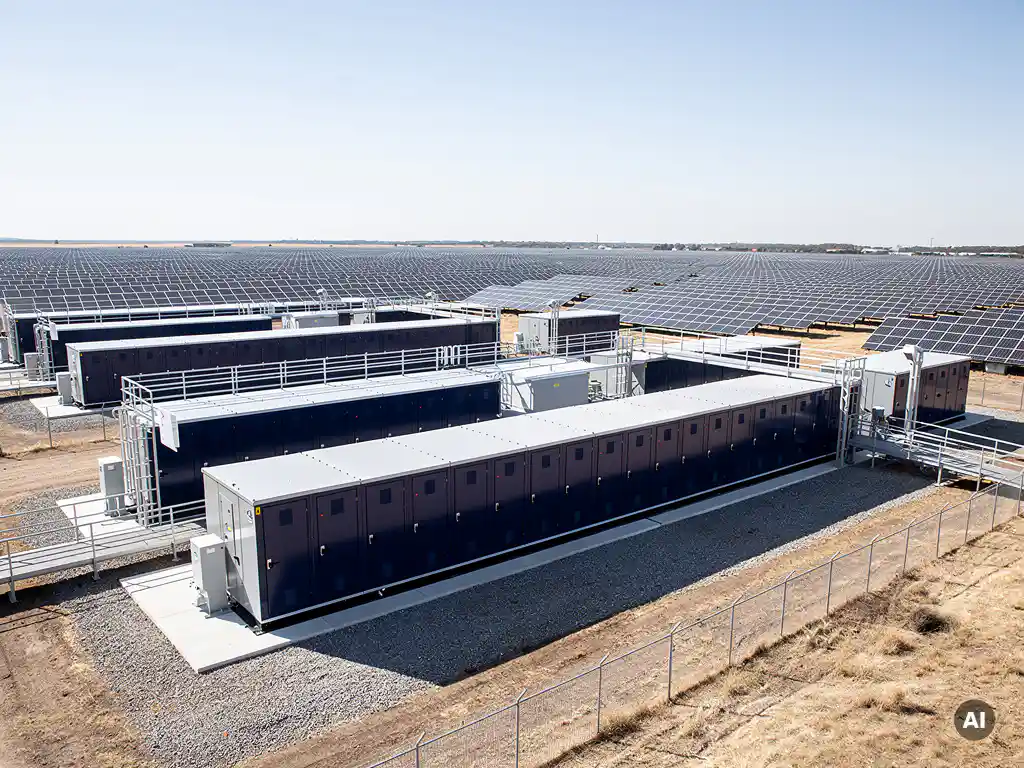
What role does battery storage actually play in a solar system?
Battery storage acts as a buffer between variable solar generation and the predictable, stable power delivery that the grid and end users require. Rather than allowing excess energy to go to waste or forcing curtailment during high-generation periods, a battery system captures that surplus and holds it for dispatch when generation falls short. In a solar project, this transforms an intermittent source into something far closer to a dispatchable asset.
In practical terms, a battery system connected to a solar installation performs several functions simultaneously. It can charge from the solar array during midday peaks, discharge during morning and evening demand ramps, and respond within milliseconds to sudden changes in grid frequency. This combination of energy shifting and rapid response capability is what makes battery storage genuinely valuable for grid stability rather than simply useful for self-consumption.
For utility-scale and large commercial projects, the battery system is typically managed by an energy management system (EMS) that coordinates charging and discharging decisions based on grid signals, price forecasts, and contractual obligations. The battery does not operate in isolation. It works as part of a broader system that includes the inverter, the solar array, and the grid connection point.
How does solar generation cause grid instability in the first place?
Solar generation causes grid instability primarily because its output is variable and difficult to predict with precision. The grid operates on the assumption that supply and demand are continuously balanced. When a large solar array ramps up rapidly at sunrise or drops suddenly under cloud cover, it creates imbalances that force grid operators to compensate quickly using other generation assets or demand response mechanisms.
Two specific phenomena are particularly problematic for grid operators managing high solar penetration:
- The duck curve effect: As solar generation peaks during midday, net demand on the grid drops sharply. Then, as the sun sets, demand surges back while solar output collapses. This creates a steep ramp that conventional generators must cover within a short window, straining grid flexibility.
- Voltage fluctuations: At the distribution level, large rooftop or commercial solar installations can push power back into the grid in ways that cause voltage to rise above acceptable limits. This is especially pronounced on weaker grid connections or in areas with high solar density.
Frequency deviations are another concern. Grid frequency stays stable when generation and load are matched. A sudden loss of solar output, such as a cloud passing over a large array, reduces generation without a corresponding drop in load. If the shortfall is large enough and fast enough, frequency begins to fall. Battery storage can respond to these deviations far faster than any thermal generator, making it one of the most effective tools available for managing solar-driven instability.
What grid services can battery storage provide for solar projects?
Battery storage paired with a solar project can provide a range of grid services, including frequency regulation, voltage support, peak shaving, energy arbitrage, and spinning reserve. The specific services available depend on the battery system’s size, inverter capabilities, grid connection agreement, and local market rules. In many regions, these services can be stacked to generate multiple revenue streams from a single asset.
Frequency regulation and fast-response services
Frequency regulation is one of the highest-value services a battery can provide. Grid operators pay for assets that can respond within seconds to frequency deviations, injecting or absorbing power to bring frequency back within the acceptable band. Battery systems can respond in milliseconds, making them far more capable than gas peakers or hydro plants for this application. In markets with ancillary service programs, a solar-plus-storage project can contract for frequency regulation independently of its energy sales.
Peak shaving and capacity services
For commercial and industrial solar projects, peak shaving reduces demand charges by preventing the site’s peak consumption from reaching levels that trigger higher tariff tiers. At the grid level, battery storage can provide capacity services by committing to deliver power during defined peak periods, effectively replacing the need for additional generation infrastructure. This is increasingly recognized in capacity market frameworks across Europe and North America.
Voltage support and reactive power
Modern battery inverters can inject or absorb reactive power independently of active power, providing voltage support at the point of connection. This is particularly valuable for solar projects on weak grid connections where voltage rise during high generation periods would otherwise require curtailment. Reactive power capability is often a grid connection requirement for large projects, and battery inverters frequently satisfy this requirement more flexibly than dedicated reactive power compensation equipment.
What’s the difference between AC-coupled and DC-coupled battery systems?
The key difference between AC-coupled and DC-coupled battery systems is where in the electrical circuit the battery connects. In a DC-coupled system, the battery connects on the DC side of the inverter, sharing the same conversion stage as the solar array. In an AC-coupled system, the battery has its own dedicated inverter and connects on the AC side, after the solar array’s inverter has already converted DC to AC.
DC-coupled systems
DC coupling is generally more efficient for new-build solar-plus-storage projects because energy from the solar array charges the battery without an additional AC-to-DC conversion step. This reduces round-trip losses. DC-coupled systems also allow the battery to be charged from clipped solar energy, the generation that would otherwise be lost when the array output exceeds the inverter’s AC capacity. This makes DC coupling particularly attractive for projects with high DC-to-AC ratios. The trade-off is that the battery and solar array must be designed together, limiting retrofit flexibility.
AC-coupled systems
AC coupling is the standard approach for retrofitting battery storage to an existing solar installation because the battery system connects independently without modifying the existing solar inverter. AC-coupled systems are also more flexible in terms of battery technology and inverter selection. The additional conversion step does introduce slightly higher round-trip losses compared to DC coupling, but for many projects the difference is modest and outweighed by the installation simplicity and flexibility. AC coupling also allows the battery to charge from the grid, which is important for projects that want to participate in energy arbitrage or provide grid services during periods when solar is not generating.
How do you size a battery system for grid stability in a solar project?
Sizing a battery system for grid stability involves determining the required power capacity in kilowatts and the required energy capacity in kilowatt-hours based on the specific grid services the battery will provide, the solar array’s generation profile, and the grid connection requirements. There is no single formula because the right size depends on the project’s primary use case and the local grid conditions.
For frequency regulation, the sizing focus is on power capacity and response speed rather than energy capacity. A battery providing frequency response may only need to sustain output for a few minutes, so a high power-to-energy ratio is appropriate. For peak shaving or energy shifting, energy capacity becomes the dominant factor, and the battery must be sized to cover the expected duration of the discharge period at the required power level.
Key inputs for battery sizing in a solar project include:
- The solar array’s generation profile, including peak output, daily generation curve, and seasonal variation
- The grid connection agreement, including any export limits or curtailment requirements
- The target grid services and their power and duration requirements
- The battery’s round-trip efficiency and degradation rate over the project lifetime
- The DC-to-AC ratio if DC coupling is planned, since the battery must be sized relative to the inverter capacity
Engineers typically model several scenarios using energy simulation tools to find the size that maximizes value while meeting technical requirements. Oversizing a battery adds capital cost without proportional benefit, while undersizing limits the services the project can provide and may result in curtailment that reduces revenue. Tools like Virto Solar’s design platform help engineering teams model these trade-offs accurately within their existing workflows.
When does adding battery storage to a solar project make financial sense?
Adding battery storage to a solar project makes financial sense when the revenue from grid services, avoided curtailment, demand charge reduction, or energy arbitrage exceeds the total cost of the battery system over its operational life. In 2026, the economics are increasingly favorable for projects in markets with high solar penetration, time-of-use tariffs, or active ancillary service markets, but the case is not universal and depends heavily on local conditions.
The strongest financial cases for battery storage in solar projects typically share several characteristics:
- High curtailment risk: If the grid connection agreement limits export and the solar array regularly generates more than the limit allows, a battery captures that otherwise lost generation and shifts it to periods when export is permitted.
- Significant demand charges: For commercial and industrial projects, demand charges can represent a large share of the electricity bill. A battery that consistently shaves peak demand delivers measurable savings that are easy to quantify.
- Access to ancillary service markets: Projects in markets where frequency regulation or capacity services are compensated can stack multiple revenue streams, significantly improving the return on the battery investment.
- Time-of-use price spreads: Where electricity prices vary significantly between midday and evening, storing cheap solar energy and selling or consuming it during high-price periods generates arbitrage value that can justify the battery cost.
Projects that lack these drivers, particularly those with flat tariff structures, no curtailment risk, and no access to ancillary markets, will find it harder to justify battery storage on financial grounds alone. In those cases, the decision often comes down to grid connection requirements or future-proofing the asset for evolving market conditions.
If you are evaluating whether battery storage makes sense for a specific project, the engineering detail matters as much as the financial model. Getting the sizing, coupling architecture, and grid service strategy right from the start avoids costly redesigns later. Reach out to our team to discuss how to integrate battery storage into your solar project design efficiently and accurately.
Frequently Asked Questions
Can an existing solar project be retrofitted with battery storage without replacing the inverter?
Yes, in most cases an existing solar installation can be retrofitted using an AC-coupled battery system, which connects on the AC side of the existing solar inverter and requires no modifications to the original equipment. This makes retrofitting relatively straightforward from an engineering standpoint, though you will still need to assess whether the grid connection agreement, switchgear, and available space can accommodate the addition. The main trade-off compared to a new DC-coupled build is slightly higher round-trip losses and the inability to capture clipped solar energy.
What happens to the battery system when the grid goes down — does it keep the solar project running?
Not automatically. Most grid-tied solar-plus-storage systems are designed to shut down during a grid outage for safety reasons, a requirement known as anti-islanding protection. To maintain power supply during an outage, the system must be specifically designed with islanding capability, which requires compatible inverters, appropriate protection relays, and a defined load to serve. If backup power or resilience is a project requirement, this needs to be specified at the design stage rather than added as an afterthought.
How does battery degradation affect grid stability performance over the project lifetime?
Battery capacity degrades over time, typically losing 20–30% of usable capacity over a 10–15 year period depending on the chemistry, cycling frequency, and operating conditions. For grid stability applications, this means the battery’s ability to sustain power output for the required duration gradually diminishes, which can affect compliance with contracted grid service obligations. Engineers account for this by either oversizing the battery at the outset to maintain minimum performance at end-of-life, or by building degradation curves into the financial model to anticipate when capacity augmentation may be needed.
What is the typical round-trip efficiency of a battery storage system, and how much does it affect project economics?
Modern lithium-ion battery systems typically achieve round-trip efficiencies of 85–92%, meaning that for every 100 kWh stored, 85–92 kWh is available for discharge. The remaining energy is lost as heat during the charge and discharge process. For projects relying heavily on energy arbitrage or energy shifting, this efficiency loss directly reduces revenue and must be factored into the financial model — a battery cycling daily at 88% efficiency loses roughly 12% of its throughput value, which compounds significantly over thousands of cycles across the project lifetime.
Are there grid connection requirements that mandate battery storage for large solar projects?
Increasingly, yes. Many grid operators and transmission system operators now require large solar projects to demonstrate a minimum level of grid-forming or grid-supporting capability as a condition of connection, which battery storage can help satisfy. Requirements vary by jurisdiction and connection voltage level, but commonly include reactive power provision, fault ride-through capability, and in some cases active power ramp-rate control — all of which modern battery inverter systems can address. Checking the specific grid code and connection agreement requirements early in the project development process is essential, as these obligations can directly influence battery sizing and inverter specification.
What is the difference between a grid-forming and a grid-following battery inverter, and does it matter for stability?
A grid-following inverter synchronizes to the existing grid voltage and frequency and can only operate when the grid is live, making it the standard choice for most solar-plus-storage projects today. A grid-forming inverter, by contrast, can actively establish voltage and frequency references, enabling it to support weak grids, operate in islanded mode, and provide synthetic inertia — a capability that becomes increasingly important as conventional rotating generators are displaced by renewables. For projects on weak grid connections or in systems with very high renewable penetration, specifying a grid-forming inverter can meaningfully improve stability contribution, though at a higher cost and complexity.
How often should a battery storage system be re-optimized after commissioning, and what triggers a review?
Battery dispatch strategies should be reviewed at least annually, and more frequently if market conditions, grid tariffs, or the project’s grid service contracts change significantly. Common triggers for re-optimization include changes to time-of-use tariff structures, new ancillary service market rules, observed degradation that affects available capacity, or changes in the solar array’s generation profile due to soiling or equipment aging. An energy management system with adaptive algorithms can handle routine adjustments automatically, but a formal engineering review ensures the overall strategy remains aligned with the project’s commercial and technical objectives.
Related Articles
This content was generated with the help of AI — it may contain mistakes
Source link