

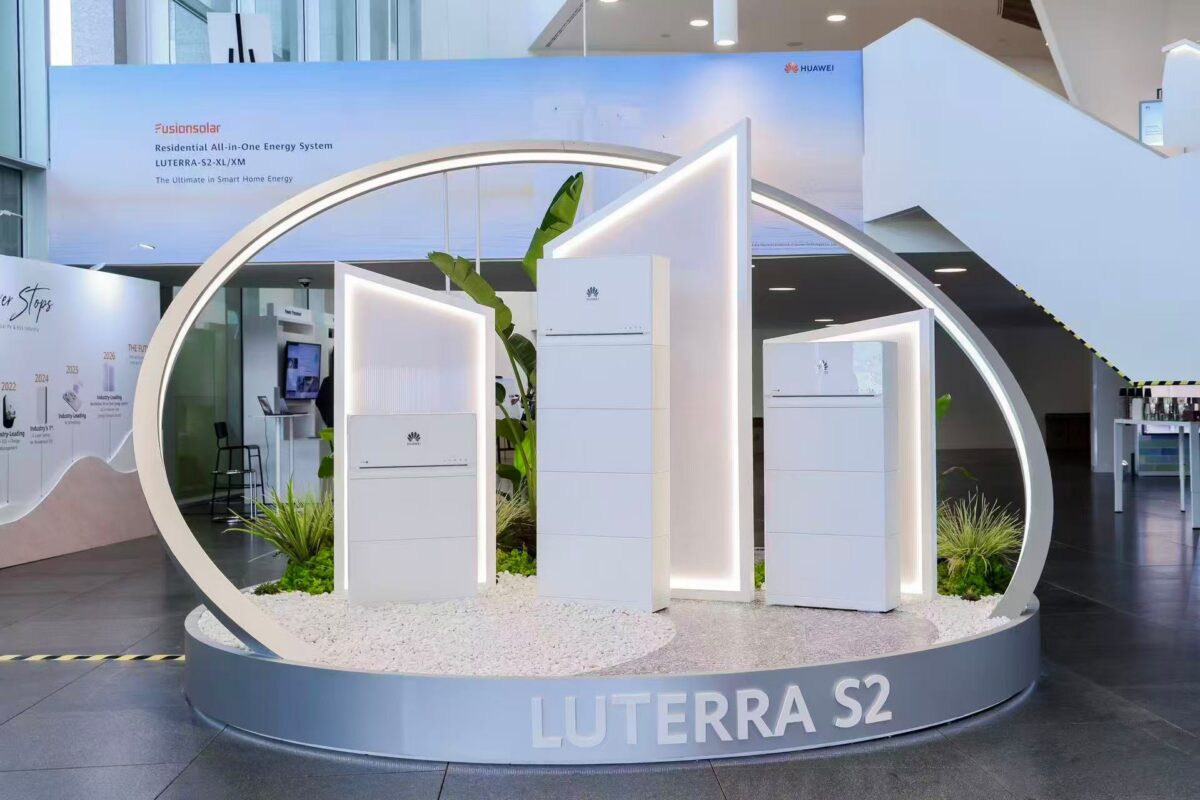
On November 9, Huawei launched LUTERRA S2, its new all-in-one residential energy storage solution, in Palma de Mallorca, Spain. It integrates a hybrid inverter, storage, and AI-powered energy management in one stackable unit. Designed for easy deployment, LUTERRA S2 can be installed and commissioned in minutes. Available in single-phase (3-10 kW) and three-phase (5- 20 kW) configurations, LUTERRA S2 is the industry’s first all-in-one residential energy system built on Huawei’s proprietary full-SiC (silicon carbide) architecture, delivering exceptional efficiency, power density, and reliability.
Steve Zhang, President of Huawei Distributed PV & BESS Business, officially introduced LUTERRA S2. During his presentation, he reviewed the evolution of residential systems, from split to integrated architectures and from AC coupling to DC coupling.
LUTERRA S2 combines a hybrid inverter and a modular energy storage system in a single residential solution. Huawei presented it as the industry’s first all-in-one residential system based on a Full-SiC MOS architecture. The company has brought SiC MOS technology, widely used in the automotive industry, to solar and energy storage applications, combining it with intelligent algorithms to improve efficiency while reducing the system’s size and weight.
Industrial design: an integrated architecture
Jules Parmentier, Director of Industrial Design Strategy and Innovation at Huawei, introduced LUTERRA S2’s industrial design. Inspired by the purity of Arctic landscapes and the beauty of sunlight, the all-in-one system combines a timeless monolithic design with an iconic, dynamic charge and discharge indicator.
To achieve a cleaner and more integrated appearance, Huawei relocated the heat dissipation structure to the rear of the unit and eliminated the plastic side covers of the modules. Ergonomics have also been improved through newly designed quick-release handles, facilitating the handling and installation of the battery modules. The entirely passive cooling system ensures quiet operation, with noise levels below 29 dB.

The FusionSolar app and user experience
Simon Ekstrand, Huawei’s Chief User-Centered Design (UCD) Expert, presented the design philosophy behind the LUTERRA S2 app. The interface uses dynamic visual elements to represent energy flows, illustrating exchanges between photovoltaic panels, the grid, the battery, the home and the electric vehicle.
The visualization adapts to the day-night cycle and weather conditions, making charging and discharging processes easier to understand. The app also provides natural-language explanations of how the system operates and how energy management decisions are made.
Among the new features is Cevia, an intelligent assistant that enables users to make complex queries using natural language and a visual interface based on dynamic cards. These features are integrated into FusionSolar app, allowing users to manage and monitor the system and access information about their installation’s energy performance.
Safety validation and partner participation
The event program included a presentation by Diego Becerro, a representative of TÜV Rheinland, focusing on safety validation. Huawei highlighted that its residential energy storage system had achieved the highest level of TÜV Rheinland’s Safety Mark certification.
LUTERRA S2 incorporates cell-level risk isolation mechanisms to prevent thermal runaway propagation, a directional channel for venting and cooling high-temperature gases, and continuous temperature monitoring at AC and DC connection points. If overheating is detected, the system automatically enters safe mode, activates LED alerts and sends notifications to the user.
Efficiency, safety, and ease of installation
Pablo Sánchez, Huawei’s Technical Director for Distributed Generation PV and Battery Storage, highlighted that the residential system delivers power outputs of up to 10 kW in single-phase configurations and 20 kW in three-phase configurations. The company estimates a cumulative energy delivery of 34,600 kWh over 15 years and states that the battery uses 318 Ah A+ grade cells.
The inverter incorporates Energy Boost technology, based on DTO packaging on SiC MOS, ANPC topology and high-frequency PWM algorithms. Its peak efficiency exceeds 99%, while the low-load algorithm enables efficiency levels above 98.5%. The system’s full charge-discharge round-trip efficiency (RTE) exceeds 90%.
The system also features Glacier Cooling, a technology that reduces total heat generation by 33% thanks to its Full-SiC power design. Meanwhile, Pin-fin technology increases thermal conductivity fivefold and expands the heat dissipation surface area by 90%.
In the area of energy management, Huawei introduced AI Scheduling 2.0, which uses Transformer and Mixture-of-Experts (MoE) models to forecast photovoltaic generation and household demand and calculate charging and discharging strategies. More than 46,000 households are already using Huawei’s AI-powered energy scheduling solution, achieving an average revenue increase of more than 20%, according to figures presented during the event.
The installation process has been simplified into five stages: marking, base mounting, handling using integrated grips, connecting the stackable modules and completing the final plug-and-play connection. Sánchez emphasized that the system can be installed in less than ten minutes. As a benchmark, during the seventh FusionSolar Installer Summit, held in China with 48 teams from 36 countries, the average installation time was under five minutes, while the winning team completed the assembly in just 2 minutes and 32 seconds.
Commissioning is carried out through automatic connectivity via Huawei Home Gateway, NearLink communication and dual-channel WLAN, supported by a guided five-step setup process. To simplify distribution, five stock-keeping units (SKUs) cover the various LUTERRA S2 configurations.
The system provides power outputs of up to 10 kW in single-phase configurations and 20 kW in three-phase configurations. With the new Mini Backup Box, Huawei offers backup solutions of up to 60 kW, with a switchover time of 10 milliseconds.
Sánchez also explained that the system supports up to three inverters operating in parallel and up to 48 battery modules, providing a combined capacity of 336 kWh.
“It also supports integration with third-party inverters in existing photovoltaic installations, enables both grid-connected and off-grid operation, and provides monitoring of those inverters,” he said.
With LUTERRA S2, Huawei brings together energy storage, power conversion, backup capabilities and intelligent energy management on a single platform. The new residential solution combines simplified installation and commissioning with advanced safety features, flexible configuration options and integration with FusionSolar.
More information is available at https://solar.huawei.com/en/products/luterra-s2-xl-xm/
Source link