

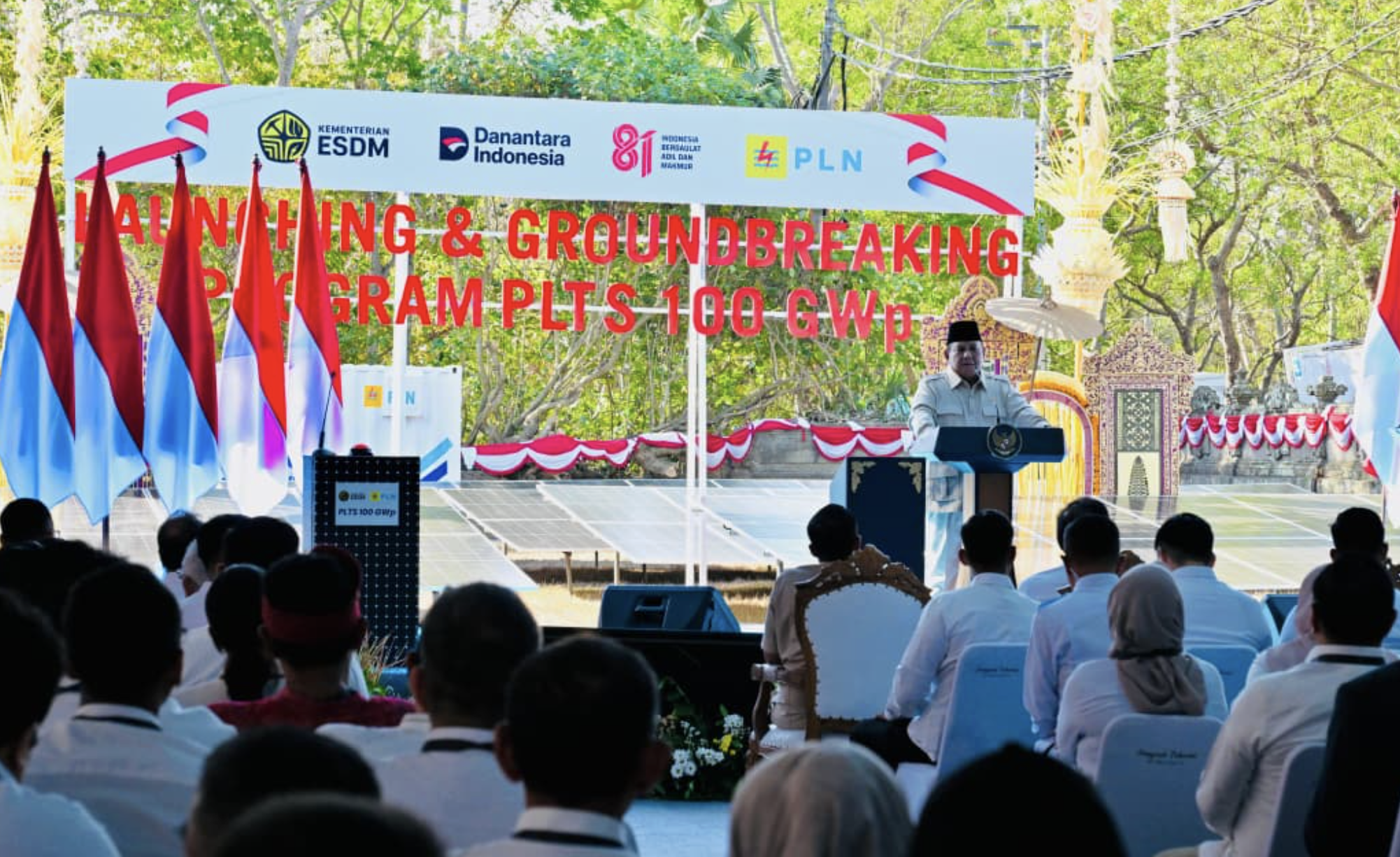
The Indonesian government has officially launched its 100 GW solar power plant program.
Speaking during a groundbreaking ceremony, President Prabowo Subianto said the government is serious about realizing the program and is aiming to develop 100 GW within three years.
According to a statement published by the government, the program will be carried out in phases with the initial phase targeting 17 GW of new capacity.
Under this first phase, 14 solar plants with a combined capacity of 5.2 GW are already in various stages of development. Reports from Reuters add that two of these plants are already in operation, with six in the construction phase and another six to be offered to investors.
Indonesia’s flagship solar program will target the deployment of ground-mounted, rooftop and floating solar power plants, as well as decentralized, smaller-scale solar systems, in order to replace diesel generation, electrify rural areas and villages and strengthen the country’s energy security and independence.
The program will also deploy battery energy storage systems (BESS) in efforts to support a more reliable power system. The official launch of the program coincided with the start of construction of a 305 MW solar project alongside a 1 GWh BESS in the port town of Gilimanuk, west Bali. The project belongs to Indonesia’s power utility PLN.
The 100 GW target surpasses Indonesia’s current electricity generation capacity, which stands at around 88 GW. According to the country’s Minister of Energy and Mineral Resources, Bahlil Lahadalia, it will require approximately $73 billion in investment and has the potential to create over 5.5 million jobs.
In a statement sent to pv magazine, Indonesian think tank Institute for Essential Services Reform (IESR) said that achieving the 100 GW target in less than four years is highly ambitious and will require innovative approaches to implementation.
“For the program to succeed, Indonesia needs a strong and consistent national implementation architecture backed by regulatory certainty,” IESR said. “The government must immediately establish clear program leadership with the authority to coordinate across ministries, PLN, local governments, industry, financial institutions, and businesses.”
IESR’s Chief Executive Officer, Fabby Tumiwa, added that success of the program should not be measured by how many projects break ground, but by how many gigawatts of solar can be built, connected to the grid, and reliably generate electricity before 2029.
“The biggest challenge now is to translate the President’s political commitment into an implementation engine capable of delivering tens of gigawatts of solar PV every year,” Tumiwa added.
IESR is recommending six priority measures to ensure the program achieves its 100 GW target, beginning with immediately finalzing a presidential regulation as the legal framework for the program, and aligning the country’s national energy general plan and PLN’s electricity supply business plan to accommodate the additional capacity.
It also recommends developing a clear annual project pipeline through 2029, accelerating procurement through competitive, transparent, and bankable tenders, ensuring power system readiness, developing a national supply chain and adopting a multi-track implementation so the program is not solely dependent on PLN projects.
Earlier this year, IESR released a report exploring how Indonesia can mobilize its 100 GW solar target as it warned against trying to adopt a one-size-fits all approach to electrifying the 80,000 villages targeted by the program.
Indonesia surpassed 1 GW of solar capacity in 2025, with total capacity reaching 1.49 GW by the end of the year.
Source link