

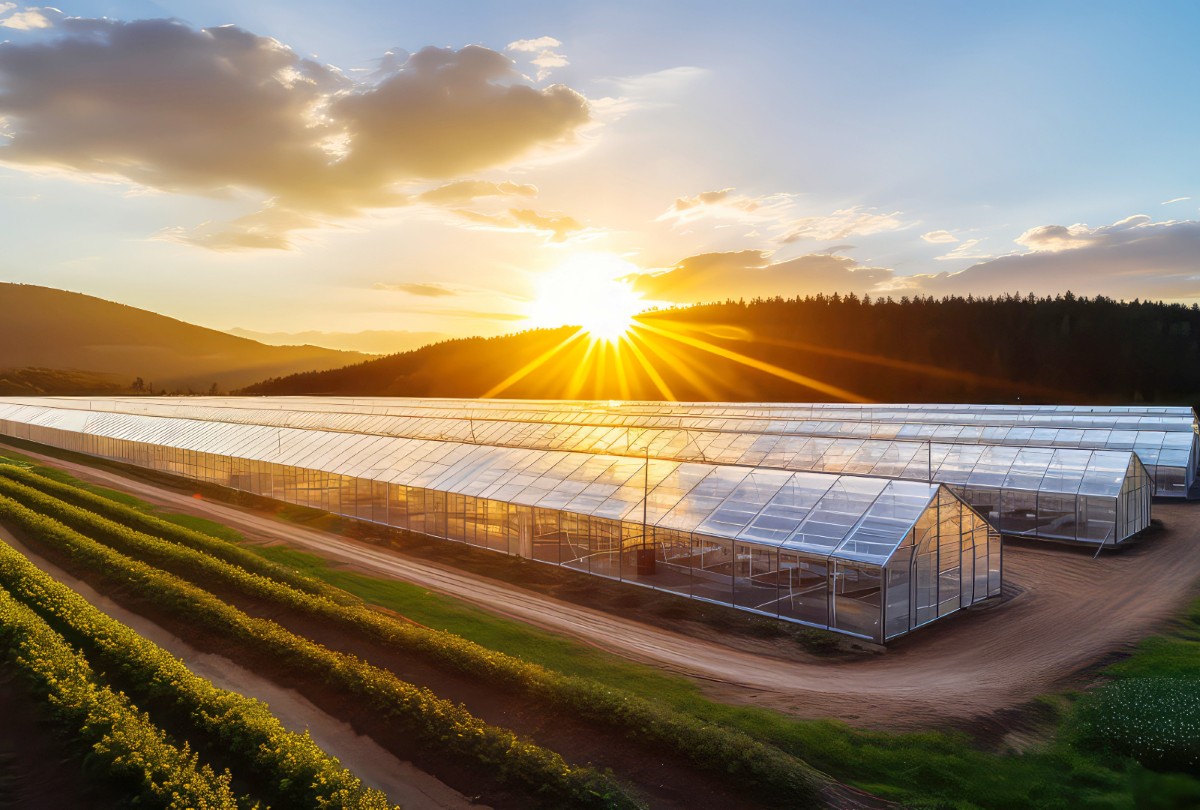
An Italian research team has developed a monitoring system for agrivoltaic greenhouses that integrates 121 sensors across three main subsystems: PV system performance monitoring, greenhouse microclimate and environmental sensing, and automated irrigation management.
“The contribution of this work is threefold,” the researchers said. “First, the development of a modular and integrated microclimate monitoring and irrigation architecture tailored for pilot greenhouse research applications; second, the deployment and operational validation within a semi-transparent PV-equipped greenhouse under real environmental conditions; and third, the demonstration of enhanced irrigation responsiveness and monitoring stability, establishing a scalable foundation for future Digital Twin-based adaptive control.”
The study was carried out within the EU-funded REGACE project at a pilot agrivoltaic greenhouse in Pontinia, central Italy. The site has a Mediterranean climate, with annual global horizontal irradiation exceeding 1,600 kWh/m². Temperatures typically range from around 4 C in winter to 31 C in summer.
The double-span arched greenhouse covers 180 m² (18 m × 10 m). It is oriented along an east-west axis and equipped with a suspended single-axis tracking agrivoltaic system covering approximately 50% of the roof area.
The PV installation has a capacity of 4.8 kW and comprises 64 custom semi-transparent bifacial monocrystalline passivated emitter and PERC modules, each rated at 75 W. The modules are installed 3.2 m above ground level.
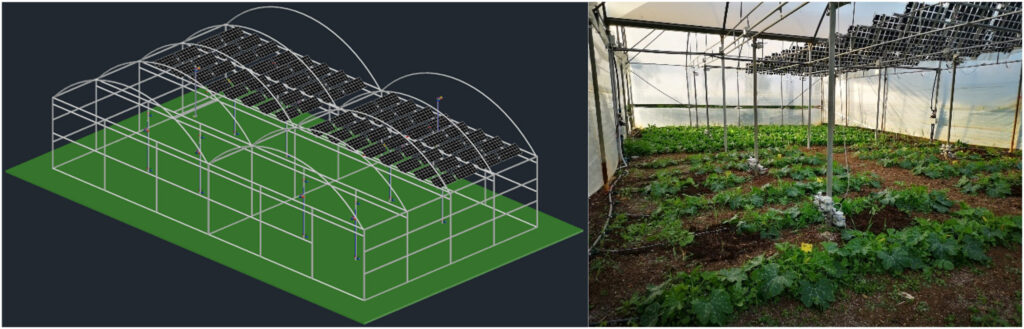
The greenhouse is divided into four experimental sectors: PV-E (east, beneath the PV modules), REF-E (east, unshaded reference), PV-W (west, beneath the PV modules), and REF-W (west, unshaded reference). This configuration allows direct comparison between PV-shaded and unshaded cultivation areas under the same structural, irrigation, and management conditions.
During the first year of operation (2025-2026), the researchers cultivated several crop cycles, including zucchini, lettuce, tomato, eggplant, chard, and fennel.
The 121 sensors communicate through three independent RS-485 Modbus RTU buses, with data collected at five-minute intervals. The PV monitoring subsystem measures global and reflected tilted irradiance, module backsheet temperature, illuminance, air temperature, relative humidity, and CO₂ levels to assess both PV performance and the impact of the system on crop-growing conditions.
The subsystem also uses sub-panel illuminance measurements to control the single-axis tracking PV system, automatically moving the modules toward a near-vertical position when light levels fall below a predefined threshold.
The microclimate monitoring subsystem uses distributed sensor nodes installed at multiple heights inside and above the greenhouse, along with an external weather station, to measure temperature, humidity, CO₂ concentration, photosynthetically active radiation (PAR), illuminance, irradiance, and weather parameters.
Meanwhile, the irrigation subsystem monitors soil moisture, soil temperature, water flow, and pressure, and automatically regulates irrigation in each greenhouse sector using a dual-threshold soil moisture algorithm.
“The distributed sensing network provided synchronized measurements across all environmental variables and captured physically coherent spatial and temporal patterns, including stable diurnal dynamics, vertical microclimatic stratification, and consistent radiometric differences between photovoltaic-covered and reference sectors,” the researchers concluded. “These observations confirm the reliability of the monitoring architecture for long-term environmental characterization in agrivoltaic greenhouse systems.”
The system was described in “Design and implementation of an integrated microclimate, irrigation, and photovoltaic monitoring system for a pilot agrivoltaic greenhouse,” published in the Journal of Building Engineering. Researchers from Italy’s University of Rome Tor Vergata and Fattoria Solidale del Circeo (Circeo Social Farm) have participated in the research.
Source link