

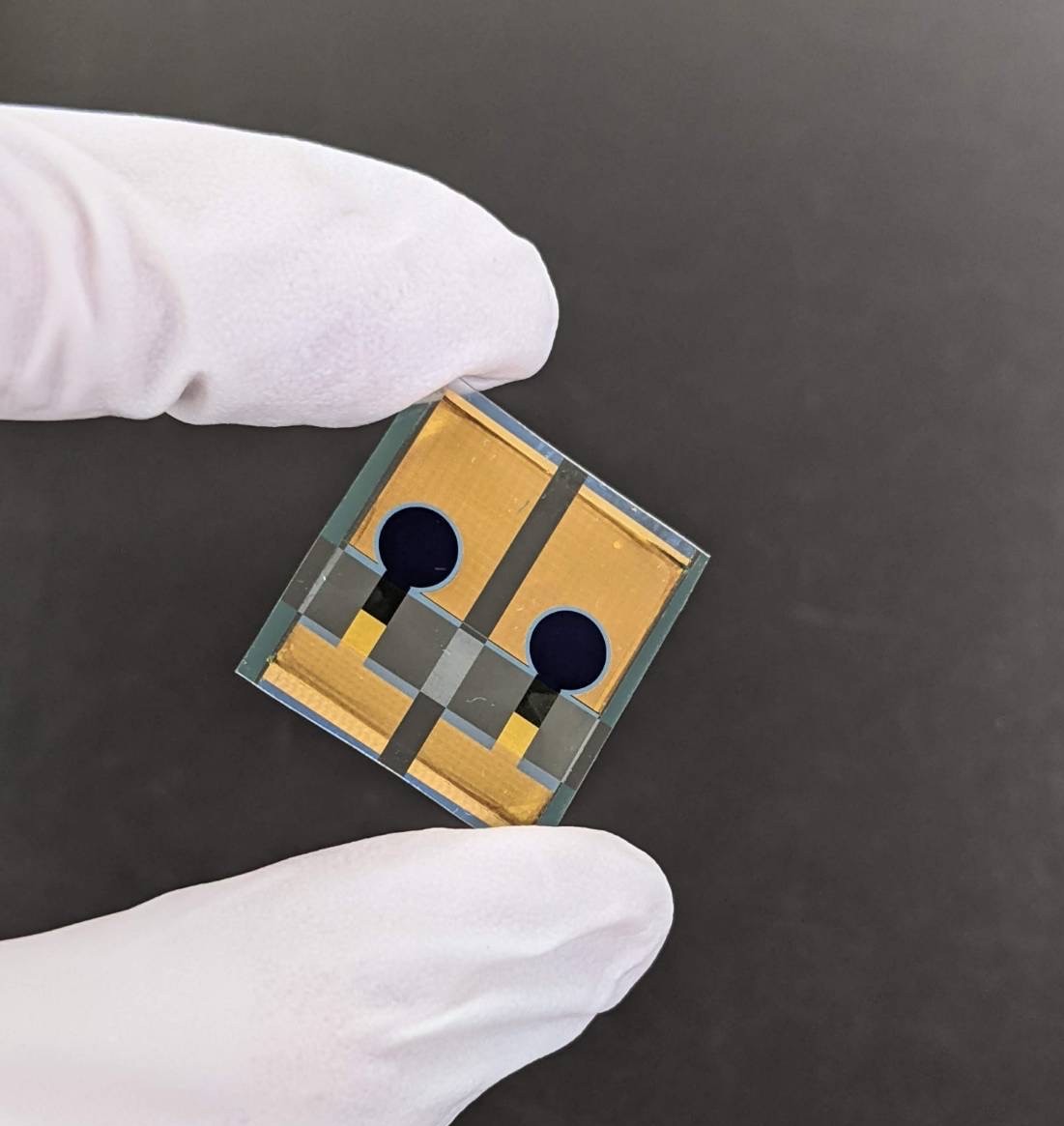
The four-terminal tandem device relies on FAPbI₃ nanoparticles and a spectral splitting design, combining a 24.4% wide-bandgap top cell and a 21.5% narrow-bandgap bottom cell to reach 30.2% efficiency. The system improves light utilization by directing different wavelengths to optimized subcells.
Researchers at the University of Tokyo in Japan have fabricated an all-perovskite tandem solar cell using a novel a light-absorbing layer deposition technique using formamidinium lead iodide (FAPbI3) nanoparticles.
FAPbI3 is widely used in high-efficiency perovskite solar cells because its bandgap of around 1.48 eV, which is close to the ideal value for solar energy conversion. It enables strong light absorption and has helped achieve power conversion efficiencies above 25% in research devices. However, its main limitation is that the desired black α-phase is metastable and can transform into a non-functional yellow phase. This has serious consequences for solar cell performance because it directly changes the material from a light-absorbing semiconductor into a wide-bandgap, non-active phase.
To address this, researchers typically use mixed cations, additives, and interface engineering to stabilize the material and improve durability. The Japanese scientists used FAPbI3 nanoparticles that were synthesized beforehand by a hot injection method for perovskite film formation using a two-step method. FAPbI₃-based perovskite layers were fabricated using a solution spin-coating process on cleaned and UV–ozone-treated substrates under inert conditions. A precursor solution was prepared by dissolving PbI₂ and formamidinium iodide (FAI) in a mixed solvent of dimethylformamide-dimethyl sulfoxide (DMF/DMSO) and stirring it until fully homogeneous.
The solution was then spin-coated onto substrates, followed by controlled thermal annealing to induce crystallization of the perovskite film. This process converted the liquid precursor into a dense, crystalline FAPbI₃ thin film with the desired photoactive α-phase.
The four-terminal (4T) tandem device was built with wide-bandgap (WBG) top cell with an efficiency of 24.4% and a bottom narrow-bandgap (NBG) cell with an efficiency of 21.5% and an inverted structure. The two cells were integrated into a four-terminal spectral splitting architecture using dichroic mirrors that separate light at selected wavelengths. This optical design reportedly minimizes losses while enabling efficient utilization of the solar spectrum across both cells.
The top cell was built with a substrate made of glass and fluorine-doped tin oxide (FTO), a hole transport layer (HTL) made of tin oxide (Sno2), the perovskite absorber, a Spiro-OMeTAD electron transport layer (ETL) and a gold (Au) metal contact. The bottom inverted device was fabricated with a glass and FTO sustrate, a Spiro-OMeTAD ETL, the perovskite absorber, a buckminsterfullerene (C60) HTL, a bathocuproine (BCP) buffer layer, and a silver (Ag) metal contact.

Image: University of Tokyo
“The main advantage of spectral split two-junction, four-terminal solar cells lies in their ability to reduce losses caused by spectral mismatch while achieving high efficiency,” corresponding author Satoshi Uchida told pv magazine. “This is accomplished by directing incident light to the most suitable subcell according to its wavelength. Furthermore, because of the four-terminal configuration, there is no constraint of current matching, allowing for flexible combinations of solar cells with a wide range of compositions. In addition, even if one subcell experiences a failure, the other can continue generating power, providing an advantage from a maintenance perspective.”
Tested under standard illumination conditions, the four-terminal cell was found to achieve a maximum power conversion efficiency of 30.2%. The best performance was obtained at a 775 nm split wavelength, where the WBG top cell contributes 24.1% and the NBG bottom cell 6.1%. This wavelength closely matches the absorption edge of the top cell, ensuring nearly full utilization of its spectral range. Beyond 775 nm, the top cell gains only a small increase in current, while the bottom cell loses significantly more photocurrent, reducing overall gains.
“Overall, our study demonstrates that carefully chosen spectral splitting wavelengths enable very high efficiencies in both four-terminal and two-terminal perovskite solar cell architectures,” said Uchida.
“As for practical deployment, conventional outdoor photovoltaic systems and integration with concentrator photovoltaics are considered particularly promising for our solar cell concept,” he went on to say. “On the other hand, the high cost of dichroic mirrors used for spectral splitting remains a challenge. For future practical implementation, it will be important not only to build on the findings of this study but also to explore simplified architectures, such as monolithic two-junction two-terminal devices and mechanically stacked two-junction four-terminal devices.”
The tandem device was presented in “All-Perovskite Four-Terminal Spectral Splitting Solar Cells of 30% PCE with FAPbI3 Wide-Bandgap Perovskite Fabricated by Nanoparticle Technology,” published in ACS Omega.
This content is protected by copyright and may not be reused. If you want to cooperate with us and would like to reuse some of our content, please contact: editors@pv-magazine.com.
Popular content

Source link