

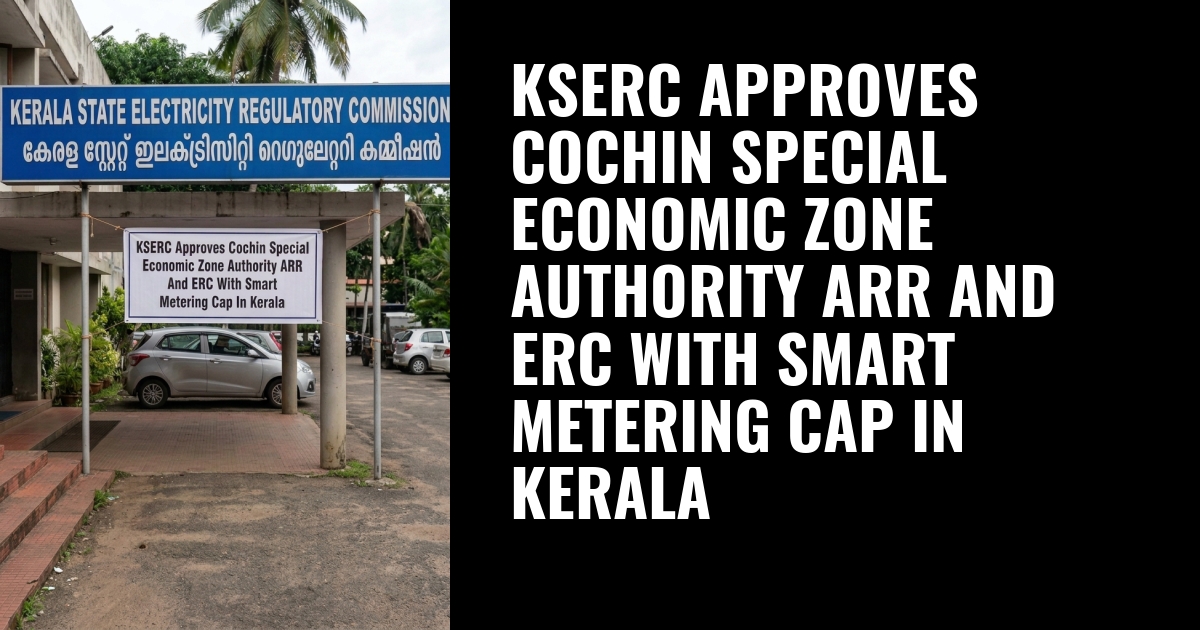
The Kerala State Electricity Regulatory Commission (KSERC) has approved the Mid-Term Performance Review and revised Aggregate Revenue Requirement and Expected Revenue from Charges (ARR & ERC) for the Cochin Special Economic Zone Authority (CSEZA) for the remaining control period of FY 2025-26 and FY 2026-27.

CSEZA, a government-owned developer under the Ministry of Commerce and Industry, manages a 105-acre Special Economic Zone at Kakkanad in Kochi. The authority approached KSERC seeking revisions to its approved projections, citing changes in energy demand following the COVID-19 period, technical losses, operational requirements, and modifications to capital expenditure plans.
CSEZA had sought permission to increase its distribution loss target to 1.58%, citing recent system performance and aging electrical equipment. KSERC, however, rejected the request and maintained the previously approved loss trajectory of 1.41% for FY 2025-26 and 1.39% for FY 2026-27. The Commission held that distribution loss reduction is a controllable efficiency parameter.
Based on the approved projections, power purchase costs from Kerala State Electricity Board Limited (KSEBL) were fixed at Rs. 4,215.95 lakh for FY 2025-26 and Rs. 4,216.80 lakh for FY 2026-27.
KSERC also examined two major capital investment proposals submitted by CSEZA. The first involved the replacement of its approximately 20-year-old metering infrastructure with an Advanced Metering Infrastructure (AMI)-based smart prepaid energy metering and management system. While KSEBL raised concerns regarding the proposed enterprise-scale Meter Data Management System (MDMS), KSERC accepted the need to replace the obsolete system. The Commission approved the project but capped its cost at Rs. 2.27 crore, the amount provided in the original Detailed Project Report (DPR), instead of the vendor’s Rs. 2.75 crore proposal. CSEZA was directed to procure a lean and scalable system through competitive bidding.
The second investment concerned replacement of 11 kV Vacuum Circuit Breaker (VCB) panels at the 110 kV substation. KSERC approved a revised cost of Rs. 233 lakh, compared with the earlier estimate of Rs. 182.60 lakh. The higher cost was attributed to additional technical requirements, including increasing the fault-level rating from 25 kA to 40 kA, additional panels for a new ring system, arc flash protection, and increases in copper and other raw material prices.
Both capital projects will be financed from CSEZA’s accumulated surplus. Since assets funded through regulatory surplus are not eligible for returns or depreciation, KSERC made corresponding adjustments to CSEZA’s claims. Annual depreciation was fixed at Rs. 34.37 lakh, while Return on Net Fixed Assets was approved at Rs. 18.66 lakh for FY 2025-26 and Rs. 16.77 lakh for FY 2026-27. O&M expenses were retained at the normative levels specified under the applicable tariff regulations.
Following these regulatory adjustments, CSEZA’s projected revenue deficits of Rs. 155.24 lakh and Rs. 172.93 lakh were converted into revenue surpluses of Rs. 52.14 lakh for FY 2025-26 and Rs. 52.77 lakh for FY 2026-27. KSERC subsequently disposed of the petition.
Discover more from SolarQuarter
Subscribe to get the latest posts sent to your email.
Source link