

A UNSW-led research team proposed two low-power ride-through strategies for standalone PV–electrolyzer systems to maintain stability during sudden solar power fluctuations without using battery storage.
A research team led by Australia’s University of New South Wales (UNSW) Sydney has proposed two novel low-power ride-through (LPRT) project configurations for standalone PV-electrolyzer (PVEC) systems.
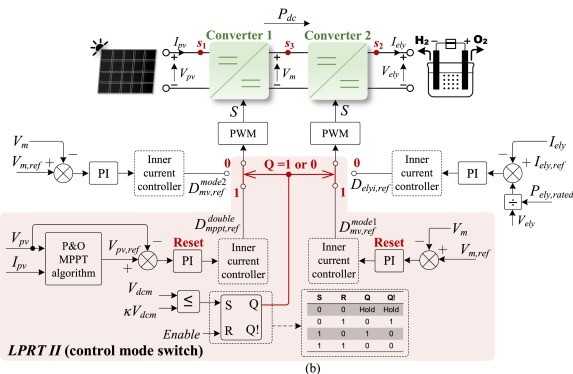
LPRT is a control capability for electrical equipment that allows it to stay connected and continue operating, at reduced power, during short grid disturbances, such as voltage sags, frequency deviations, or partial power loss. When used in PV-driven electrolyzers, it can maintain system stability during drops in solar output by matching the electrolyzer’s power demand to the reduced electricity supply.
“The novelty of this research lies in the systematic comparison of single-stage and dual-stage converter architectures for standalone PV-electrolyzer systems,” corresponding author Kaiwen Sun told pv magazine. “We further included the proposal and experimental validation of two LPRT strategies such as current-reference reduction and control-mode switching, which prevent DC-link collapse during sudden solar power deficits without requiring battery storage.”
The study began with a comparative analysis of single- and dual-stage power interface architectures. Because PV modules and electrolyzers operate at significantly different voltage–current ranges, a power interface (DC/DC converter) was required to match the two systems. In a single-stage configuration, a single converter directly connected the PV array to the electrolyzer, offering simplicity but limited control flexibility. In contrast, a dual-stage architecture introduced an intermediate DC link with two converters, enabling more independent control of the PV and electrolyzer and improving system flexibility and stability under variable solar conditions.
The dual-stage system operated in two modes. In mode 1, the PV array operated under maximum power point tracking (MPPT), while the DC link was regulated, allowing the electrolyzer to follow the available solar power. In mode 2, the DC link was regulated and the electrolyzer current was held constant, enabling precise control of hydrogen production. However, in this mode, sudden drops in solar power can create a mismatch between generation and demand, potentially leading to DC-link voltage instability. Low-power ride-through (LPRT) addressed this issue by either reducing electrolyzer current to match the available PV power or switching back to mode 1, thereby maintaining stable operation.
The proposed approach was evaluated through both simulation and experimental validation. In simulation, a detailed 5 kW system model was developed, including the PV array, electrolyzer, and power electronic converters. The system was tested under dynamic operating conditions, including sudden reductions in solar irradiance. Experimental validation was carried out using a 200 W laboratory prototype based on a gallium nitride (GaN)-based converter, confirming the simulation results under real operating conditions.
“The most surprising results include the dual-stage converter maintaining hydrogen production of 0.58–1.01 Nm³/h with electrolyzer system efficiency as high as 96.75%–97.12% under a 50% irradiance reduction, the control-mode switching strategy stabilizing the system in less than 0.5 seconds, and the counterintuitive finding that electrolyzer efficiency increases as input power decreases (e.g., from 81.42% at 5 kW to 97.18% at 2.04 kW),” said sun.
In conclusion, the researchers noted that their results clearly show that while a single-stage converter is sufficient for small-scale systems, a dual-stage architecture becomes essential for scaling up PV–electrolyzer (PVEC) applications to industrial levels. At these larger scales, significant voltage mismatches make staged power conversion and advanced control features critical for reliable and efficient operation.
“We will focus on the co-design and optimal energy management of hybrid energy storage systems integrated at the intermediate DC-link, alongside advanced control algorithms to enable fully dispatchable, on-demand green hydrogen production, while also exploring isolated converter topologies such as DAB and TAB for improved fault tolerance and scalability in hundred-kilowatt-scale systems,” Sun said, referring to the future direction of the team’s work.
The research work was presented in “Enhancing operational resilience of standalone photovoltaic-electrolyzer systems: A comparative analysis of single- and dual-stage power interface architectures,” published in Applied Energy. Scientists from Australia’s UNSW Sydney, the Netherlands’ Delft University of Technology, and the United Kingdom’s University of Bath have contributed to the study.
This content is protected by copyright and may not be reused. If you want to cooperate with us and would like to reuse some of our content, please contact: editors@pv-magazine.com.
Popular content

Source link