

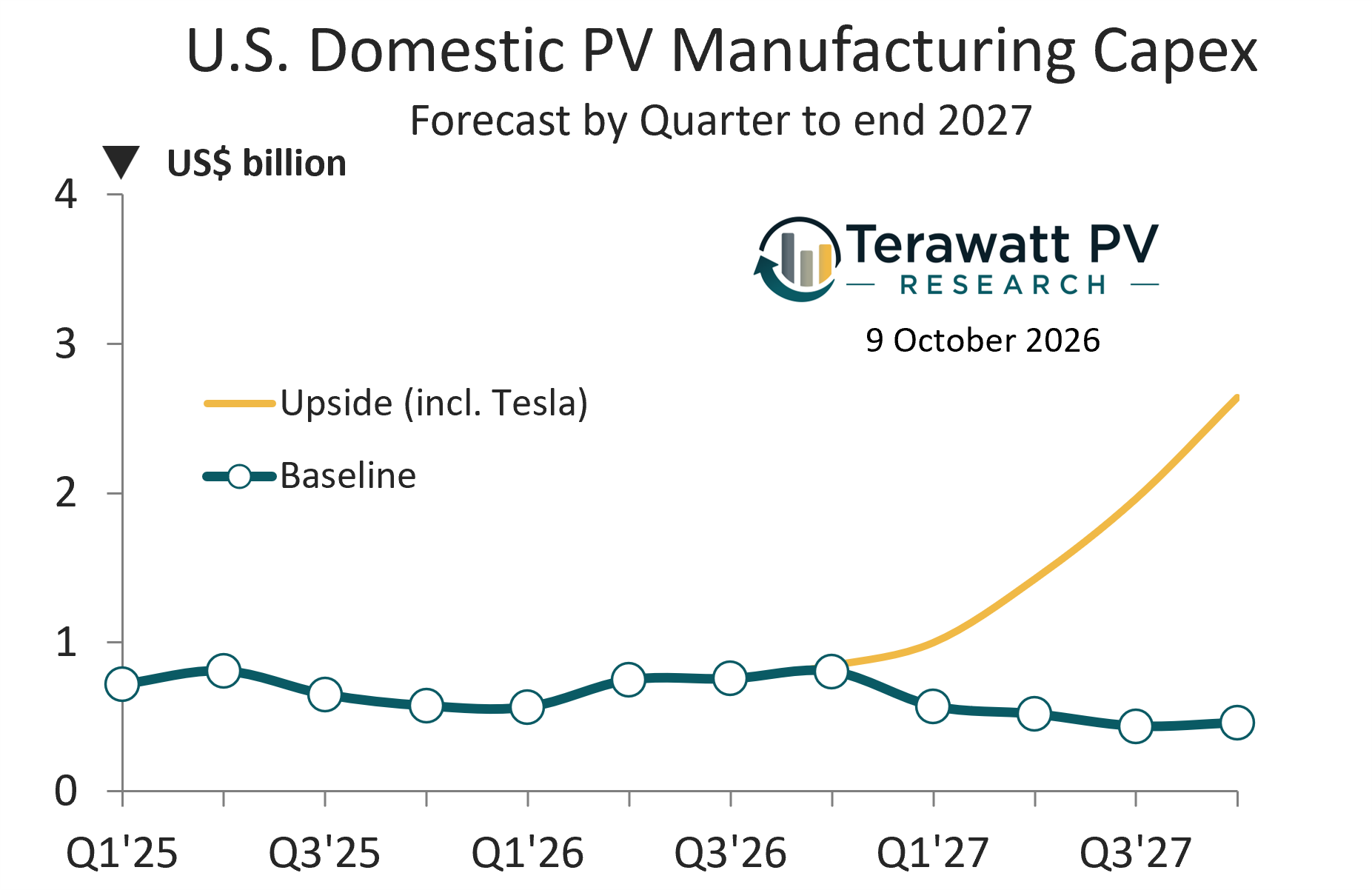
In the final part of the special Austin-debrief series of articles this week in pv magazine, I review the outlook for U.S. solar manufacturing capital expenditure (capex) by quarter to the end of 2027.
For reference, Part 1 of the series addressed domestic U.S. module production forecasting, capturing themes covered at the recent Solar Manufacturing USA 2026 event in Austin, Texas on 22-23 September, with Part 2 looking at cell production by quarter to the end of 2027.
The analysis underpinning the data and conclusions within each of the articles is taken directly from the new Solar Manufacturing USA Quarterly report.
The bottom-up analysis from more than 50 companies in the U.S. manufacturing space for 2027 shows that solar PV manufacturing capex is forecast to see a year-on-year decline compared to the final numbers expected for 2026 (circa. $3 billion).
U.S. solar manufacturing capex peaked in 2024 (almost $4 billion), with more than half this spending coming from just two companies; First Solar and Qcells.
The forecast for 2027 solar manufacturing capex reveals that more than 70% of the announcements made by companies over the past 12-18 months (that would have necessitated spending in 2027) are either unfunded or stranded.
Waiting in the wings however is potentially the most disruptive play ever to be seen in the history of U.S. solar PV manufacturing; Tesla’s mega-sized ingot-to-module manufacturing plans.
It is getting close to factoring in Tesla’s manufacturing capex plans to the analysis that forms the basis of the new Solar Manufacturing USA Quarterly report and indeed using the capex phasing to drive the incremental production volumes across the silicon-based value-chain in the United States.
This would appear to be the missing link in forming a credible 2030 capex and production forecast – something that the downstream buying community and the upstream equipment/materials supply side is badly in need of. Many have spent the past few years looking at interactive pins-on-maps, a trend that was started back in 2022 by U.S. trade associations and government-based portals (once the IRA was introduced) and has no shortage of variants these days.
The financing details and phasing of solar manufacturing capital expenditure ultimately hold the key to forecasting domestic U.S. productivity out to 2030 and beyond. I will return to 2030 production forecasting in the coming days, pending the ‘Tesla’ question.
Why is solar manufacturing capex forecast to decline in 2027?
Those who heard my talk at the recent Solar Manufacturing USA 2026 event in Austin, Texas on 22-23 September will recall me stating that capex is the most important aspect of solar market research and part of understanding this relates to spending cycles.
End-markets can grow during capex downturns, but a capex downturn is likely a symptom of other industry factors that could have longer-term implications.

Figure 1 Excluding Tesla and other upside PV manufacturing capex in 2027, investments in domestic U.S. PV manufacturing are still adapting to the initial post-IRA flurry that was loaded into 2024 as First Solar and Qcells committed record levels of capex to the U.S. sector.
Since 2025, solar manufacturing capex in the United States has been going through a minor downturn cycle. This is a consequence of two factors.
First, the capex by First Solar and Qcells, that was loaded mostly into 2024, was significant in comparison to the overall spending trends of the 20-30 companies that were investing in the U.S. manufacturing space at this point. The loading into 2024 can therefore be regarded as a one-time hit, or an annual outlier. Had the spending phases from either or both companies been spread more into 2023 or 2025, the peak seen in Figure 1 for 2024 would not have been so pronounced.
Second, outside the capex from First Solar and Qcells, there is no other ‘major spender’ at the billion-dollar annual level. Therefore, although the number of manufacturing sites associated with solar manufacturing capex in the United States in the past few years now exceeds 60, the total capex figures for 2025, 2026 and 2027 are all well below the peak seen in 2024.
But the big issue for 2027 is not the specific capex number being forecast. It is driven by Tesla. When will spending start for real? How long does the company plan to keep Chinese equipment in warehouses?
No longer ‘if’, the changes are coming soon. Forecasting U.S. solar capex and production is set to move into unchartered territory
To register your interest in the Solar Manufacturing USA Quarterly report, please send an email to: [email protected]
Source link