

An Austrian research group has developed an integrated optimization framework for heat pump investment planning that explicitly accounts for nonlinear part-load efficiency. The approach recognizes that heat pump efficiency varies with operating load, rather than remaining constant, depending on how much of the system’s total capacity is being used at a given time. This enables the model to more accurately represent real-world operating conditions.
“Heat pumps’ performance characteristics are inherently nonlinear, depending on factors such as minimum load constraints and part-load efficiency, particularly for inverter-driven systems,” explained the team. “While advanced optimization methods exist for operational scheduling, investment planning models typically neglect part-load behavior due to the computational challenges associated with solving nonlinear mixed-integer problems. Instead, simplified linear approximations are commonly employed.”
The new method is designed to address this gap by integrating heat pump sizing and operation into a single optimization framework that accounts for efficiency changes at different part-load ratios.
It can use an exact piecewise-linear (PWL) formulation, a relaxed piecewise-linear formulation (PWLR), or a second-order cone relaxation (CR). The PWL approach models part-load behavior more precisely using linear segments, while PWLR simplifies some of these constraints to reduce computational effort. The CR approach uses a convex approximation of the nonlinear relationships, offering another way to reduce computation time while maintaining a close representation of heat pump performance.
The relaxed approaches reduce computational requirements while preserving the relationship between installed capacity, electrical input, heat output, and part-load efficiency. A linear underestimator can also be applied to limit physically infeasible operating points that may otherwise be permitted by the relaxations.
The researchers demonstrated the method in a case study involving six renovated public administration buildings in Innsbruck, western Austria.
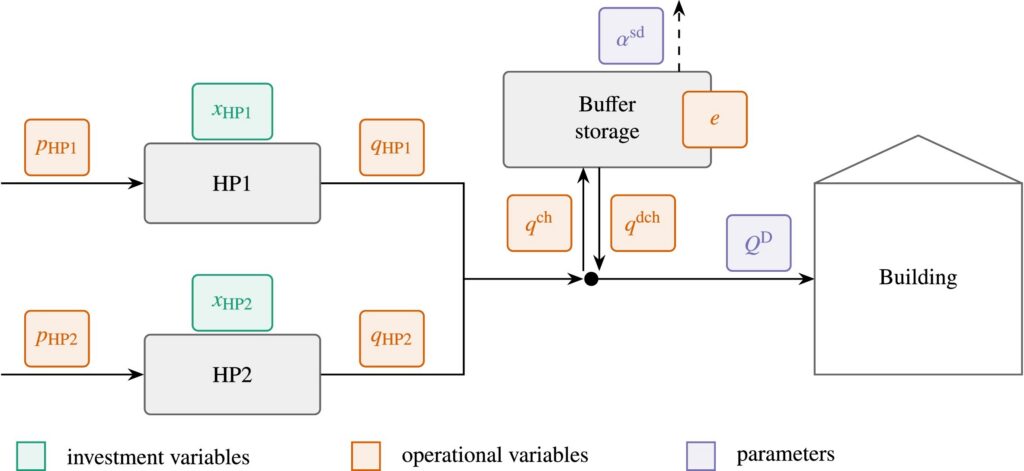
They modeled a heating system comprising two potential water-to-water heat pumps and a 4,000-liter hot-water storage tank, using 15-minute heat-demand data generated with TRNSYS for cold, warm, and average weather years. The buildings had an average annual heat demand of 2,087 MWh and a peak thermal load of 1,664 kW. The heat pumps used groundwater at a constant source temperature of 8 C and operated with a minimum part-load ratio of 10%.
The researchers ran the PWL, PWLR, and CR models separately and compared their performance with two reference formulations – linear programming (LP) and unit commitment (UC) – using the same case study. The reference models selected a single heat pump with 623.5 kW of electrical capacity, while the part-load-aware models favored two differently sized units with approximately the same combined capacity.
“The resulting system design reduces electricity consumption by 4.5% and annual costs by 2.9%, confirmed in an ex-post validation on the full, unaggregated time horizon,” the researchers said. “Furthermore, computational performance analysis shows a 10.3-fold speed-up for the piecewise-linear relaxation and a 4.3-fold speed-up for the conic relaxation, measured in deterministic work units, paving the way for their application to larger energy hub and multi-technology investment problems.”
The article “Modeling nonlinear heat pump part-load efficiency for optimal investment planning” was presented in Applied Energy. Researchers from Austria’s Graz University of Technology and Research Center ENERGETIC have participated in the study.
Source link