


Latest report from Renewables First finds that Pakistan’s solarization continues to grow with households, farms and businesses turning to distributed solar to reduce their reliance on the grid.
Pakistan had deployed an estimated 51 GW of solar as of March 2026, according to a new report from Renewables First, with solar module imports reaching 54 GW by the end of the same month.
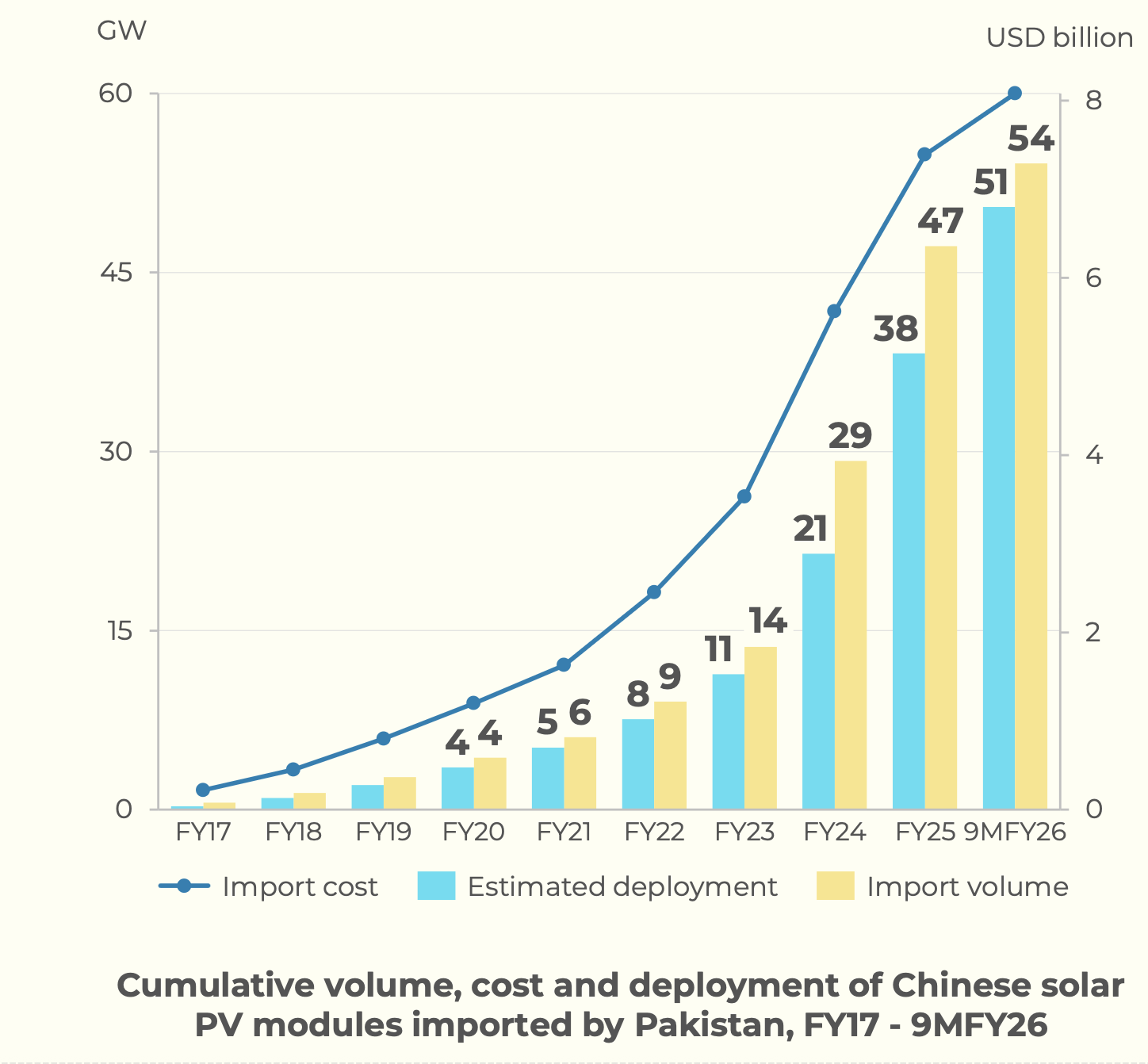
Image: Renewables First
The latest edition of the think tank’s flagship report, Pakistan Electricity Review 2026, finds that electrification in Pakistan is accelerating through distributed solar installations despite grid-based indicators suggesting stagnation.
Figures in the report highlight that electricity generated by utility-scale power sources in Pakistan reached 135 TWh in the period from July 2024 to June 2025, known as fiscal year 2025 (FY25), representing a 2% year-on-year decline. This is the fourth consecutive decline in reliance on utility-scale electricity generation, which peaked at 154 TWh in fiscal year 2022 (FY22).
Away from these figures, distributed solar, consisting of net-metering, behind-the-meter and off-grid solar deployment, generated 51 TWh in FY25, taking Pakistan’s total electricity generation to a record 186 TWh. Renewables First’s report says the 51 TWh generated last fiscal year is equivalent to roughly 46% of grid-supplied electricity over the same time period.

Image: Renewables First
Speaking during a webinar launching the report earlier today, Renewables First Associate – Energy Insights, Nabiya Imran, explained that new growth in electricity is increasingly being met by distributed solar. “It is being met outside the grid,” Imran said. “Or in other words, the demand that was first entirely on the grid has migrated to behind the meter and net metered distributed solar.”
The report adds that grid sales, defined as the electricity purchased by consumers from the state-owned central utility network, reached 111 TWh in FY25, a 1.7% increase year-on-year but down on a FY22 peak. “This does not reflect falling electricity demand,” the report explains. “Instead, a growing share of consumption is being met through distributed solar, indicating that underlying electricity use continues to rise but is increasingly bypassing the grid.”

Image: Renewables First
Renewables First latest report follows previous research that highlighted the scale of Pakistan’s solar market is underrepresented in official statistics. In today’s webinar, Imran explained that there are two parallel systems currently operating in Pakistan.
“On one side, we have the centralized grid, which is structured around unidirectional power flows, thermal plants and thermal dependence. At the same time, we have consumers investing increasingly in distributed solar, driven by high electricity tariffs and cheaper solar panel costs,” Imran told attendees. “So, there’s a mismatch between these two systems. The goal is to bridge that mismatch, because that will help us reduce our fossil fuel dependence and improve macroeconomic resilience.”
Imran added that clean technologies such as solar, batteries and electric vehicles are also an opportunity to localize manufacturing. “And in turn, it supports the broader economic development of the country,” she said.
In the report’s forward, Sohaib Malik, Senior Fellow – Energy Transitions at Renewables First, wrote that while policymakers are starting to recognize the challenges facing the country’s centralized model of power generation and supply, the full extent of the shift is yet to be appreciated by most stakeholders because of the incomplete and imprecise datasets available to them.
The report adds that with distributed solar eroding utility revenues faster than thermal capacity can be rationalized, the sector is moving towards an inflection point with insufficient policy frameworks to navigate it.”
“The sector’s inflection point will depend on how quickly planning and policy frameworks adapt to decentralized, bi-directional electricity flows,” the report says. “A shift in focus from capacity expansion to system optimization (flexibility, storage and demand side management) will be critical to improving efficiency and reducing costs.”
This content is protected by copyright and may not be reused. If you want to cooperate with us and would like to reuse some of our content, please contact: editors@pv-magazine.com.
Popular content

Source link