
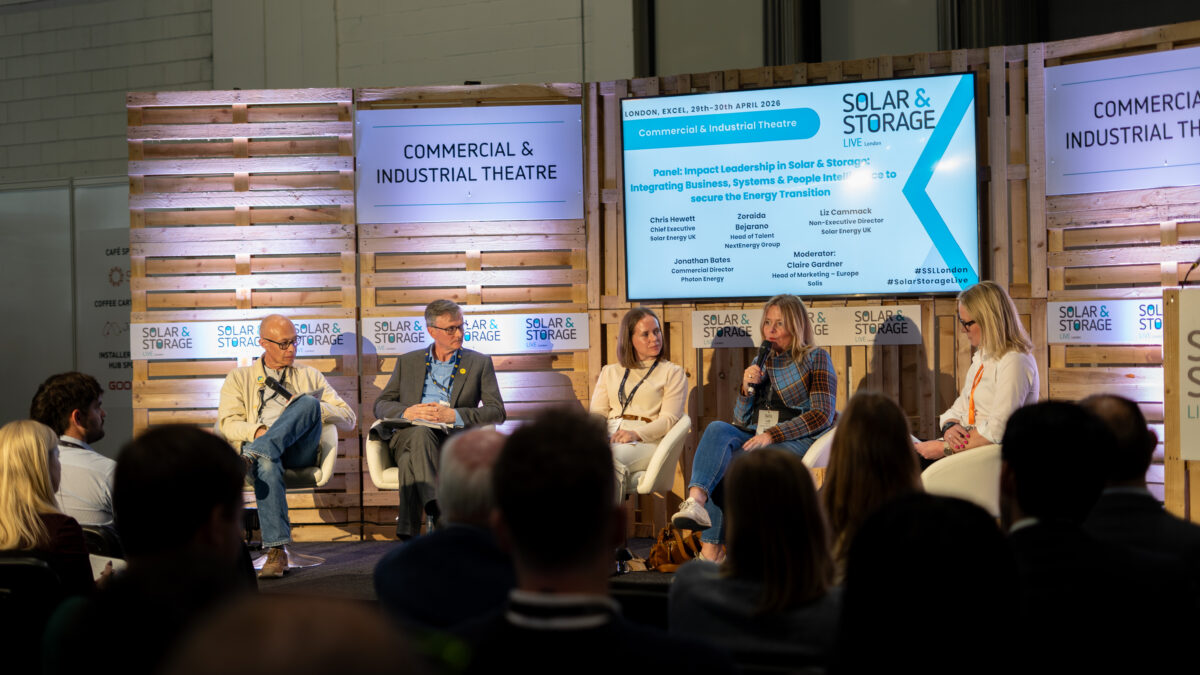
Women in Solar+ Europe highlights this week the insights shared by industry leaders during the panel “Impact Leadership in Solar & Storage: securing the energy transition through people, purpose and systems thinking,” organised by the leadership ecosystem Solar+ Leaders at Solar & Storage Live London. Bringing together voices from across the value chain, the discussion explored how leadership is evolving in response to growing system complexity, skills gaps, and the need for greater alignment across the industry.
At Solar & Storage Live London this week, the Solar+ Leaders panel “Impact Leadership in Solar & Storage: Integrating Business, Systems & People Intelligence to secure the Energy Transition” explored a defining reality: the success of the energy transition will not be determined by technology alone, but by how we lead it.
Moderating the session, Claire Gardner, Head of Marketing- Europe at Solis and Ambassador of WiSEu- Women in Solar+ Europe, framed the conversation by bridging technology and leadership, highlighting that while innovation is accelerating, it is leadership intelligence that will ultimately determine progress: “When we talk about the energy transition, we often focus on the technology. Increasingly, what will differentiate progress, what will prevent delays and truly move things forward, is leadership and how it is led. It is people who will deliver that.” She emphasised that the qualities often used to describe the sector: resilience, agility, responsibility, are not only technological characteristics, but leadership ones: “Those same qualities apply to people. It is leadership intelligence, those who lead with that awareness, that will make the real difference.”
From this foundation, Chris Hewett, Chief Executive, Solar Energy UK anchored the discussion in purpose, a distinctive force shaping the sector: “There is a thread of purpose that runs through most people who work in this sector. It is commercial, businesses are growing and delivering results, but people choose this industry for a reason. That sense of purpose is not unique, but it is certainly special.”
This sense of purpose sets the foundation, and leadership today is being tested by a rapidly changing and uncertain environment. Zoraida Bejarano, Global Head of Talent, NextEnergy Group, brought the human dimension into focus: “We are navigating a complex and challenging moment as an industry, reflecting the wider world we operate in. As leaders in the energy transition, we need to connect with people as they are closely watching their energy bills, global prices, and the impact of change on their lives. Leadership cannot ignore that reality. It requires confidence, transparency, and the ability to respond clearly, while also being honest about the fact that not all answers are available.”
As the industry moves into mass deployment, the complexity increases, not only technically, but systemically. Liz Cammack, Non-Executive Director at Solar Energy UK and Member of the Board of Advisors at OpenSolar, described this shift clearly: “The industry has moved beyond early adoption. What lies ahead is mass deployment, and that is the most complex stage. This phase is more price-sensitive, more demanding, and requires clear value for consumers. While innovation is progressing rapidly, success now depends on alignment across the entire value chain. Targets alone are not enough. If manufacturers, distributors, installers, and policymakers are not aligned, those targets will not be achieved. The technology is in place, success now depends on leadership.”
That complexity is also reflected in the nature of the work itself. Jonathan Bates, Director, Photon Energy, highlighted how the industry exposes the skills challenge in a very tangible way. “The technical bit actually is the easy bit. The difficult part is the breadth of understanding required beyond the technology. You need to understand building types, legal frameworks between tenants and landlords, health and safety, and financing mechanisms. To operate effectively in this industry, you need a whole range of skills. We can’t simply take people off the shelf and expect them to fit into these roles. We need to train them, empower them, and nurture them to be able to fulfil their job and their role. It’s a highly varied and complex environment.”
Jonathan also pointed to the structural implications of this challenge, particularly at the level of workforce development. We need apprenticeships, we need career paths, and we need a clear vision for people across the entire delivery chain, from those working on rooftops to those delivering large-scale projects on the ground.”
Chris Hewett addressed how the sector can actively address these gaps: “There is a set of technical skills we need in the industry, but also a set of cross-cutting skills. As an industry, we need to be more open to the transfer of these skills across sectors. People may start in one area and move into solar and energy storage as part of a wider career path, and we can learn a great deal from more mature industries. Anyone working in solar energy has to become a fast learner. There are so many different skills involved. Across teams, whether in marketing or policy, people are required to grasp complex topics, learn quickly, and translate that knowledge into meaningful communication.”
He also emphasised the importance of making those pathways visible: “Through initiatives like Solar Careers UK, we are identifying skill gaps, defining competencies, and signposting training pathways. We are now seeing people from different backgrounds actively seeking to enter the sector. That porous nature is essential if we are to attract talent from beyond our traditional boundaries.”
This perspective was reinforced as the conversation moved into leadership capabilities and investment priorities. Zoraida Bejarano raised a critical imbalance: “Significant investment is being made in technology, software, and AI. The question is whether the same level of investment is being made in leadership capabilities. Are leaders being prepared to respond to uncertainty, to communicate change, and to manage complexity? In most cases, investment in people is not keeping pace with investment in technology.” Bejarano emphasised the importance of transparency in leadership. “People do not expect leaders to have all the answers. They expect clarity, honesty, and an understanding of what is happening within organisations and across the industry.”
Liz Cammack closed with a reflection that brought the discussion back to the system as a whole: “There is still a lack of alignment and communication across different segments of the industry… leadership must become more connected and more willing to prioritise long-term outcomes over short-term gains.”
The message from the panel was clear: the energy transition is no longer only a technological challenge. It is a leadership challenge, one that requires integrating business intelligence, systems thinking, and people intelligence to deliver not only speed, but resilience, trust, and lasting impact.
The views and opinions expressed in this article are the author’s own, and do not necessarily reflect those held by pv magazine.
This content is protected by copyright and may not be reused. If you want to cooperate with us and would like to reuse some of our content, please contact: editors@pv-magazine.com.
Popular content

Source link