

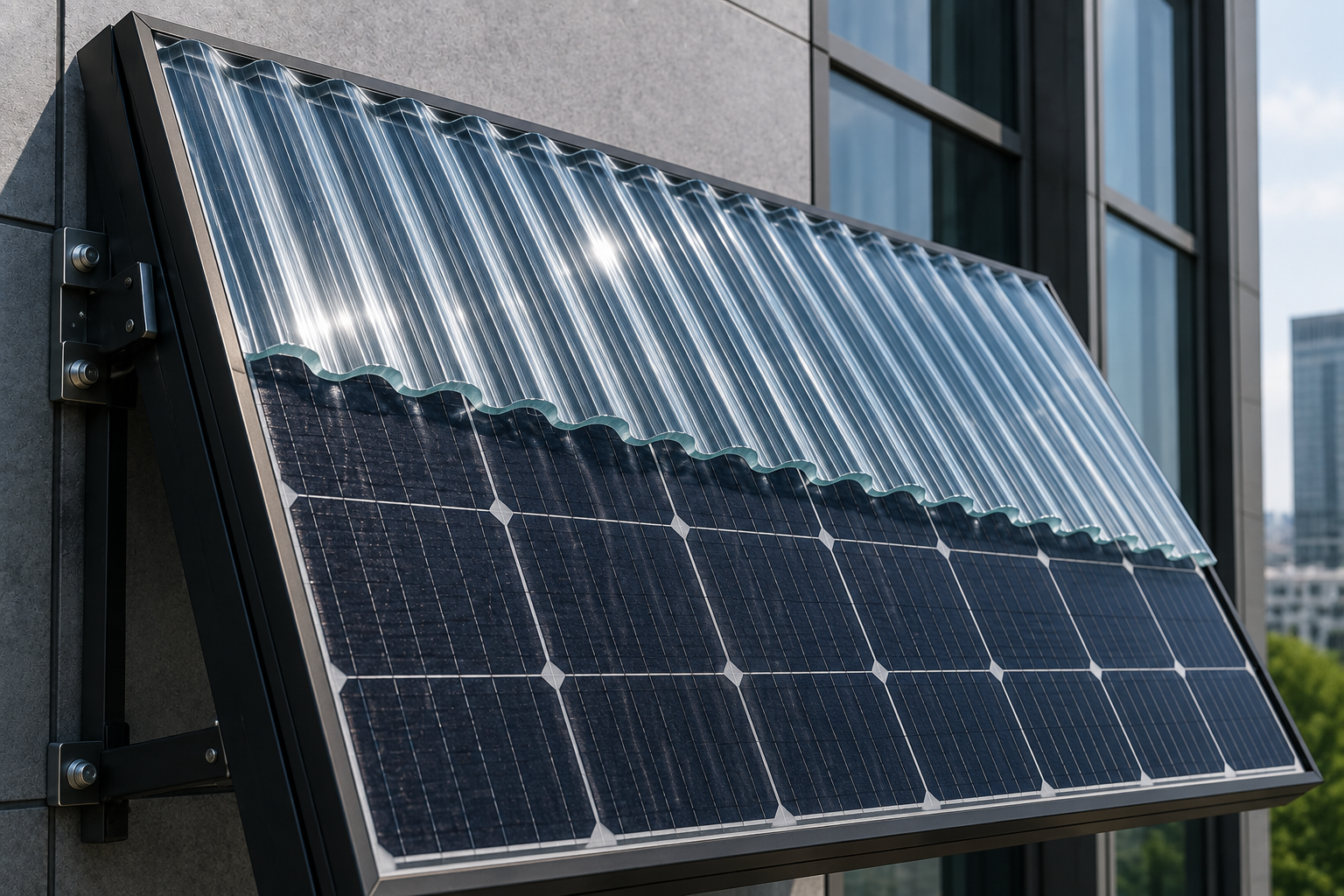
A research team led by China’s Harbin Institute of Technology has developed a novel cover glass for facade-mounted PV modules that reduces reflection at high angles of incidence. The glass features a periodic groove structure optimized through a constrained optimization by linear approximation (COBYLA) algorithm combined with ray-tracing simulations in Comsol Multiphysics.
“Existing antireflective technologies for glass could not address the issue of high reflectivity on photovoltaic-module glass surfaces under large-angle-of-incidence (AOI) conditions,” the researchers said. “Therefore, it remained a significant challenge to design a high-performance light-trapping structure that reduced reflectance at the air/glass interface over a broad incidence range of 0° to 89°, particularly at angles between 70° and 89°, while remaining suitable for the rolling process.”
The team used the Cobyla algorithm to optimize the groove profile by adjusting parameters including groove depth, height, width, and segment angles. The Cobyla algorithm is a numerical optimization method that finds the best solution to a problem with constraints by iteratively improving an approximate linear model of the objective function. It is often used for optimization problems where derivatives are unavailable or difficult to calculate.
The objective of the algoritjm was to minimize average reflectance across wavelengths from 400 nm to 1,050 nm and AOIs ranging from 0° to 89°. The optimized structure was then validated through three-dimensional optical simulations of a crystalline silicon PV module. The researchers also assessed its robustness by varying groove dimensions and internal angles to determine whether its antireflective performance could be maintained under manufacturing tolerances.
“The numerical results were very promising,” the researchers said. “Within a wavelength range of 400 nm to 1,050 nm, the average reflectance of the air/groove-structured glass interface remained below 2.4% for AOIs of up to 60°, while the maximum reflectance was only 12.6% at an AOI of 89°.”
The simulations showed that integrating the light-trapping glass into a crystalline silicon solar module increased spectral absorption by 12% at an AOI of 70° and by 73% at an AOI of 89%, compared with modules using conventional flat glass.
The researchers said the structural parameters, including an aspect ratio of 0.76 and a smooth contour cross-section, were selected to balance optical performance with manufacturability.
“Simulation results on the effects of scaling and geometric variations indicated that this light-trapping structure retained its superior performance under moderate linear scaling and internal segment-angle perturbations,” the team concluded. “These results indicate that the structure has significant potential to support the wider deployment of photovoltaic modules on building facades and to be compatible with existing large-scale PV cover-glass manufacturing processes, including rolling.”
The novel technology was presented in “High-efficiency periodic groove structured glass with broad angle antireflection for facade‑mounted photovoltaic modules,” published in Results in Engineering. Scientists from China’s Harbin Institute of Technology and Shenzhen Yongxing Technology have participated in the research.
Source link