

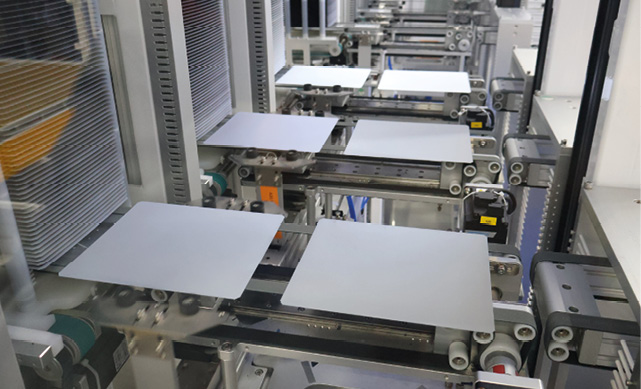
Achieving the targeted cell efficiency and production volume is only part of establishing a new manufacturing line. Maintaining stable processes and the ability to identify a deviation before it becomes a significant production or reliability issue are equally important.
Both cell and module manufacturing require a high level of process discipline. Production consists of many interconnected steps, and deviations at an early stage can propagate through the process chain and ultimately affect product quality, yield and reliability. Every advancement in cell technology adds another layer of complexity with a larger number of highly interdependent process steps and, in many cases, narrower process windows.
Modern cell factories generate substantial production data. Statistical process control (SPC), automated inspection and manufacturing execution systems (MES) can provide valuable information about individual process steps and the overall production flow.
These systems alone do not ensure high-quality manufacturing. Effective quality management requires trained personnel who understand the underlying processes and actively monitor them. An SPC chart is only useful if deviations and trends are recognized, understood and acted upon. Every critical process step therefore needs appropriate monitoring, clear responsibilities and qualified personnel.
This is particularly important during a rapid ramp-up. A production line may have the required equipment and nominal capacity while the organization responsible for process control is still developing. Quality management can then easily become reactive rather than preventive.
Spend to compete
Indian manufacturers face significant pressure to remain cost competitive, making low initial capital expenditure (capex) an understandable priority. However, as more manufacturing capacity comes online, long-term operational expenditure (opex) becomes increasingly important in determining the factory profitability.
Investments in process monitoring, traceability, metrology and automation may increase initial capex but can reduce operating costs over the lifetime of a factory. A good MES and traceability system, for example, can identify deviations early, prevent large quantities of defective material from being produced, and reduce troubleshooting time.
Stable processes result in higher yield, require less rework and generate fewer production interruptions and quality-related losses. Better process control can therefore translate directly into lower opex.
Once capacity is no longer the limiting factor, factories that operate consistently, efficiently and with high yield will have a significant advantage. Quality management should therefore be considered as a contributor to long-term cost competitiveness.
Management discipline
During a factory ramp-up, there is pressure to achieve production targets, increase utilization, and reach targeted efficiency as quickly as possible. However, the objective should not simply be to maximize the speed of the ramp-up. It should be to establish a stable and well-controlled process as quickly as possible.
Increasing throughput while a process is still unstable can simply increase the amount of material affected by an unsolved underlying problem. Once an issue is embedded in high-volume production, its consequences can be considerably greater.
This is where manufacturing discipline becomes critical. Mature manufacturing environments maintain close control of critical process parameters, investigate deviations systematically, and ensure corrective actions are implemented and verified.
The best-performing PV factories combine continuous process monitoring with clearly defined responsibilities, systematic root-cause analysis and continuous improvement. This manufacturing discipline has been an important factor in combining high-volume production with highly competitive costs.
For the rapidly expanding Indian PV industry, established manufacturing environments therefore offer valuable lessons. Quality and cost competitiveness are not opposing objectives: stable processes, high yield and early detection of deviations ultimately reduce manufacturing costs.
Testing regime
Reliability testing is another essential element. Not all potential reliability risks can be identified through the standard electrical measurements performed at the end of a production line, particularly when interactions of cell and module materials are concerned.
Tunnel oxide passivated contact (TOPCon), for example, has progressed from lab development to large-scale production within a relatively short period. New process combinations and material interfaces require manufacturers to understand not only initial electrical performance, but also behavior under long-term environmental stress.
UV-induced degradation is one example. Manufacturers should not rely solely on results generated for similar processes or materials elsewhere. The specific products and processes used in a production environment need to be characterized and tested under relevant conditions.
This requires appropriate testing infrastructure, measurement equipment and qualified personnel capable of interpreting the results. The findings also need to be connected back to the manufacturing process so that degradation mechanisms can be understood and addressed.
Reliability testing should therefore be integrated into technology implementation, qualification and process development rather than treated solely as a final certification requirement.
What audits reveal
Independent technical audits provide another perspective on manufacturing quality. They assess not only the final product, but also the systems and processes behind it: technology maturity, process control, equipment condition, quality management procedures, testing capabilities and the handling of deviations.
This broader assessment is important because some reliability risks cannot be identified from efficiency data or a limited sampling of finished cells. A factory may achieve good headline efficiency while still having weaknesses in process stability, traceability or reliability qualification.
Experience from technical assessments of manufacturing facilities in different markets, including China, shows that mature manufacturing is characterized by a systematic approach: critical processes are understood, deviations are actively managed, and reliability is treated as an integral part of manufacturing.
Such assessments are also increasingly relevant for insurers and financiers, who need confidence that the technology and manufacturing processes behind a product are sufficiently mature for long-term operation.
Built-in quality
India has a significant opportunity to establish a strong and internationally competitive PV manufacturing industry. The speed of the current expansion makes it particularly important to establish the foundations for reliable and efficient production from the beginning.
Reliable, high-quality manufacturing ultimately requires five key elements: skilled and well-trained personnel, a quality-oriented management mindset, thorough metrology systems, strong in-house quality control, and a willingness to continuously monitor and improve every part of the manufacturing process.
These should not be seen simply as additional manufacturing costs. Effective quality control reduces yield losses, rework, downtime and troubleshooting effort. Good process control therefore leads to lower opex and greater competitiveness over the lifetime of a factory. The objective should not only be scale, but to establish gigawatts of stable, cost-efficient, bankable, reliable and sustainable capacity.
The post Quality at gigawatt scale appeared first on pv magazine Global.
Source link