

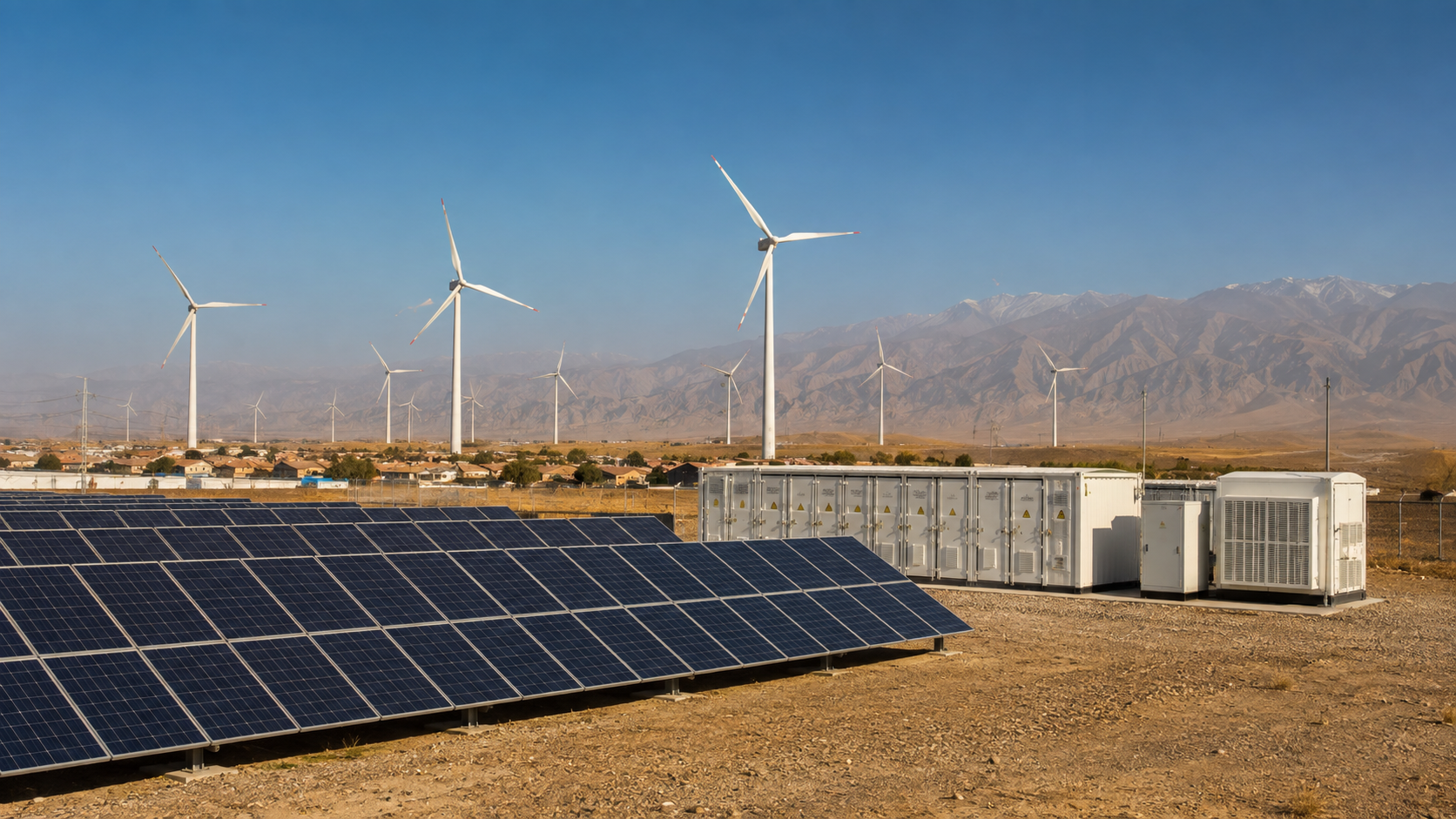
A research group in China has conducted an integrated techno-economic-environmental assessment of a grid-connected PV-wind hybrid system for community-scale energy applications. The findings are presented in the paper Designing and evaluating the grid-connected hybrid PV-WT-battery system from techno-economic perspectives, published in Case Studies in Thermal Engineering.
The study compared three grid-connected community energy systems, each with 400 kW of renewable generation capacity and a 100 kWh lithium-ion battery. The three configurations comprised a 400 kW PV system, a 400 kW wind system and a hybrid system combining 200 kW of PV with 200 kW of wind.
Each wind turbine was rated at 20 kW, while the PV system had a module efficiency of 17.3%, a 90% derating factor, a 25-year service life and a converter efficiency of 98%. The battery operated between 20% and 100% state of charge.
The study modeled the systems in the Chinese city of Karamay, northern Xinjiang, and Kashgar in southwestern Xinjiang, with an average electricity demand of 1,000 kWh per day, or approximately 365 MWh per year. The systems were simulated over a representative full year using 8,760 hourly values for solar radiation, wind speed, ambient temperature and electricity demand.
Renewable electricity first met community demand, with surplus generation used to charge the battery before any remaining electricity was exported to the grid. When renewable output was insufficient, the battery discharged before electricity was imported from the grid.
Grid electricity prices were CNY 0.24 ($0.036)/kWh during off-peak periods, CNY 0.40/kWh during standard periods, and CNY 0.59/kWh during peak periods, while exported electricity received CNY 0.262/kWh. The economic analysis assumed a 20-year project lifetime, a 5% nominal discount rate, 3% inflation, PV capital costs of CNY 3,500/kW, wind costs of CNY 4,000/kW, and battery costs of CNY 1,000/kWh.
The results show that the standalone PV system achieved the lowest levelized cost of energy (LCOE), at CNY 0.189/kWh, compared with CNY 0.237/kWh for the PV-wind hybrid system and CNY 0.291/kWh for the standalone wind system.
However, the hybrid system provided the best overall balance between economic performance and supply reliability, achieving the highest self-sufficiency rate (SSR) of 70.8% and requiring only 106.7 MWh/year of grid electricity. By comparison, the standalone PV and wind systems achieved SSRs of 58.2% and 58.0%, respectively, while requiring 152.6 MWh/year and 153.2 MWh/year of grid electricity.
The researchers found that resource availability strongly influenced performance. “Karamay exhibits higher SSR and lower LCOE but suffers from stronger curtailment, while Kashgar maintains higher self-consumption rate but lower SSR and weaker economic competitiveness,” they explained.
They added that their assessment provides “a theoretical basis and engineering guidance for the optimal allocation and operation of regional hybrid energy systems.”
Scientists from China’s Xinjiang University, Chongqing University and The Hong Kong Polytechnic University contributed to the research.
Source link