

A group of Chinese scientists have developed a molecular locking strategy for organic solar cells.
The team’s strategy involves using a vacuum-deposited indium chloride (InClx) interlayer to stabilize the interface between the electrode and the hole-transport layer in organic solar cells.
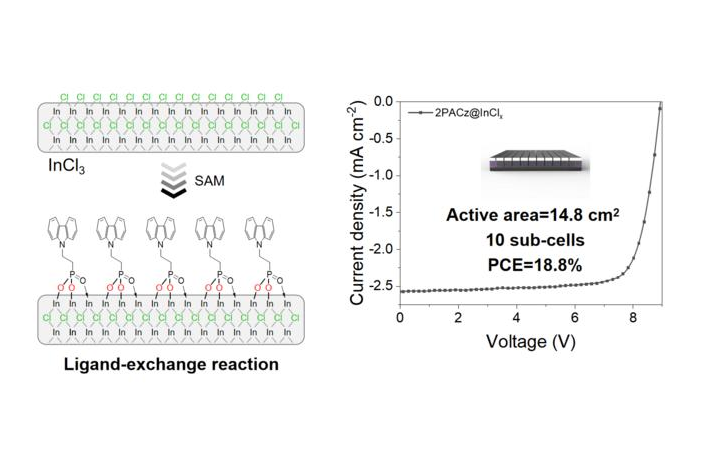
The interlayer works by triggering ligand exchange, forming a robust, multidentate indium-oxygen-phosphorus (In-O-P) coordination network capable of densely and uniformly anchoring self-assembled monolayers (SAMs).
The scientists’ work is presented in the research paper Chloride-mediated SAM locking via ligand-exchange reaction enables 18.8% active-area efficiency and stable organic solar modules, available in the journal Joule.
The paper explains that while organic solar cells have reached impressive laboratory efficiencies, the difficulty in forming dense and stable SAM contacts on indium tin oxide surfaces is holding the technology back from forming commercially-viable modules. It adds that the In-O-P coordination network “increases the binding energy and promotes near-ideal monolayer coverage, even on large-area substrates with excellent batch-to-batch reproducibility”.
The research team developed small-scale organic solar cells featuring the molecular locking strategy that achieved a power conversion efficiency of 20.4%.
Professor Liu Quan, corresponding author of the study, added the team then scaled the technique to modules with an aperture area of 15.6 square centimeters. These larger-area devices achieved an active-area power conversion efficiency of 18.8%, which Liu said is a record.
Additional findings from the research paper reveal the devices retain more than 85% of their initial efficiency after 2,000 hours of maximum power point tracking under continuous operation at 25 C.
“Our approach provides a generalizable interfacial platform that overcomes the efficiency-stability-scalability trilemma,” the research paper concludes.
The research team consisted of scientists from the Ningbo Institute of Materials Technology and Engineering of the Chinese Academy of Sciences. The work was supported by the National Natural Science Foundation of China and the key program of the Ningbo Public Welfare Research Plan.
Source link