

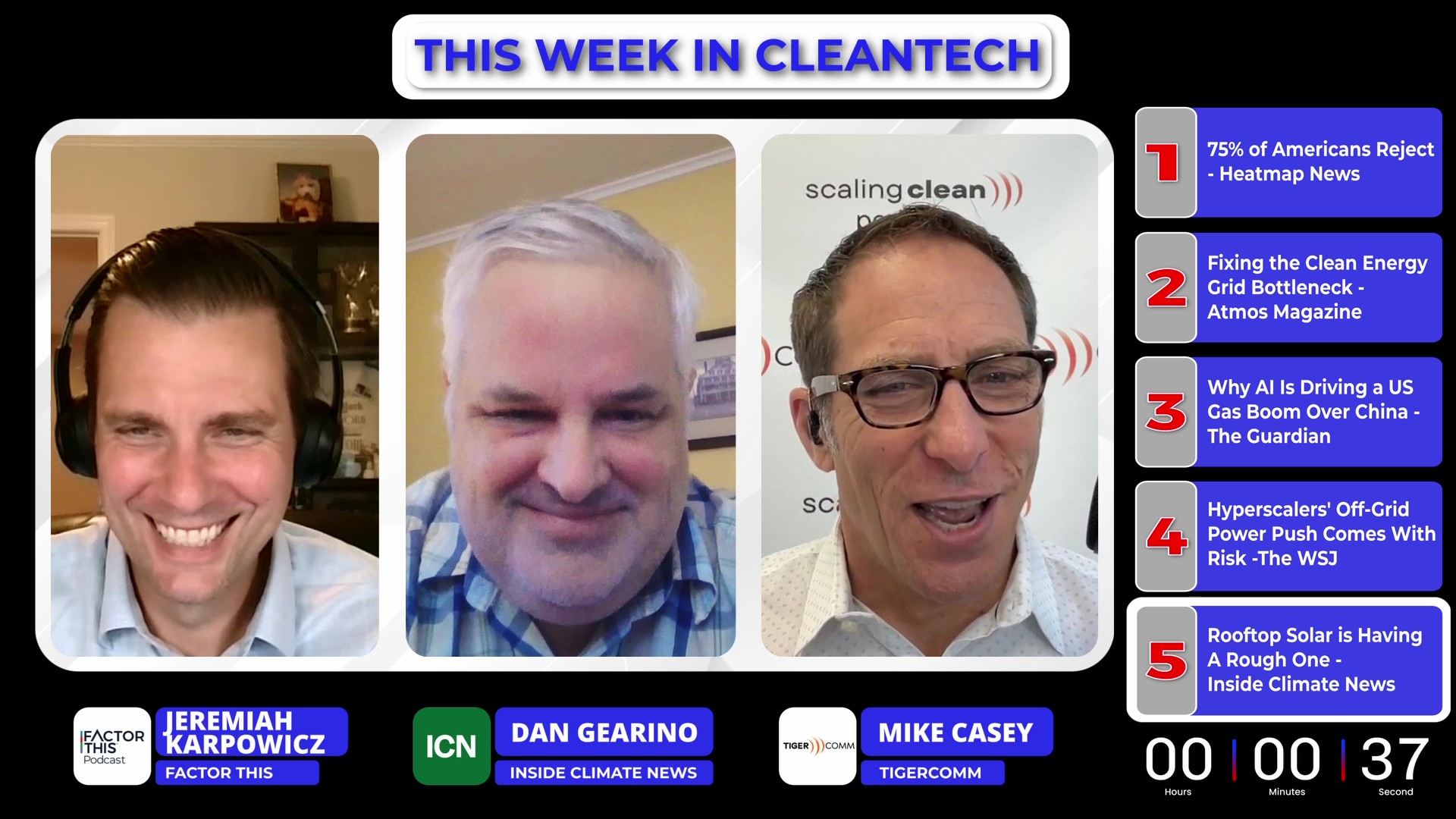

This Week in Cleantech is a weekly podcast covering the most impactful stories in clean energy and climate featuring Paul Gerke of Factor This and Tigercomm’s Mike Casey.
This week’s episode features special guest Dan Gearino from Inside Climate News, who lays out how new tariffs and the phaseout of federal tax credits have dealt a heavy blow to the rooftop solar industry.
This week’s “Cleantecher of the Week” is Richard Wang, CEO and co-founder of Voya Energy, which just raised $35 million to turn scrap aluminum into backup power for data centers. Instead of diesel generators, Voya’s system runs an electrochemical reaction that pulls energy out of aluminum with zero carbon pollution, aiming to be quieter, smaller, and cleaner than the diesel backup that’s become a flashpoint in local data center opposition. The company plans to have generators ready for on-site testing by the end of 2027, with nearly a dozen companies already lined up for pilot demonstrations.
A new Heatmap Pro poll conducted by Embold Research finds that three-quarters of Americans would now oppose a data center being built near where they live, and more than six in 10 say they’d oppose it strongly. This is the most negative response Heatmap has recorded since it started asking the question about a year ago. American opinion has swung 33 points against data centers in just 12 months.
There is increasing opposition across every party, income level, age group, and rural versus urban. Rural voters, who’ve trended more Republican over the last decade, are 63 points underwater on data centers. Urban and suburban voters aren’t far behind.
This piece argues that the bottleneck holding back the clean energy transition isn’t building solar and wind projects, it’s connecting them to the grid. A January assessment from NERC, the non-profit overseeing grid reliability across North America, found that 60% of U.S. grid regions are at elevated or high risk of demand outrunning supply by 2030. Part of the problem is that the country doesn’t have one power grid, it has three that barely talk to each other, and hooking up a new plant means getting in a long line of other projects competing for approval on an aging system.
Texas does it differently. Instead of making every new project fund a full study of its impact on the wider grid before connecting, Texas lets generators connect first and manages congestion as it comes up. That’s a big reason the state leads the country in new interconnections. A bill from New Mexico Senator Martin Heinrich would push the rest of the country toward that same model.
A new analysis from Global Energy Monitor finds the U.S. is now building twice as much gas-fired power capacity as China, and more than any other country in the world.
Under-construction gas projects in the U.S. jumped 76% in just the first half of this year. Since January, total gas capacity in development here has grown from 252 gigawatts to 378, about a third of global gas capacity in development. If all of it gets built, the group estimates a price tag of more than $647 billion.
About half of that new capacity is going straight toward powering the data center boom, and one estimate says leaning on gas instead of renewables for that buildout could push up U.S. power sector pollution by as much as 20%.
Big tech companies are building their own off-grid power systems to keep pace with AI’s rushed timelines. But, out of the four operational data centers in the U.S. running on off-grid or partially grid-connected power, three of them have already had reported issues.
The main issue is that AI workloads create massive, sudden power swings, spiking during computation and then dropping off, and those swings can stress and even fracture turbine shafts.
Anthropic pays xAI $1.25 billion a month for computing capacity on Colossus and Colossus II, which means a single day of downtime could cost tens of millions of dollars.
Rooftop solar installers are having a brutal year. New tariffs on imported panels and the phaseout of the federal tax credit have pushed Wood Mackenzie to project a 21 percent drop in new residential solar capacity in 2026, forcing companies to cut costs or shut down entirely. The biggest casualty so far is Freedom Forever, which filed for bankruptcy in April after operating in about 30 states. Small installers like Indiana’s GAI Energy describe the year as chaotic and unpredictable, with most of their current work now coming from commercial projects that still have runway under the new tax credit deadlines.
Despite the turmoil, analysts see room for optimism. Rising electricity prices are keeping consumer interest in solar and storage alive, and rooftop installations are expected to tick back up gradually through 2031, even if they stay well below the 2023 peak.
Source link