

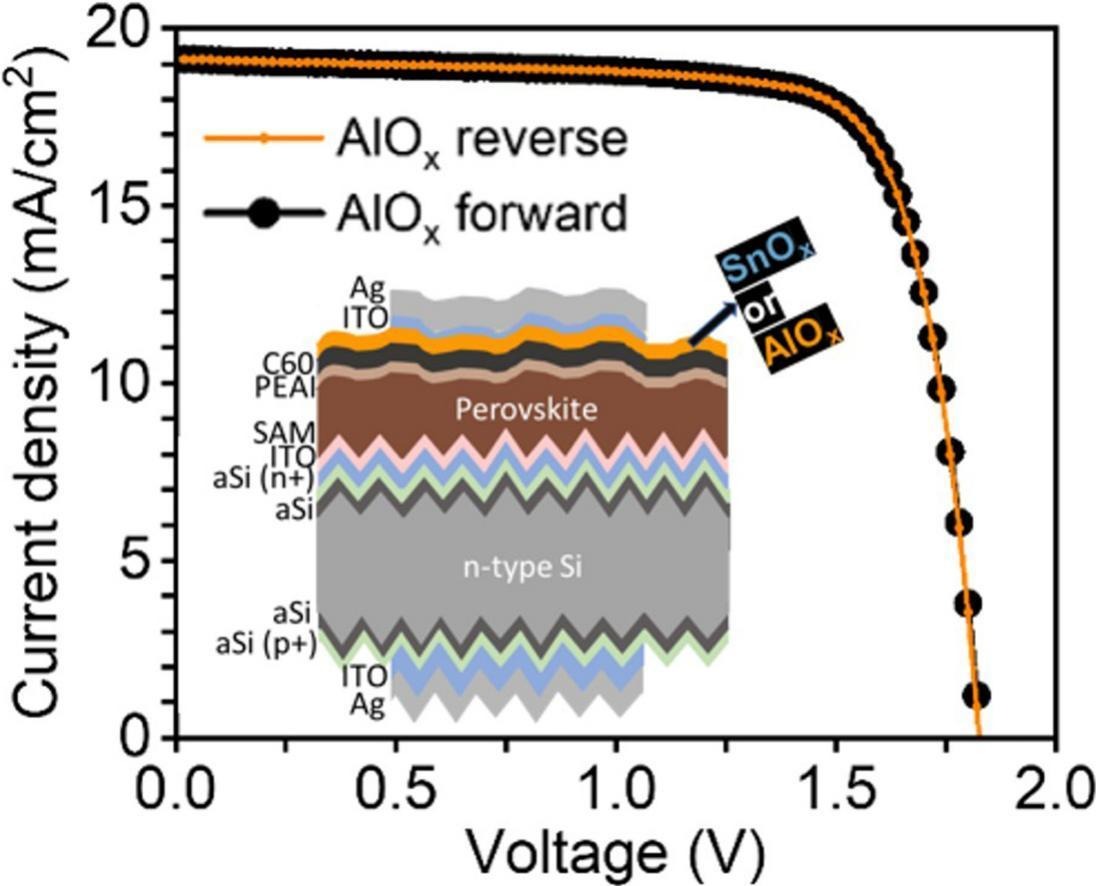
An international research team has proposed using a thin aluminum oxide (AlOₓ) buffer layer in inverted perovskite solar cells to suppress interfacial charge recombination and protect the perovskite, thereby improving both efficiency and operational stability.
Deposited via atomic layer deposition (ALD), the layer sits between the buckminsterfullerene (C₆₀) electron transport layer (ETL) and the sputtered indium tin oxide (ITO) contact.
“The novelty of this research lies in demonstrating that the conventional 10 nm to 20 nm thick SnO₂ buffer layer, typically used to prevent sputter damage, can be replaced by a much thinner, yet more uniform AlOₓ layer,” corresponding author Stephanie Essig told pv magazine. “It was surprising to find that a 3 nm thick AlOₓ layer allows efficient charge-carrier extraction across the C₆₀/ITO interface.”
“We plan to further optimize the transparent conductive oxide (TCO) sputtering process to mitigate sputter damage, alongside extended stability testing of device performance,” she said.
To evaluate the buffer layers, the researchers fabricated semi-transparent inverted perovskite solar cells with ALD-deposited AlOₓ or SnOₓ layers between the C₆₀ electron transport layer and a sputtered ITO electrode. They tested AlOₓ thicknesses of 1.5 nm, 3 nm, 5 nm, 8 nm, and 15 nm, comparing their performance with buffer-free cells and reference devices featuring SnOₓ layers of 3 nm, 10 nm, and 20 nm.
The team also investigated the effects of ALD deposition temperature by comparing AlOₓ layers deposited at 75 C and 80 C. It optimized the process using a repeated water-pulse sequence.
The scientists built the top inverted cell with a glass and indium tin oxide (ITO) substrate coated with a Me-4PACz hole-selective layer and silicon oxide nanoparticles. A roughly 1.4-nm aluminum oxide (AlOₓ) interlayer was placed between the perovskite absorber and a 20-nm C₆₀ electron-transport layer. The device was completed with a 25-nm atomic-layer-deposited tin oxide layer and a 130-nm silver electrode. A 100-nm lithium fluoride coating on the glass side served as an antireflective layer.
The scientists used microscopy, spectroscopy, X-ray diffraction, photoluminescence, and electrical measurements to assess the layers’ morphology, coverage, chemical composition, resistance to sputter damage, and charge-transport properties. They then incorporated the optimized 3 nm AlOₓ layer into monolithic two-terminal perovskite-silicon tandem cells and compared their performance with that of cells featuring a conventional 20 nm SnOₓ buffer layer.
The results showed that, under low-power magnetron sputtering conditions, a 3 nm AlOₓ buffer layer effectively suppressed sputtering-induced damage, while a 1.5 nm layer did not. Devices featuring the 3 nm AlOₓ layer performed similarly to those with a 20 nm SnOₓ layer, achieving power conversion efficiencies of more than 17% in semi-transparent perovskite cells and more than 26% in perovskite-silicon tandem devices.
The researchers said the suitability of thin AlOₓ as a sputter-resistant buffer layer offers several advantages, including a dense and uniform ALD process, lower material consumption, and faster fabrication of future perovskite tandem and semi-transparent devices.
The research, “Sputter-resistant aluminum oxide layer enables robust perovskite tandem solar cells,” was published in Materials Today. Scientists from Germany’s University of Stuttgart, Forschungszentrum Jülich, and Solarlab Aiko Europe, as well as Portugal’s INL – International Iberian Nanotechnology Laboratory, contributed to the study.
Essig highlighted first author Seyma Topcu’s role in advancing the research and said the team plans to conduct follow-up studies.
Source link