

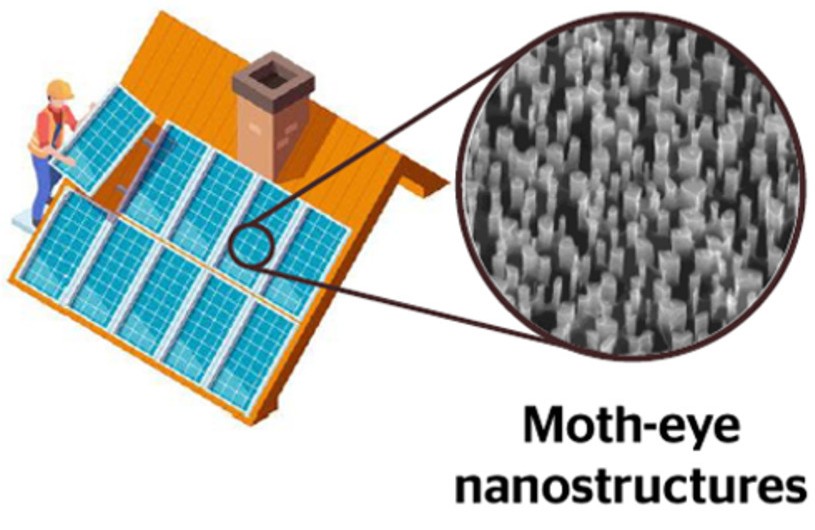
Researchers in Portugal have investigated the friction and wear behavior of moth-eye-inspired silicon surfaces designed to reduce light reflection and improve light absorption in solar cells. The study examined, in particular, how these antireflective nanostructures withstand mechanical stress relevant to solar module operation.
“If we want to integrate these nanostructures into the outer surfaces of photovoltaic modules, we also need to understand how they respond to mechanical contact, cleaning operations, and other environmental challenges,” corresponding author Vítor Lopes told pv magazine. “Rather than focusing only on optical performance, we investigated how these structures respond to friction and repeated mechanical loading, and how their morphology evolves as damage accumulates.”
Lopes said the team believes that applying a tribological perspective to light-management nanostructures is an important step toward understanding their durability and supporting their development for practical PV applications. “Coming from a mechanical engineering background and now working in photovoltaic research, I saw an opportunity to approach this problem from a different perspective,” he added.
The researchers fabricated moth-eye-inspired silicon surfaces measuring approximately 2.5 cm × 2.5 cm, with nanopillars averaging 434 nm in height and about 100 nm in diameter. They produced a silicon master mold through reactive ion etching, using gold nanoparticles formed by thermal dewetting as an etching mask. They then replicated the pattern onto an intermediate polymer stamp and imprinted it onto resist-coated silicon wafers using nanoimprint lithography, before transferring the pattern into the silicon through reactive ion etching.
To assess friction and wear, the team slid a 5 mm-diameter steel ball across the patterned surfaces without lubrication, applying loads of 0.1 N and 0.5 N at a sliding speed of 5 mm/s for up to 50 cycles. Each test condition was repeated three times.
The researchers recorded the friction coefficient throughout testing, measured wear-track widths using optical microscopy, and examined nanopillar fracture, collapse, and compaction using scanning electron microscopy (SEM). They also measured initial reflectance across wavelengths of 300 nm to 1,100 nm, but did not assess reflectance after wear testing.
“One of the most interesting findings was that the friction coefficient remained relatively stable under lower mechanical loading, even though SEM images revealed clear structural modifications to the nanostructures,” said Lopes. “This tells us that friction measurements alone may not be enough to assess the integrity of these surfaces.”
After 50 sliding cycles, the average wear-track width reached approximately 252 µm under the 0.1 N load and 388 µm under the 0.5 N load. The friction coefficient ranged from 0.40 to 0.56 under the lower load but exceeded 1.0 by the 50th cycle under the higher load. The researchers also observed changes in wear mechanisms as mechanical loading and the number of sliding cycles increased.
“While the initial damage was mainly characterized by nanopillar fracture, continued sliding led to the accumulation and compaction of fractured material, progressively changing the original surface morphology,” Lopes said. “Under higher loads, this transformation was accompanied by a noticeable increase in friction.”
The findings are presented in Exploring the mechanical resilience of light-management nanostructures: Wear and degradation analysis of silicon moth-eye-inspired surfaces for photovoltaic applications, published in Surfaces and Interfaces. The research team included scientists from Portugal’s International Iberian Nanotechnology Laboratory, the University of Minho, LABBELS – Associate Laboratory, and the University of Aveiro.
Source link