
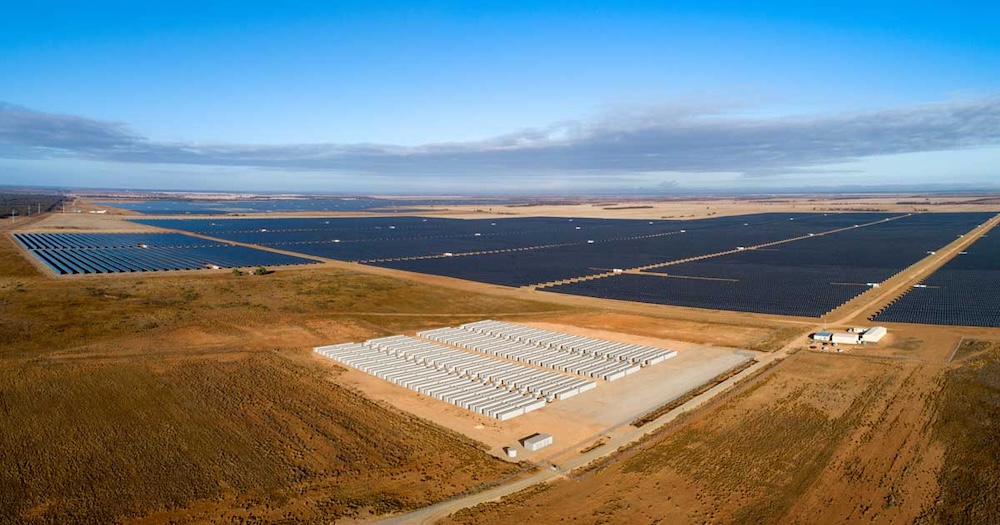
Shared grid connections at co-located solar-plus-storage sites are concentrating insured revenue into a growing risk for BESS insurers, said Olly Litterick, head of renewables at TMGX, a green transformation underwriting business that Japan’s Tokio Marine group launched in 2025.
Such projects now carry “hundreds of millions of dollars or even billions of dollars of exposure in a single location where multiple insureds share grid connection points,” he said.
Because TMGX covers loss of revenue resulting from physical damage, a failure at a shared export point can affect several insured projects at once, Litterick told ESS News.
“When the grid goes down due to [a] material damage incident or there’s a transformer failure or something of that description, you know, the numbers can be astronomical,” he said. “And that’s one of the many things that we as an industry need to get our heads around to support the green transition.”
TMGX acts as lead underwriter on much of its book.
“We lead, we set the terms on many of these projects and other insurers then follow us and provide additional capacity,” said Litterick. “But it’s about controlling that aggregation because these projects are just becoming bigger and bigger and bigger almost monthly.”
TMGX underwriter James Totton has also described aggregation risk at single substation connection points as co-location grows. In a report released in May, TMGX said the renewables insurance market must prepare for the rising complexity of co-located projects, with elevated aggregation risk where shared grid infrastructure creates a common point of vulnerability.
Marsh, an insurance broker, says in BESS risk guidance on its website that insurers need sufficient separation between battery modules and critical infrastructure such as site transformers and substations, and that minimizing single points of failure is key to avoiding contingent business interruption. Some insurers, including AXIS, sell contingent business interruption cover for lost income when the first substation a project does not own is damaged.
Fastest-growing line
TMGX builds on 20 to 25 years of renewable energy underwriting at GCube, which Tokio Marine acquired in 2020, covering solar, onshore wind, offshore wind, and now battery storage, mainly for property damage and resulting loss of revenue. Litterick said BESS is TMGX’s fastest-growing technology on a compound annual growth basis. He said TMGX’s figure of about 8 GW of BESS refers to its insured participation and is “probably slightly outdated” because the book is growing so quickly.
Most of that book is still in construction, he said, and utility-scale BESS has only been widespread “for the last three to five years,” so the claims record remains limited. TMGX writes significant BESS business in California but has not experienced earthquake losses. “Again, it is very, very early stage,” said Litterick.
Thermal runaway remains the main driver of probable maximum loss estimates, and Litterick said “the spacing arrangement is obviously crucial to how we underwrite BESS.” He credited the industry with rapid progress on standardization and certification, borrowing from the solar and wind sectors. GCube reported in 2024 that more than half of BESS failures occur within the first two years of operation.
Cybersecurity gap
TMGX’s standard property cover largely excludes cyberattacks. Cybersecurity “is usually excluded, or there are certain perils that are written back into a general property policy,” said Litterick, with broader cyber cover usually bought in a separate specialist market. He said this leaves an uncertain gap in cover that needs to be addressed.
Project-finance lenders have traditionally required property damage, natural catastrophe, and machinery breakdown cover, Litterick said. “We are beginning to see lenders insist that their clients … purchase cyber. But it’s quite rare at the moment,” he said.
Litterick said TMGX has not really declined or repriced BESS risks over cyber exposure, because cyber cover has not been a lender requirement and TMGX has not been providing it. He added that demand from clients and lenders is rising, and that TMGX is developing a broader solution.
The cyber exposure of battery storage has drawn wider scrutiny this year. A December 2025 attack on distributed energy assets in Poland revealed a cyber-insurance gap for battery storage, while an EU funding ban on high-risk inverter suppliers extends to BESS power conversion systems.
From ESS News
Source link